
- Bitcoin Mining
- Hash Rate
- Crypto Profitability
- AI & Crypto
- Bitcoin Security
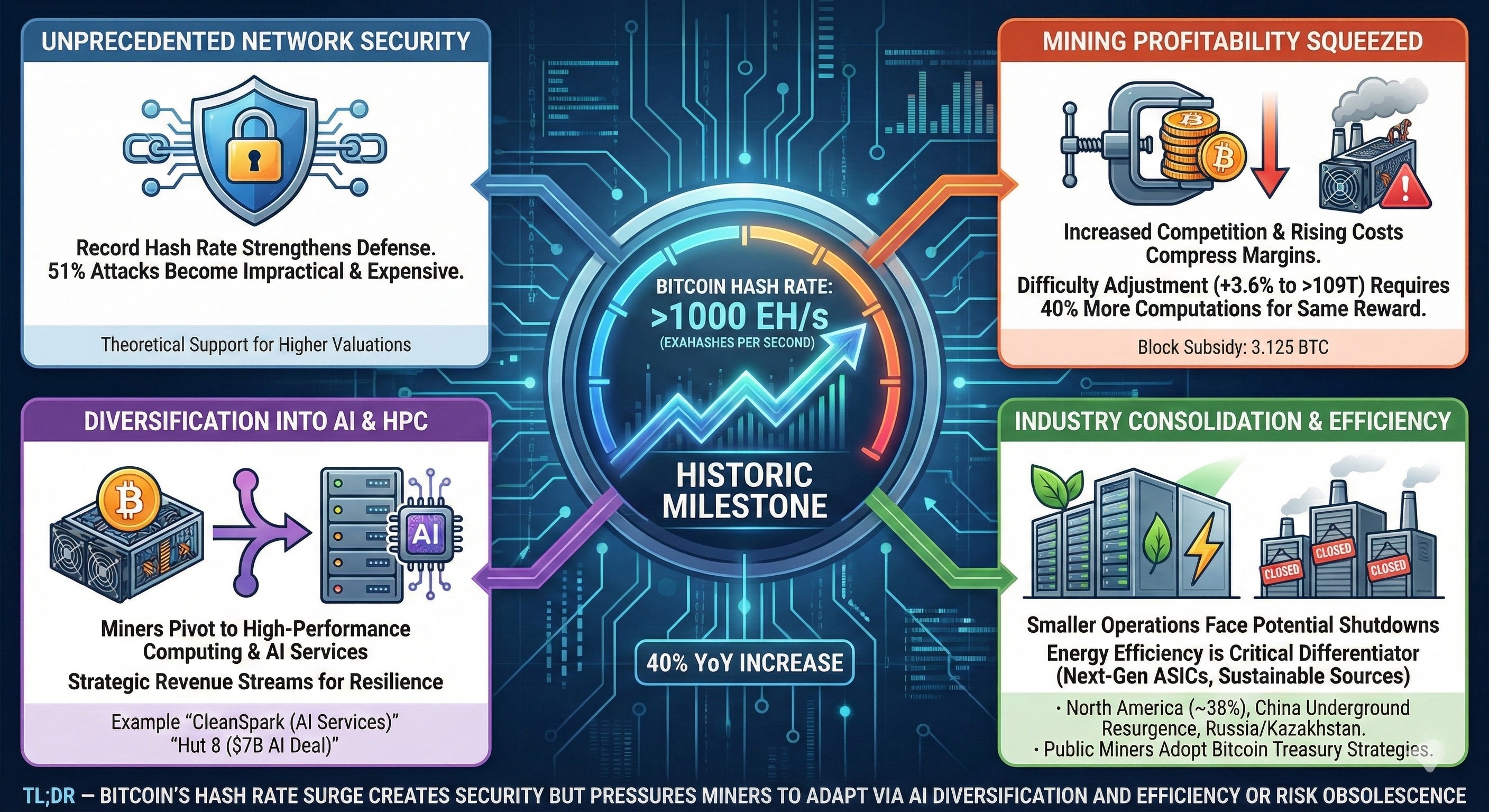
TL;DR – Bitcoin's hash rate has surged past 1000 exahashes per second, creating unprecedented network security but squeezing mining profitability. This forces miners to diversify into AI and high-performance computing while smaller operations face potential shutdowns.
Bitcoin Hash Rate Reaches Historic Milestone
Bitcoin's network hash rate has achieved a remarkable milestone, consistently operating above 1000 exahashes per second (EH/s), representing a 40% increase from the same period last year. This metric, which measures the total computational power securing the Bitcoin network, demonstrates unprecedented network security but creates significant challenges for mining operators.
The hash rate surge coincides with Bitcoin trading in the $100,000 range, yet mining companies are experiencing compressed margins due to increased competition and rising operational costs. The network's automatic difficulty adjustment mechanism ensures that blocks continue to be mined approximately every 10 minutes, regardless of total hash rate.
Mining Difficulty Adjustment Creates Margin Pressure
Bitcoin's latest difficulty adjustment increased by 3.6%, bringing the total difficulty to an all-time high of over 109 trillion. This adjustment mechanism, which recalibrates every 2,016 blocks (roughly every two weeks), ensures network stability but directly impacts mining profitability.
For context, miners must now perform 40% more computations to earn the same Bitcoin rewards compared to early 2024. With the block subsidy remaining at 3.125 BTC post-halving, only the most efficient operations can maintain healthy profit margins.
CleanSpark's transformation from pure mining to AI services exemplifies how industry leaders are adapting to these challenging conditions. Similarly, Hut 8's $7 billion AI infrastructure deal demonstrates the strategic pivot many miners are making to diversify revenue streams.
Geographic Hash Rate Distribution Shifts
The global distribution of Bitcoin mining continues evolving, with North American operations representing approximately 38% of total hash rate, according to Cambridge Centre for Alternative Finance data. This represents a significant shift from 2021, when China dominated global mining before implementing comprehensive bans.
Interestingly, China's underground Bitcoin mining operations are experiencing a resurgence, despite official prohibitions. Industry estimates suggest clandestine Chinese operations may contribute 15-20% of global hash rate, though exact figures remain difficult to verify.
Russia and Kazakhstan have emerged as significant mining jurisdictions, benefiting from abundant energy resources and favorable regulatory environments. These regions combined account for approximately 25% of global hash rate distribution.
Impact on Mining Business Models
The hash rate increase creates a clear divide between efficient, well-capitalized miners and smaller operations struggling with razor-thin margins. Large-scale miners benefit from economies of scale, securing cheaper electricity contracts and deploying latest-generation ASIC hardware.
Nasdaq's notice to Canaan, a major mining hardware manufacturer, highlights broader industry consolidation pressures. Smaller mining companies face delisting risks as operational challenges mount.
Publicly traded miners are increasingly adopting MicroStrategy-style Bitcoin treasury strategies. These companies retain mined Bitcoin rather than immediately selling, effectively becoming leveraged Bitcoin investment vehicles. This approach amplifies both potential returns and risks based on Bitcoin price movements.
Energy Efficiency Becomes Critical Differentiator
With hash rate competition intensifying, energy efficiency has become the primary competitive advantage. Next-generation ASIC miners achieving 20+ joules per terahash are becoming standard, while older equipment becomes economically unviable.
Sustainable energy sourcing also provides cost advantages. Miners utilizing stranded natural gas, excess renewable capacity, or industrial waste heat maintain competitive positioning. According to the Bitcoin Mining Council's latest sustainability report, 59.5% of Bitcoin mining utilizes sustainable energy sources.
Market Implications for Bitcoin Investors
The record hash rate strengthens Bitcoin's security proposition, making 51% attacks increasingly expensive and impractical. This enhanced security should theoretically support higher Bitcoin valuations, though current market dynamics suggest complex relationships between hash rate and price.
For investors considering Bitcoin exposure through mining stocks, the current environment favors large-scale, diversified operators over pure-play mining companies. Companies successfully pivoting to AI and high-performance computing services demonstrate more resilient business models.
Outlook: Hash Rate Growth Sustainability
Sustaining hash rate growth above 1000 EH/s requires continued mining profitability and hardware availability. Current projections suggest hash rate could reach 1200-1500 EH/s by year-end, assuming Bitcoin prices remain elevated and next-generation mining equipment becomes widely available.
However, a significant Bitcoin price correction could trigger hash rate declines as marginal miners shut down operations. The interconnected relationship between price, hash rate, and mining difficulty creates feedback loops that ultimately self-regulate network security and mining profitability.
Investors should monitor hash rate trends alongside Bitcoin ETF flows and broader market indicators when making allocation decisions. The mining industry's evolution toward diversified business models reflects broader Bitcoin ecosystem maturation.
More Articles About Bitcoin Mining
Bitcoin Miners Just Got Their Biggest Tax Break in History. The Fine Print Kills Green Energy.
The Big Beautiful Bill restored 100% first-year depreciation on mining hardware while eliminating renewable energy credits after 2027. Miners got a gi...
March 28, 2026
Foundry Digital Brings Institutional Mining Infrastructure to Zcash
Foundry Digital, operator of the world's largest Bitcoin mining pool, is launching an institutional Zcash mining pool in April 2026 - signaling privac...
March 12, 2026
Bitcoin ETF Outflows Continue in January 2026 Amid Rate Concerns
Bitcoin spot ETFs saw $1.1 billion in outflows during early January 2026 as institutional investors rotate into AI infrastructure and navigate rising ...
January 29, 2026
Podcast Conversations About Bitcoin Mining
