
- Bitcoin ETFs
- Crypto Market
- Institutional Investors
- Federal Reserve
- Interest Rates
TL;DR – Bitcoin ETFs experienced significant net outflows during January 2026, continuing a trend from late 2025. Rising interest rates, institutional rotation into AI infrastructure, and profit-taking after Bitcoin's late 2025 rally are driving the selloff, though flows have shown mixed signals with periodic rebounds.
Significant Outflows Signal Institutional Rebalancing
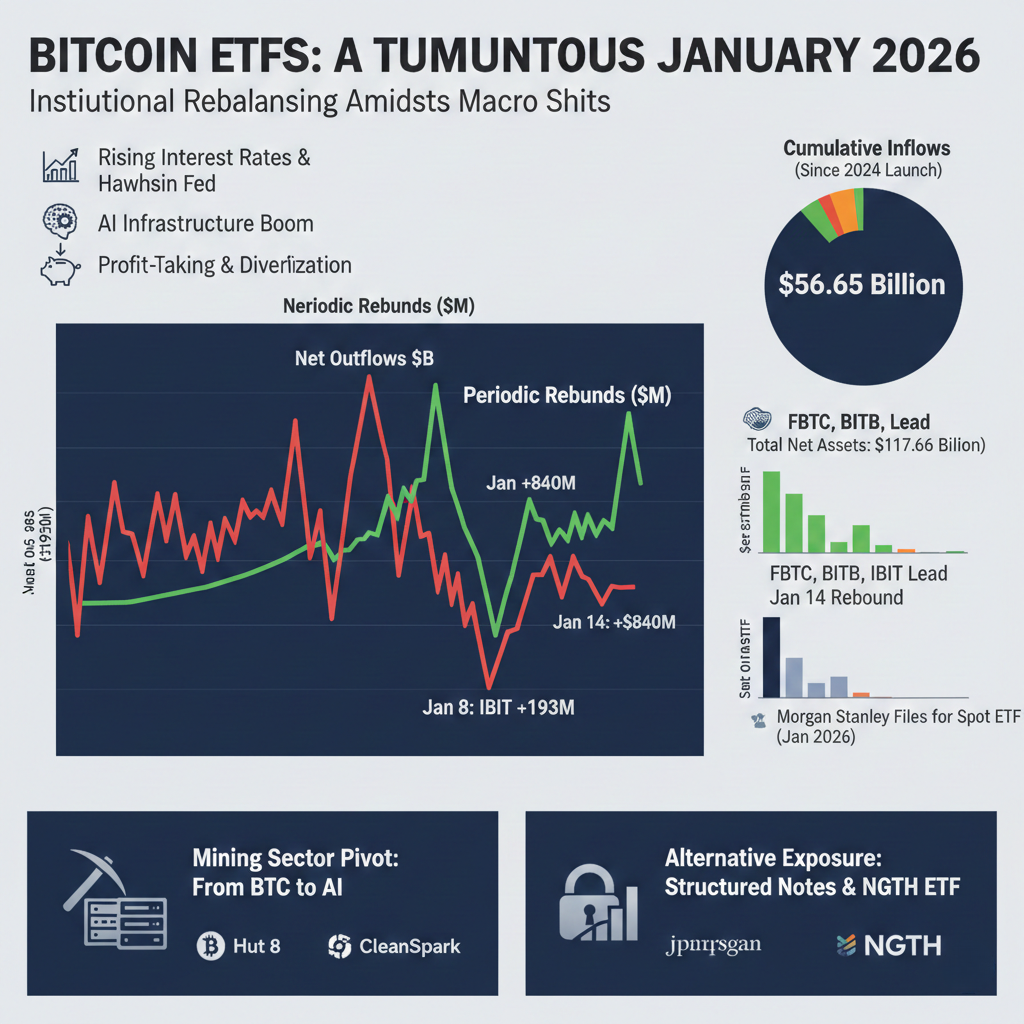
Bitcoin spot ETFs recorded substantial outflows in January 2026, continuing the momentum from a record $4.57 billion exodus during November-December 2025, according to SoSoValue data. This represents a reversal from the strong inflows witnessed during Bitcoin's push toward $100,000 in late 2025.
In early January, U.S. spot Bitcoin ETFs saw approximately $1.1 billion in outflows over just three trading days (January 6-8), nearly erasing the $697 million in inflows from the first two trading days of the year. The BlackRock iShares Bitcoin Trust (IBIT) recorded $193 million in single-day outflows on January 8, while Fidelity's FBTC saw $120 million exit the fund that same day. ARK 21Shares Bitcoin ETF (ARKB) also recorded $312 million in outflows during the month.
"We're seeing a fundamental shift in institutional allocation preferences," said Eric Balchunas, Bloomberg ETF analyst. "The AI infrastructure boom is pulling capital away from Bitcoin as investors chase the next productivity revolution."
Despite the outflows, cumulative inflows for U.S. spot Bitcoin ETFs since their 2024 launch remain strong at approximately $56.65 billion, with total net assets standing at $117.66 billion.
Federal Reserve Policy Creates Headwinds
The Federal Reserve's hawkish stance has created significant headwinds for risk assets including Bitcoin. Unlike previous rate cut cycles, the Fed's latest positioning has prioritized inflation control over market accommodation.
Bitcoin has shown volatility throughout January, with prices fluctuating between the low $90,000s and rebounding above $97,000 by mid-month. The cryptocurrency's correlation with traditional markets has increased, suggesting institutional investors are treating Bitcoin more like a risk asset during periods of macro uncertainty.
Arch Lending's Chief Investment Officer noted in The Daily Stack that "institutional borrowing against Bitcoin collateral has increased 340% as funds prefer leveraged exposure over direct ownership during uncertain rate environments."
Mining Infrastructure Pivot Impacts Sentiment
The mining sector's transformation has also influenced investor sentiment. Hut 8's $7 billion AI deal exemplifies how Bitcoin mining companies are pivoting toward artificial intelligence infrastructure, potentially reducing long-term Bitcoin accumulation by miners.
CleanSpark's strategic shift from pure-play Bitcoin mining to AI-powered data centers has been followed by other public miners, creating questions about the industry's commitment to Bitcoin network security versus profit maximization.
This pivot comes as Bitcoin's hash rate hit 1000 EH/s, creating a profitability crunch that's forcing miners to diversify revenue streams.
Institutional Interest Remains Despite Short-Term Volatility
Notably, the week of January 14, 2026 saw an $840.6 million inflow into U.S. Bitcoin ETFs as prices rose above $97,000, demonstrating that institutional appetite has not disappeared entirely. Fidelity's FBTC led this rebound, followed by Bitwise's BITB and BlackRock's IBIT.
Morgan Stanley also filed registration statements in January to launch its own spot Bitcoin ETF, alongside proposed Ethereum and Solana products—representing the first attempt by a major U.S. bank to list such products.
The bitcoin backwardation in futures markets indicates that sophisticated traders are positioning for near-term consolidation despite long-term bullish fundamentals.
Alternative Bitcoin Exposure Gains Traction
While spot ETFs face volatile flows, alternative Bitcoin investment vehicles are gaining institutional attention. JPMorgan's Bitcoin structured notes have attracted $430 million in assets, offering downside protection that appeals to risk-averse institutions.
The innovative Bitcoin After Dark ETF (NGTH) strategy, which holds Bitcoin overnight and Treasuries during market hours, has seen steady inflows of $89 million in January despite broader ETF weakness.
Outlook: Cyclical Rotation or Structural Shift?
Analysts view January's outflows as part of a normalization phase rather than a structural collapse. The alternating pattern of inflows and outflows reflects institutional recalibration in response to macroeconomic signals, including potential Fed dovishness and softer inflation readings.
Bitcoin's correlation with the S&P 500 dropped to 0.18 in January 2026, its lowest since October 2025, while its link to gold strengthened—suggesting investors may increasingly view Bitcoin as a safe-haven asset rather than purely a risk-on play.
For Bitcoin investors and users of lending platforms like Unchained and Ledn, the current environment offers opportunities to earn yield on holdings while institutional sentiment stabilizes. Active custody solutions and structured products may provide better risk-adjusted returns than direct ETF exposure during this transition period.
The key metric to watch will be whether outflows accelerate in February or if institutional appetite continues its recent rebound as interest rate expectations stabilize.
More Articles About Bitcoin ETFs
Understanding Financial Liquidity: What the Financial Liquidity Proxy Tells Us
The Financial Liquidity Proxy is a proprietary framework from Skylark Digital Assets for reading broader financial liquidity conditions as market-cycl...
October 1, 2026
The Fed Just Projected a Rate Hike for the First Time Since 2023. Here's What That Means for Bitcoin.
The Fed dot plot shifted hawkish with 9 of 18 members projecting a rate hike. Bitcoin dropped to $63,908. Three channels explain why monetary policy m...
June 23, 2026
The Economic Data Driving Bitcoin in 2026: CPI, the Fed, and Why Macro Matters More Than Ever
Inflation at 3.8%. Zero rate cuts priced. $42M+ bet on the Fed standing pat. Bitcoin now trades as a macro asset - here's how every data release moves...
June 3, 2026
Podcast Conversations About Bitcoin ETFs