- Bitcoin
- Federal Reserve
- Kevin Warsh
- Monetary Policy
- Crypto News
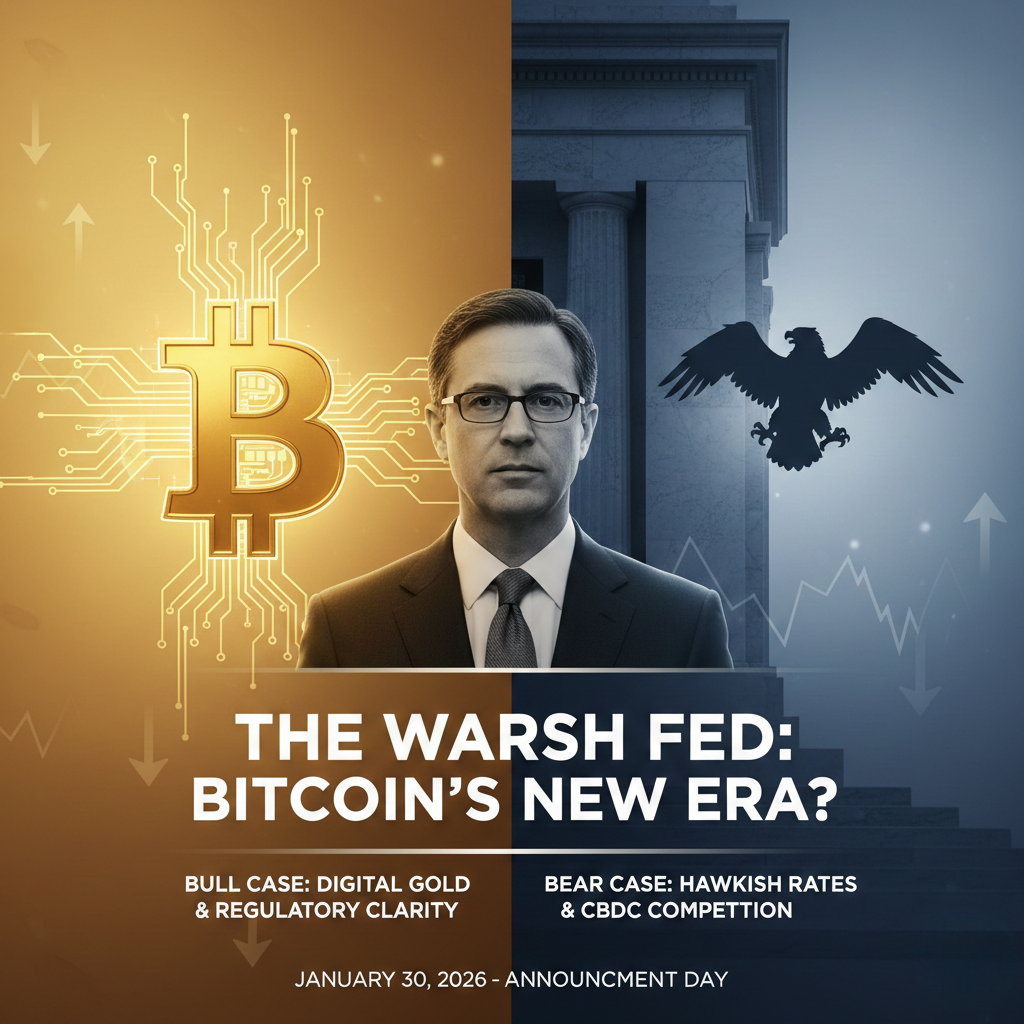
TL;DR – President Trump is expected to announce Kevin Warsh as his pick for Federal Reserve Chair Friday. For Bitcoin, the implications are mixed: Warsh has praised BTC as a "sustainable store of value" and invested in crypto startups, but his hawkish monetary stance could tighten liquidity and pressure risk assets in the near term.
Trump Set to Name Warsh as Fed Chair
President Donald Trump announced Thursday evening that he will reveal his pick for Federal Reserve Chair Friday morning, with former Fed Governor Kevin Warsh emerging as the prohibitive 80% favorite on prediction markets.
"I'll be announcing the Fed chair tomorrow morning," Trump said at the premiere for "Melania," the film about the first lady. Asked if he had settled on a choice, he replied, "I do, I better, otherwise I have to go to work very quickly."
The five-month search to replace current Chair Jerome Powell, whose term expires in May, has narrowed to a final four: Warsh, National Economic Council Director Kevin Hassett, current Fed Governor Christopher Waller, and BlackRock's Rick Rieder. But after Warsh was spotted at the White House Thursday, betting markets shifted decisively in his favor.
If confirmed, Warsh would become the youngest Fed Chair in modern history at 55 and the first with direct crypto investment experience.
Who Is Kevin Warsh?
Kevin Warsh served as a Federal Reserve Governor from 2006 to 2011, where he played a central role in navigating the 2008 financial crisis. As the Fed's primary liaison to Wall Street, he helped engineer emergency measures, including converting Morgan Stanley into a bank holding company, which effectively saved the firm.
Warsh is currently the Shepard Family Distinguished Visiting Fellow at Stanford University's Hoover Institution and a member of the Group of Thirty, an elite club of global financial leaders.
He was a finalist for Fed Chair in 2017 but was passed over for Jerome Powell, reportedly because Trump thought he was too young at the time. Now 55, Warsh has seen his core policy positions gain traction as inflation has dominated economic discourse.
"Inflation is a choice," Warsh declared earlier this year, arguing that price instability stems from Federal Reserve policy decisions rather than external supply shocks.
Warsh's Crypto History: Investor and Skeptic
Warsh's relationship with cryptocurrency is paradoxical, making him difficult to categorize as simply "pro-crypto" or "anti-crypto."
The Investor: According to Pitchbook data, Warsh made angel investments in two crypto ventures: the algorithmic stablecoin project Basis (now defunct) in 2018 and crypto index fund manager Bitwise in 2021. Bitwise still lists Warsh among its advisors and investors.
The Bitcoin Bull: In a 2021 CNBC interview, Warsh endorsed Bitcoin as a portfolio asset: "I think that Bitcoin does make sense as part of a portfolio in this environment where you have the most fundamental shift in monetary policy since Paul Volcker." He added, "I guess if you are under 40, Bitcoin is your new gold."
The Skeptic: Despite his investments, Warsh has consistently criticized crypto's monetary properties. In a 2022 Wall Street Journal column, he wrote: "Cryptocurrency is a misnomer. It isn't secretive and it isn't money. It is software." He has also argued that Bitcoin's "price volatility significantly diminishes its usefulness as a reliable unit of account or an effective means of payment."
The CBDC Advocate: Most controversially for Bitcoin maximalists, Warsh has advocated for a U.S. central bank digital currency to compete with China's digital yuan. "A narrow, resilient, and efficient digital dollar fully backed by U.S. trust and credit should be an essential component of reforms to the U.S. financial and monetary architecture," he wrote.
What a Warsh Fed Means for Bitcoin: The Bull Case
Despite his hawkish reputation, there are several reasons a Warsh-led Fed could ultimately benefit Bitcoin.
Regulatory Clarity: Warsh has advocated relaxing restrictions on banks' crypto businesses and supporting private-sector-led digital asset innovation. A Fed Chair with direct crypto investment experience could bring more nuanced, innovation-friendly regulation.
Long-Term Inflation Hedge Narrative: Warsh's praise of Bitcoin as a "sustainable store of value, like gold" reinforces the digital gold narrative. If his policies successfully tame inflation, Bitcoin's role as a hedge against currency debasement may evolve, but if inflation proves sticky, BTC could benefit from the continued devaluation of fiat currencies.
Institutional Credibility: Warsh is widely viewed as the "independence candidate," respected by both Wall Street and the Senate. His appointment could restore confidence in the Fed's institutional integrity, potentially stabilizing markets overall.
Trump's Pressure: As observers have noted, the key question isn't what a Fed Chair believes before taking office it's what they do once they're in the seat. Trump has made clear he wants rates at "1% or lower," and historically, presidents eventually get the monetary policy they want.
What a Warsh Fed Means for Bitcoin: The Bear Case
However, Warsh's core monetary philosophy poses significant near-term headwinds for risk assets, including Bitcoin.
Hawkish Rate Stance: Warsh has signaled support for what he calls the "minimum effective dose" of rate cuts enough to support growth, but not the aggressive easing crypto markets have priced in. The Fed's current target rate is 4.25%-4.50%, and Warsh may resist further cuts while inflation remains above 2%.
Quantitative Tightening: Warsh has advocated aggressive balance-sheet reduction, continuing the Fed's quantitative tightening program. Historically, less liquidity in the system has correlated with lower crypto prices, as speculative assets rely on abundant dollar liquidity.
Dollar Strength: Tighter monetary policy typically strengthens the U.S. dollar, which has historically shown an inverse correlation with Bitcoin prices. A stronger dollar makes BTC less attractive as an alternative store of value.
CBDC Competition: Warsh's support for a digital dollar could create new competition for Bitcoin and stablecoins. While a Fed-issued CBDC would operate differently from decentralized cryptocurrencies, it could capture some of the demand currently flowing into crypto.
Market Reactions and Price Implications
Bitcoin is currently trading around $104,200 after a volatile January that saw significant ETF outflows amid rate concerns. The Fed Chair announcement adds another layer of uncertainty to an already complex macro environment.
Short-Term (0-3 months): Expect increased volatility around the announcement. If Warsh signals a more hawkish-than-expected stance in confirmation hearings, Bitcoin could test support levels near $95,000. A more balanced tone could push prices back toward recent trading ranges of $85,000-$100,000.
Medium-Term (3-12 months): The transition period between Powell's departure in May and Warsh's full implementation of policy will be critical. Given recent Fed rate cut dynamics, analysts expect measured policy adjustments rather than dramatic shifts.
Long-Term (1-3 years): Warsh's emphasis on price stability and institutional credibility could ultimately create a more favorable environment for Bitcoin as a mature asset class. His Wall Street connections and crypto investment history suggest he won't pursue hostile regulation—even if his monetary policy isn't the aggressive easing crypto bulls hoped for.
The Bigger Picture: Fed Independence at a Crossroads
The Warsh nomination comes amid unprecedented tension around Fed independence. The crypto community has been watching closely as traditional monetary policy faces challenges, with some investors turning to decentralized alternatives.
The dynamics of the Senate Banking Committee remain a key battleground, with confirmation prospects depending on bipartisan support. The committee's stance on digital assets has evolved significantly since 2022, with more members recognizing crypto's growing institutional adoption.
For Bitcoin, this political uncertainty cuts both ways. On one hand, threats to traditional monetary stability could drive investors toward decentralized alternatives. On the other hand, prolonged confirmation battles could delay any policy shifts, positive or negative, that a new chair might implement.
What to Watch Friday
When Trump makes his announcement Friday morning, Bitcoin traders should focus on several key signals:
Warsh's prepared remarks: Any comments on crypto, digital assets, or monetary policy direction
Market reaction in the first hour: Initial price moves often reverse, but the direction indicates market sentiment
Senate Banking Committee statements: Early signals on confirmation prospects
Prediction market shifts: Kalshi and Polymarket odds on rate cuts and policy direction
The crypto market has learned to expect the unexpected from this administration. As institutional adoption continues through Bitcoin ETF products and corporate treasury strategies, Fed policy remains a critical factor for price discovery.
Powell's term as Fed Chair expires in May 2026. Any nominee must be confirmed by the Senate Banking Committee before a full Senate vote.
More Articles About Bitcoin
U.S. Government Moves $1 Billion in Seized Bitfinex Bitcoin: What It Means
The U.S. government moved 12,267 BTC ($1.01B) from a Bitfinex-hack seizure wallet on Oct 8, 2026. No sale is confirmed. What it means for BTC holders....
October 8, 2026
Samsung Wallet Is Adding USDC: What It Means for Stablecoin Holders and Bitcoin Borrowers
Samsung Wallet adds USDC for 82M U.S. Galaxy devices in late October 2026, held by Bastion and Coinbase. What it means for stablecoin holders and BTC ...
October 8, 2026
The State of Bitcoin-Backed Lending, Q3 2026: A Smaller Market With Better Habits
Crypto lending shrank to $56.16B in Q2 with no blowups. How Coinbase, Arch, Strike, Ledn and Unchained compare on rate, LTV, custody and transparency....
October 7, 2026
Podcast Conversations About Bitcoin