

- Bitcoin
- Lightning Network
- Scalability
- Cryptocurrency
- Digital Assets
TL;DR The Bitcoin Lightning Network is a second-layer solution that enables fast, low-cost Bitcoin transactions by moving them off-chain into payment channels. With over 16,000 nodes and 5,000 BTC capacity, Lightning is transforming Bitcoin from just a store of value into a practical medium of exchange for everyday transactions.
In the evolving landscape of digital assets, Bitcoin remains the undisputed king, but its scalability has long been a point of contention. As adoption grows from institutional treasuries to everyday users, the Bitcoin Lightning Network emerges as a game changing layer 2 solution. Designed to enable fast, low cost transactions without compromising Bitcoin's security, Lightning addresses the blockchain's limitations head on.
This 101 guide breaks down the essentials: what it is, how it works, its benefits, challenges, and the key players driving its development. Whether you're a Bitcoin holder exploring payment options or an institution eyeing efficient rails for digital asset flows, understanding Lightning is crucial in 2025's Bitcoin economy.
What Is the Bitcoin Lightning Network?
At its core, the Lightning Network is a second layer protocol built on top of the Bitcoin blockchain. Proposed in a 2016 whitepaper by Joseph Poon and Thaddeus Dryja, it aims to solve Bitcoin's scalability trilemma: maintaining decentralization, security, and speed simultaneously. The main Bitcoin chain processes about 7 transactions per second (TPS), with fees spiking during congestion, often making small payments uneconomical.
Lightning flips this script by moving most transactions off-chain into bidirectional payment channels. Users open a channel by locking Bitcoin on the main chain, then conduct unlimited private microtransactions between parties. Only the final settlement (channel close) hits the blockchain, drastically reducing load.
As of October 2025, Lightning boasts over 16,000 nodes and 75 million channels, with a total capacity exceeding 5,000 BTC, up from 3,000 BTC just a year ago, handling billions in cumulative value transferred.
This isn't a separate blockchain; it's an overlay that inherits Bitcoin's robust security model. Think of it as a network of private vaults where parties exchange IOUs, reconciled on the public ledger only when needed.
How Does Lightning Work? A Step by Step Breakdown
Lightning's mechanics revolve around payment channels and routing, making it intuitive yet technically elegant:
Opening a Channel: Two parties (e.g., Alice and Bob) create a multi signature address on the Bitcoin blockchain, funding it with BTC. This "channel" acts like a shared ledger for their transactions.
Off Chain Transactions: Within the channel, Alice and Bob update balances instantly via cryptographic commitments (Hashed Time Locked Contracts, or HTLCs). No blockchain confirmation required, settlements are near instantaneous and cost pennies.
Routing Payments: For indirect payments (Alice to Charlie via Bob), Lightning uses a mesh network of channels. Onion routing, borrowed from Tor, ensures privacy, with fees incentivizing nodes to relay payments. Advanced features like atomic swaps and submarine swaps allow cross chain interoperability.
Closing the Channel: When done, the latest balance state is broadcast to Bitcoin's main chain for finality. If disputes arise, "watchtowers" (third party monitors) prevent fraud.
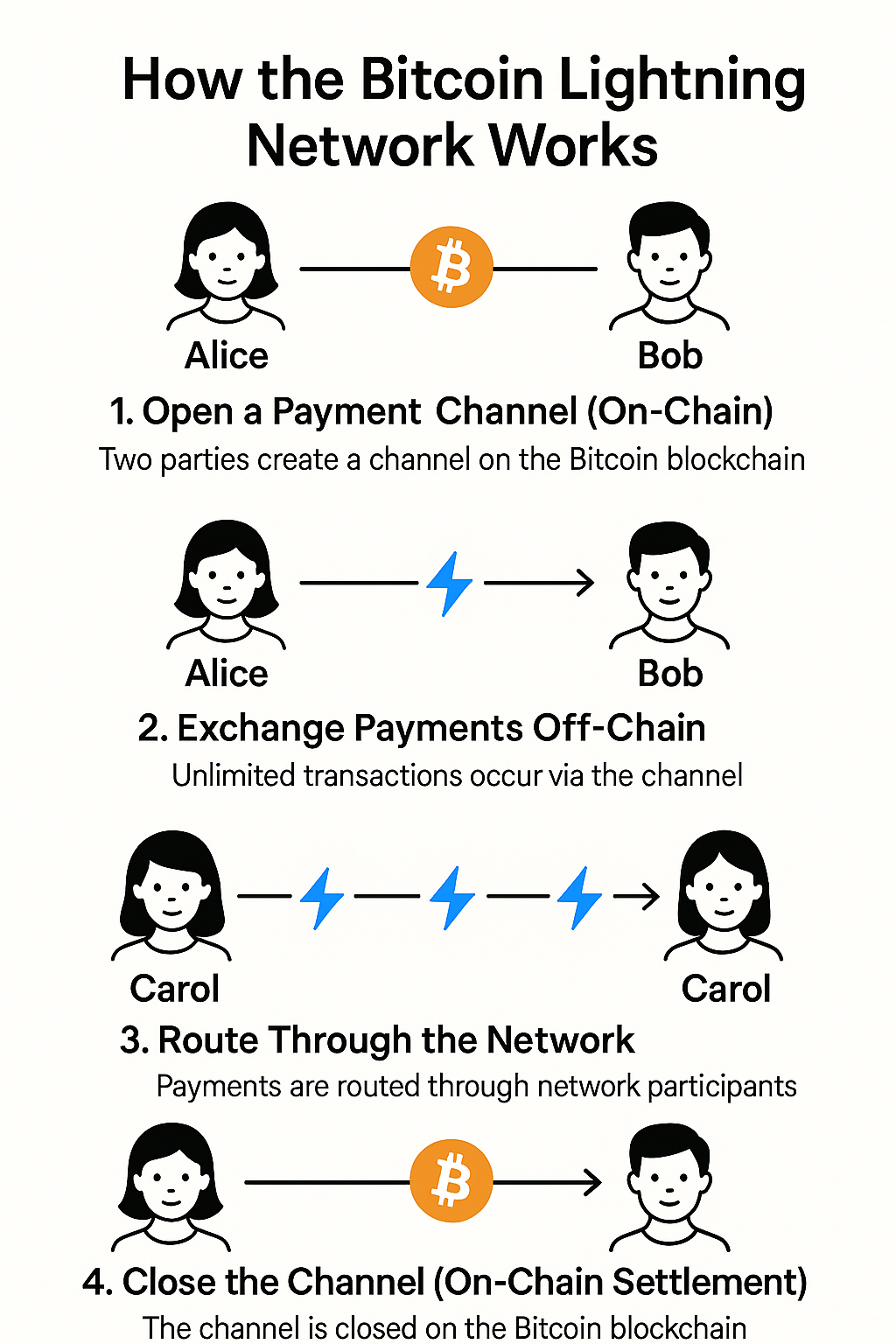
Implementations like Core Lightning, LND (Lightning Network Daemon), and Eclair power this ecosystem, with wallets such as Phoenix, Breez, and Muun simplifying user access. For developers, it's plug and play via APIs, integrating seamlessly with Bitcoin's ecosystem.
To help you get started, here's a comparison of the top 5 Bitcoin Lightning wallets as of October 2025:
| Wallet | Type | Custodial/Non-Custodial | Key Features | Link |
|---|---|---|---|---|
| Breez | Mobile | Non-Custodial | Automatic channel management, built-in podcast player with value-for-value payments, digital POS for merchants, supports up to 1M sats instantly. | Breez |
| Phoenix | Mobile | Non-Custodial | Automated channel management, splicing for resizing channels, transparent fees, high payment success rates, minimal setup. | Phoenix |
| Wallet of Satoshi | Mobile | Custodial | Instant registration, easy sending/receiving LN payments, email backup, centralized management for simplicity. | Wallet of Satoshi |
| Muun | Mobile | Non-Custodial | Seamless on-chain/Lightning routing, submarine swaps, advanced fee estimation, multi-sig security, intuitive interface. | Muun |
| BlueWallet | Mobile | Non-Custodial | Open-source, supports LN channels, watch-only wallets, batch spending, integration with hardware wallets. | BlueWallet |
The Benefits: Why Lightning Matters for Digital Assets
Lightning's value proposition shines in a world where Bitcoin is more than a store of value, it's a medium of exchange. Key advantages include:
Speed and Scalability: Transactions confirm in seconds, supporting millions of TPS theoretically. Ideal for remittances, e commerce, and micropayments (e.g., paying per article read on a news site).
Ultra Low Fees: Average costs hover at 1 10 satoshis (fractions of a cent), versus main chain fees that can exceed $5 during peaks.
Privacy Enhancements: Off-chain activity reduces on-chain footprints, though not fully anonymous.
Financial Inclusion: In regions with unstable fiat, Lightning enables borderless, censorship-resistant payments. Partnerships with platforms like Strike and Cash App have channeled millions in remittances to emerging markets.
For institutions, Lightning integrates with custody solutions and treasury strategies, offering efficient on-ramps for Bitcoin-backed services. As ETFs and corporate holdings mature, Lightning could underpin DeFi like yield generation on Bitcoin.
Challenges and Considerations
No innovation is without hurdles. Lightning faces:
Liquidity Management: Channels require upfront funding; illiquid routes can fail payments. Solutions like channel factories and splicing are emerging.
Centralization Risks: Large hubs (e.g., exchanges) dominate routing, potentially creating chokepoints. Trampoline payments and submarine swaps mitigate this.
Security Nuances: While inheriting Bitcoin's base layer, users must guard private keys and monitor channels to avoid "force close" penalties.
Adoption Barriers: User education lags, and regulatory scrutiny (e.g., KYC for nodes) could slow growth. Quantum threats remain a distant concern, but post quantum upgrades are in R&D.
Despite these, network health metrics, uptime over 99.9% and growing node count, signal maturity.
Key Players Shaping Lightning's Future
"Who are" the innovators behind this? A vibrant community drives Lightning:
Lightning Labs: Led by Elizabeth Stark and Christian Decker, creators of LND. They're pioneering Taproot Assets for token issuance on Lightning.
ACINQ: Developers of Eclair and Phoenix Wallet, focusing on mobile first experiences.
Blockstream: With c lightning (now Core Lightning), they're advancing satellite integration for global reach.
Exchanges and Wallets: Binance, Kraken, and Wallet of Satoshi operate major hubs. Non custodial options like BlueWallet empower self sovereignty.
Enterprises: Companies like Fold and OpenNode embed Lightning for merchant payments, while Visa's pilots explore interoperability with traditional rails.
Institutions like Fidelity are experimenting with Lightning for settlement layers, aligning with broader digital asset strategies.
Conclusion: Lightning as Bitcoin's Highway to Mass Adoption
The Bitcoin Lightning Network isn't just a technical fix, it's the on ramp turning Bitcoin into a practical currency for the digital age. By scaling without sacrificing principles, it paves the way for seamless financial services, from lending integrations to ETF redemptions. As capacity surges and tools mature in 2025, Lightning's role in the Bitcoin economy will only expand.
More Articles About Bitcoin
The State of Bitcoin-Backed Lending, Q3 2026: A Smaller Market With Better Habits
Crypto lending shrank to $56.16B in Q2 with no blowups. How Coinbase, Arch, Strike, Ledn and Unchained compare on rate, LTV, custody and transparency....
October 7, 2026
Skylark Digital Assets — Institutional Intelligence Summary: September 2026 Month-End
Michael Pierre examines competing cycle scenarios: a rollover or an extended expansion, alongside September liquidity, funding, and Bitcoin network re...
October 6, 2026
FinCEN Withdraws Unhosted Wallet Rule and Crypto Mixer Proposal
FinCEN withdrew its 2020 unhosted wallet proposal, which would have required reports on self-custody crypto transactions over $10,000, plus a 2023 mix...
October 5, 2026
Podcast Conversations About Bitcoin


