
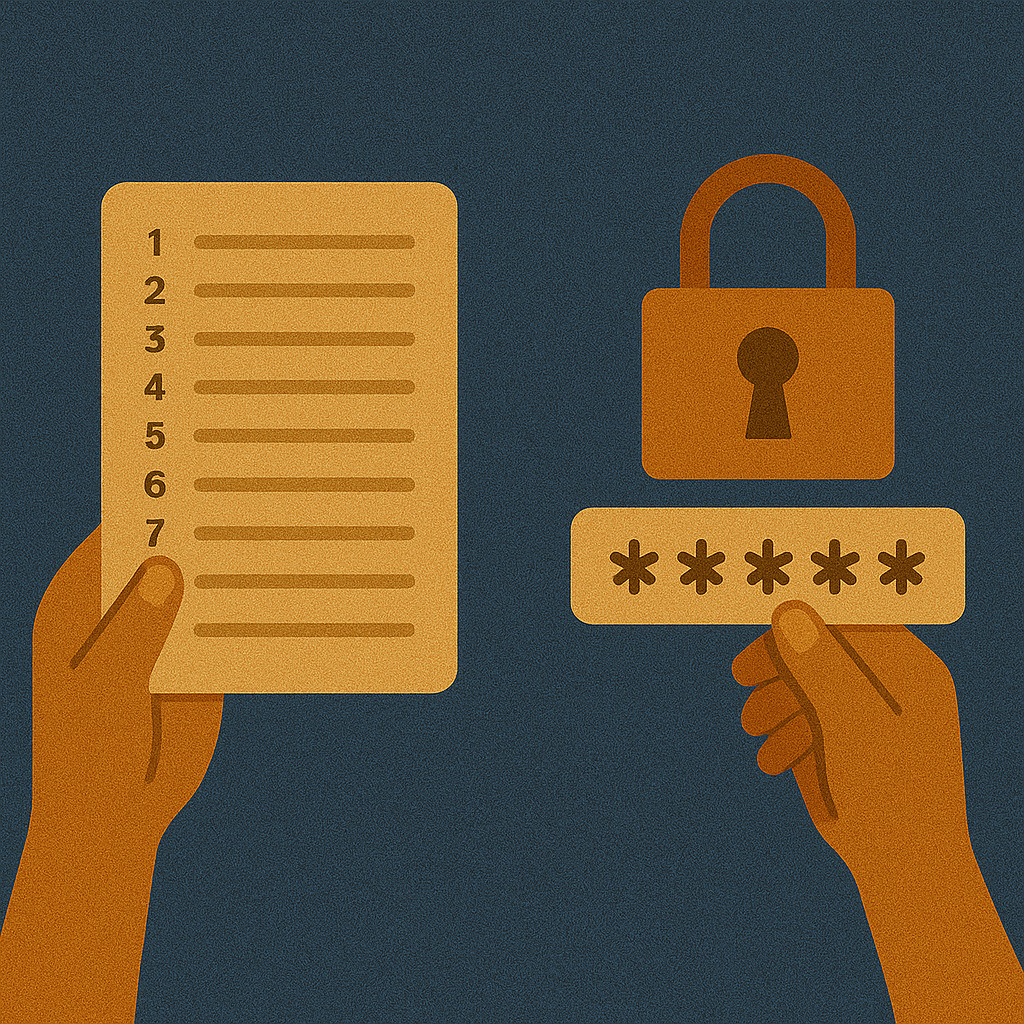
Bitcoin Seed Phrases vs. Private Keys: The Beginner’s Guide to Security
Estimated reading time: 14 minutes
TL;DR – A seed phrase is a human-readable backup that can regenerate all your private keys. Private keys authorize Bitcoin transactions. Lose your seed, and you lose everything. Understanding the difference—and protecting both—sets the foundation for real Bitcoin ownership.
1. Key Terms in Plain English
| Term | What It Means | Why It Matters |
|---|---|---|
| Private Key | A long, random number that allows you to spend Bitcoin. | Whoever controls it controls the coins. |
| Public Key / Address | A hash derived from the private key; safe to share. | People use this to send you Bitcoin. |
| Seed Phrase (Mnemonic) | A list of 12 or 24 words that recreate your wallet’s keys. | Easier to store than raw private keys. |
Bottom Line: Your private keys live inside your wallet. Your seed phrase is the master backup that can restore them all.
2. Why This Matters: “Not Your Keys, Not Your Coins”
When you keep Bitcoin on an exchange, you do not own the keys. The exchange does. If they freeze withdrawals or go under (think FTX or Celsius), your coins are gone.
Self-custody removes that risk—but now you become the bank. That means mastering seed phrases and private keys is non-negotiable.
3. How Seed Phrases and Private Keys Connect
- Entropy → Seed: Wallet generates random data for security.
- Seed → Mnemonic Words: BIP-39 maps the seed into 12 or 24 easy-to-write words.
- Mnemonic → Private Keys: Using BIP-32, the wallet derives thousands of keys for future transactions.
Key Insight: Guard one seed phrase, and you guard your entire Bitcoin future.
4. Best Practices for Protecting Seed Phrases
4.1 Generate Offline
Always use an air-gapped hardware wallet (Ledger, Trezor, Coldcard, Foundation Passport). The keys never touch the internet.
4.2 Write by Hand (or Etch in Steel)
- Use fire- and water-resistant backups like Seedplate or Billfodl.
- Never store seeds in cloud storage or on a phone. Real-world breaches often start there.
4.3 Store Multiple Backups in Separate Locations
Think home safe + bank deposit box, or geographically diverse spots.
4.4 Add a Passphrase (“25th Word”)
Boosts security by requiring an extra word known only to you.
4.5 Test a Full Recovery
Before going all-in, practice restoring from your seed. Send a small test transaction to confirm.
5. Common Mistakes (and How to Avoid Them)
| Mistake | What Happens | Fix |
|---|---|---|
| Storing seed in cloud apps or notes | Hackers can steal it | Keep backups offline and physical |
| Using the same seed on multiple hot wallets | Increases attack surface | Use separate wallets or watch-only setups |
| Telling people “it’s 12 words” | Helps social engineers | Keep word count and details private |
| Forgetting to update backups after adding a passphrase | Wallet won’t restore | Immediately update all copies |
6. Providers and Tools Snapshot
| Provider | Focus | Standout Feature |
|---|---|---|
| Ledger | Consumer-grade hardware | Secure Element chip + Ledger Live app |
| Trezor | Open-source security | Shamir Backup (split seed feature) |
| Coldcard | Air-gapped purist wallet | PSBT signing via microSD |
| Casa | Multi-sig security service | Collaborative key-sharing setup |
All tools prioritize self-custody—you hold the keys.
7. FAQs
Q: What if I lose one backup?
A: You’re fine as long as you have at least one intact copy.
Q: Can I memorize my seed?
A: Some do, but memory fades. Treat memorization as a bonus, not your only backup.
Q: Is a PIN the same as a passphrase?
A: No. A PIN unlocks your hardware wallet. A passphrase is part of the cryptographic seed.
8. Security Extras Worth Considering
- Metal backups for fire and water resistance.
- Geographic distribution for disaster resilience.
- Collaborative custody (e.g., Unchained, Casa) for multi-key protection without sacrificing control.
9. Final Takeaway
Your seed phrase is the single point of truth for your Bitcoin. Treat it like a physical bearer asset: create it offline, back it up in multiple secure locations, and never share it. Get this right, and you’ve eliminated the biggest single point of failure in Bitcoin ownership.
Written by the 21Rates Editorial Team, July 27, 2025.

