

- Bitcoin
- Cathie Wood
- Market Analysis
- ETFs
- Halving
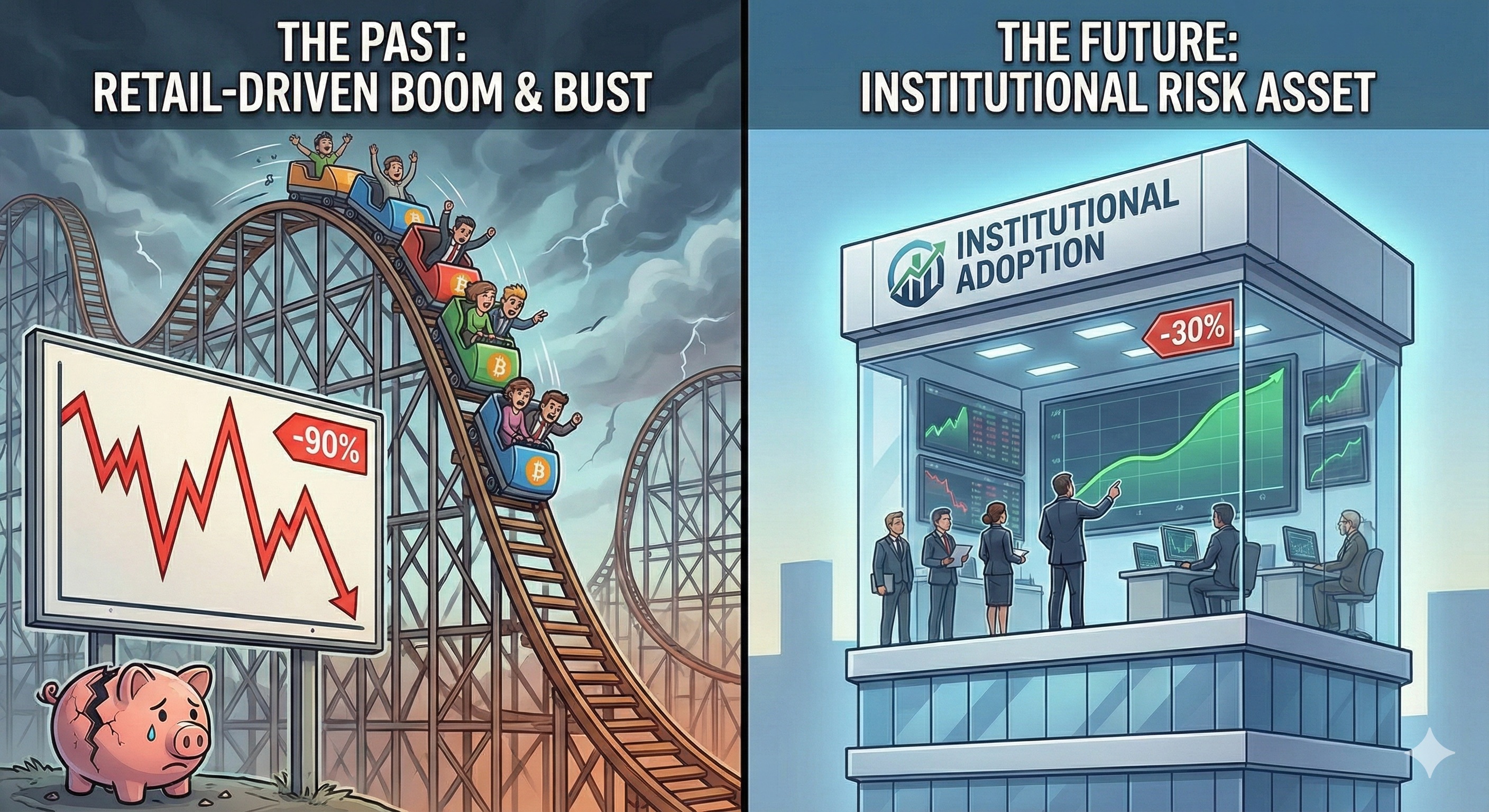
TL;DR – ARK Invest's Cathie Wood says Bitcoin's famous four-year halving cycle is starting to break down as institutions soak up supply and smooth out volatility. Instead of 75%–90% boom-and-bust crashes, she expects shallower drawdowns and a market that behaves more like a mainstream risk asset than a retail-driven science experiment.
Cathie Wood vs. the "sacred" four-year cycle
For more than a decade, Bitcoin's story has been told in four-year beats:
- Halving (block reward cut)
- Supply shock and parabolic rally
- Brutal bear market
- Long grind higher… then repeat
ARK Invest CEO Cathie Wood is now openly challenging that script.
In a recent Fox Business interview, Wood argued that Bitcoin's historic four-year cycle is being rewritten by a single force: institutional adoption. Instead of retail traders driving manic boom-bust cycles around halvings, she says large financial players are increasingly setting the tone.
"The volatility's going down," she said, adding that institutions are "going to prevent much more of a decline" during future sell-offs
 . In her view, the most recent leg lower may already have found a bottom "a couple of weeks ago."
That's a direct challenge to one of Bitcoin's core narratives: that every four years, the code cuts new supply and the market dances to that beat.
Halvings still matter, but less than they used to
Wood isn't claiming that halvings are irrelevant. The latest, on April 20, 2024, reduced miner rewards from 6.25 BTC to 3.125 BTC per block, reducing new issuance by about 450 BTC per day.
Her point is about proportion:
- In Bitcoin's early years, that supply hit was enormous relative to total market size and trading volumes.
- Today, with a multi-trillion-dollar market cap and billions in ETF and institutional flows, 450 BTC a day is a rounding error.
As one strategist quoted in related coverage put it, halvings now look more like a "small nudge" inside a much larger liquidity and adoption story.
Big banks increasingly share that view. Standard Chartered, for example, recently cut its 2025 Bitcoin target from $200,000 to $100,000 and said the old pattern of prices peaking roughly 18 months after a halving is "no longer valid" in a world dominated by ETF buying and institutional flows.
Institutions as volatility shock absorbers
Wood's core claim is that who owns Bitcoin now matters more than how much miners earn.
Historically, deep drawdowns of 75% to 90% from peak were followed by speculative blow-offs. Retail traders with short time horizons, leverage, and weak hands made it easy for cascades to feed on themselves.
Now, she argues, three institutional trends are changing that:
1. Spot ETFs and managed products
Bitcoin held in regulated ETFs, funds, and trusts tends to be stickier. These vehicles are owned by advisory platforms, family offices, and allocators who rebalance on quarterly or annual cycles, not TikTok sentiment. For a breakdown on how ETF flows are driving this shift away from traditional cycles, tune into our episode with Bitwise CIO Matt Hougan on Bitcoin ETFs: The New Institutional Playbook—exploring post-halving adoption trends.
2. Corporate treasuries and long-term mandates
Public companies, institutional funds, and some sovereign entities that buy BTC for long-term strategic reasons are less likely to panic sell into every 30% correction. For a live look at how 157+ companies are navigating Bitcoin volatility in their treasuries, check out our Bitcoin Treasury Companies tracker—including allocation strategies and risk planning amid shifting cycles.
3. Deeper, more liquid markets
As market depth grows across futures, options, and spot venues, liquidity shocks are stiffer but not impossible to create. Big players are both sources of volatility and buffers against the most extreme accidents.
The result, if Wood is right: more "rolling corrections" and fewer absolute wipeouts. Bitcoin behaves more like a high beta macro asset, swinging with risk sentiment, rates, and tech stocks rather than a pure halving-driven commodity.
→ For deeper insights on managing Bitcoin's evolving volatility as institutions take over, listen to our episode with Ledn CIO John Glover on Risk Management in Bitcoin Personal Finance—a must-hear for sizing positions in a post-cycle world.
The broader debate: Is the cycle really dead?
Wood's comments enter an already heated industry debate.
On one side are analysts who still see the four-year template as useful:
- Accumulation → halving → explosive rally → blow-off → multi-year bear.
On the other side are those who say the pattern was always more about global liquidity than about block rewards, and that the growing role of institutions has finally made that obvious.
Recent research highlighted by CryptoPotato, for example, argues that every prior post-halving bull phase has coincided with massive expansions in liquidity and risk appetite, making the halving more of a narrative marker than a causal driver.
Meanwhile, voices like Bitwise CIO Matt Hougan and CryptoQuant's Ki Young Ju have gone as far as to say "the cycle is dead," pointing to ETF flows and institutional positioning as the new north star for Bitcoin's medium-term behavior. To hear Ki Young Ju dive into on-chain data signaling the end of halving dominance, check out On-Chain Signals: Beyond the Four-Year Cycle with CryptoQuant.
The compromise view, echoed by traders like Sentora's Patrick Heusser, is that halvings still matter—but only as small ripples within a long-term power law curve, where time, adoption, and liquidity drive the big picture.
What Wood's thesis means if you own Bitcoin
If you're holding or considering Bitcoin, Wood's argument has a few practical implications:
1. Don't over-optimize around halving dates
If the four-year cycle is weakening, rigidly timing entries and exits around halving calendars may offer less edge than it once did. Macro conditions, ETF flows, and risk sentiment could matter more than the exact block height.
2. Expect more minor, but more frequent, shocks
Shallower drawdowns sound comforting, but they also mean fewer "obvious" generational bottoms. Instead of one massive 80% crash, you may get a series of 30–50% hits that are harder to distinguish from routine volatility.
3. Institutional comfort cuts both ways
Big, sticky holders can slow crashes, but they also tend to sell or rotate when macro regimes shift. If Bitcoin is now part of the broader risk asset complex, it may rise and fall in sync with equities, real estate, and tech rather than serving as a simple hedge.
4. Narrative risk is shifting
For years, "just wait for the next halving" was the lazy bull case. If that script no longer works, bulls will need better stories around adoption, settlement use, balance sheet exposure, and macro tailwinds—to justify each new leg higher.
For more on how ETF flows and institutional strategies are reshaping Bitcoin's risk profile, dive into our full Bitcoin podcast archive—featuring episodes on ETF dynamics, corporate adoption, and beyond-the-cycle investing. We also recommend Macro Tailwinds for Bitcoin: Navigating Institutional Volatility with Sygnum Bank's Fabian Dori for tying Wood's views to real-world risk sentiment.
Wood remains firmly in the bullish camp: she still sees Bitcoin as a core component of a long-term monetary and innovation shift, and her team continues to add exposure through Coinbase, Circle, and ARK's 21Shares Bitcoin ETF.
Whether you share her conviction or not, one thing is clear: as institutions claim a bigger share of the market, Bitcoin's future will likely be decided less by four-year folklore and more by the same forces that shape every other global asset.
More Articles About Bitcoin
Ledger Pauses Reseller CryptoBilis After Reports of $86 Million in Drained Wallets
Ledger asked reseller CryptoBilis to pause sales while it probes lost funds. An analyst puts drains at $86M+, including 211 BTC. What's known so far....
October 9, 2026
Best Bitcoin Lending Platforms in Q4 2026
Ledn, Arch, Strike, Figure, SALT and more compared on rate, LTV, minimum loan and how your bitcoin is held. Rates checked Oct 8, 2026....
October 9, 2026
Thailand Approves Spot Bitcoin and Ether ETFs for the Stock Exchange of Thailand, Rules Take Effect Oct. 16
Thailand's SEC finalized rules for spot bitcoin and ether ETFs on the Stock Exchange of Thailand, effective Oct. 16, 2026. The rules, numbers and what...
October 9, 2026
Podcast Conversations About Bitcoin


