
- Bitcoin Mining
- China
- Crypto Regulation
- Decentralization
- Hash Rate
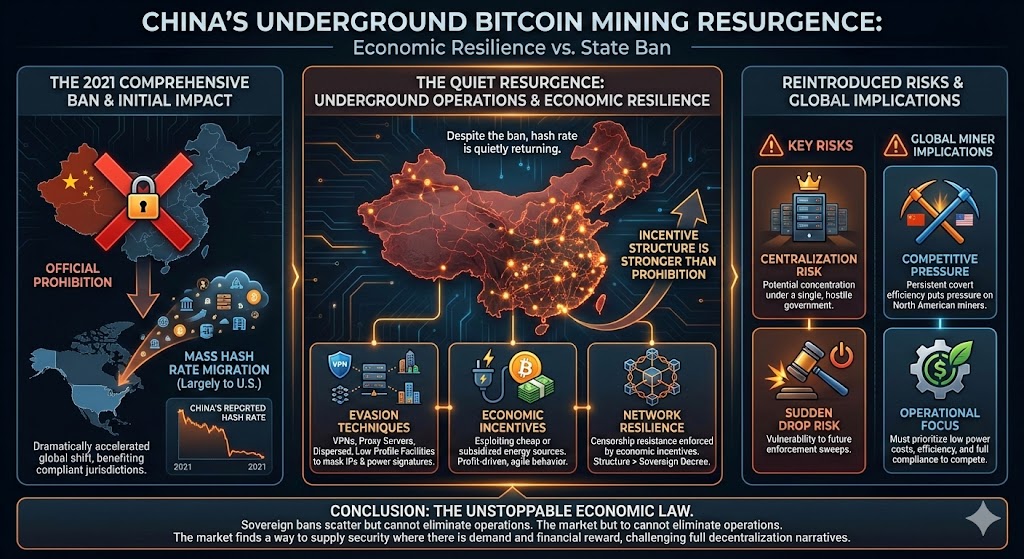
TL;DR – Despite China's comprehensive 2021 ban, Bitcoin mining is quietly resurging in the country through underground operations, demonstrating the network's economic resilience against state prohibition while reintroducing centralization risks and competitive pressure on global miners.
Despite a comprehensive nationwide ban enacted in 2021, Bitcoin Mining in China is experiencing a notable resurgence in hash rate, according to recent reports. This phenomenon, driven by small-scale, decentralized, and often subsidized operations, proves the extraordinary resilience of the Bitcoin network's incentive structure against state-level prohibition.
This analysis examines the surprising return of China's underground hash rate, the regulatory risks it highlights, and the long-term implications for the decentralization of global Bitcoin production.
The Underground Hash Rate: An Indication of Bitcoin's Resilience
The reported increase in China's contribution to the global Bitcoin hash rate indicates a massive effort to evade. Operators are utilizing sophisticated techniques such as VPNs, proxy servers, and geographically dispersed, low-profile facilities to mask their IP addresses and power consumption signatures. This underground economy thrives by exploiting cheap or subsidized energy sources, directly challenging the central authority.
This resurgence underscores a core tenet of Bitcoin: its censorship resistance is enforced by economic incentives. The network's resilience is the ultimate counterargument to state attempts at prohibition, confirming that the incentive structure is stronger than any sovereign decree.
"The decentralization of cryptocurrencies has been a key factor... Bitcoin was the first decentralized, blockchain-based cryptocurrency and remains the most well-known... Bitcoin's decentralized system and a unique combination of anonymous miners and profit-driven incentives have been the primary drivers of its unstoppable innovation."
— Explore: BITCOIN WILL WIN! | Nic Carter on The Bitcoin Economy
Regulatory Risk and the Hash Rate Migration Challenge
The 2021 ban dramatically accelerated the Hash Rate Migration out of China, mainly benefiting the United States. However, the current resurgence reintroduces two key risks: Centralization Risk (potential concentration under a single, hostile government) and Sudden Drop Risk (a future enforcement sweep).
The structure of Bitcoin's financial incentives drives both migration and evasion. Miners are constantly calculating the highest profit potential, which requires capital allocation and strategic decision-making amid regulatory uncertainty. This agile, profit-seeking behavior is why the hash rate continually moves.
"The Bitcoin mining business requires constant, large-scale capital deployment. This episode delves into why public miners constantly seek capital and how they strategically make decisions like moving operations or expanding—based on long-term profit outlook rather than short-term market fears."
Long-Term Implications for Global Bitcoin Mining
The ongoing resilience of Bitcoin Mining in China serves as a vital case study for the entire digital asset industry. It confirms that sovereign bans can scatter operations geographically but cannot eliminate them. The hash rate flows to where energy is cheapest, and regulations are most easily circumvented.
For publicly traded miners in North America, this persistent Chinese competition puts pressure on operational efficiency. The industry must continue to prioritize low power costs, efficient hardware, and a fully compliant operational structure to compete with the persistent, covert efficiency of the underground Chinese mining sector.
Conclusion: The Unstoppable Economic Law
China's resurgent hash rate is a testament to the powerful economic law encoded in Bitcoin's protocol. Where there is demand for a service (security) and a clear financial reward, the market will find a way to supply it. This quiet return challenges the narrative of a fully decentralized hash rate and reminds the global industry that regulatory risk remains a fundamental yet surmountable factor in the Bitcoin economy.
Videos from "The Bitcoin Economy" on YouTube
- The Bitcoin Economy YouTube Channel – Explores financial services built on Bitcoin, with over 1.1 million streams.
- Bitcoin Treasury 2.0: Why ReserveOne Thinks Bigger Than ETFs(Published Nov 20, 2025)
- Off-Grid & Flare Gas - Bitcoin Education (Published Nov 17, 2025) – Relevant to mining efficiency and energy sources.
- Bitcoin Mining Before the 2028 Halving: Strategic Insights with Jill Ford (Published Nov 7, 2025) – Insights on mining costs vs. buying Bitcoin.
Videos and Podcasts from 21rates.com
- Bitcoin Podcast & Videos: Expert Insights & Analysis – In-depth analysis, expert interviews, and educational content on Bitcoin lending, custody, ETFs, and more.
- Video: Will Institutions Buy Into Bitcoin Credit? Strive Strategy Launch, SATA, and Stre – Podcast episode on institutional Bitcoin strategies.
Related on 21Rates:
More Articles About Bitcoin Mining
Bitcoin Miners Just Got Their Biggest Tax Break in History. The Fine Print Kills Green Energy.
The Big Beautiful Bill restored 100% first-year depreciation on mining hardware while eliminating renewable energy credits after 2027. Miners got a gi...
March 28, 2026
Foundry Digital Brings Institutional Mining Infrastructure to Zcash
Foundry Digital, operator of the world's largest Bitcoin mining pool, is launching an institutional Zcash mining pool in April 2026 - signaling privac...
March 12, 2026
SEC and CFTC Sign Landmark MOU for Unified Crypto Oversight
The SEC and CFTC signed a binding MOU formalizing Project Crypto. Both chairs agree most crypto assets are not securities. The framework enables onsho...
March 12, 2026
Podcast Conversations About Bitcoin Mining