
- Federal Reserve
- Bitcoin
- Crypto Markets
- Interest Rates
- Macroeconomics
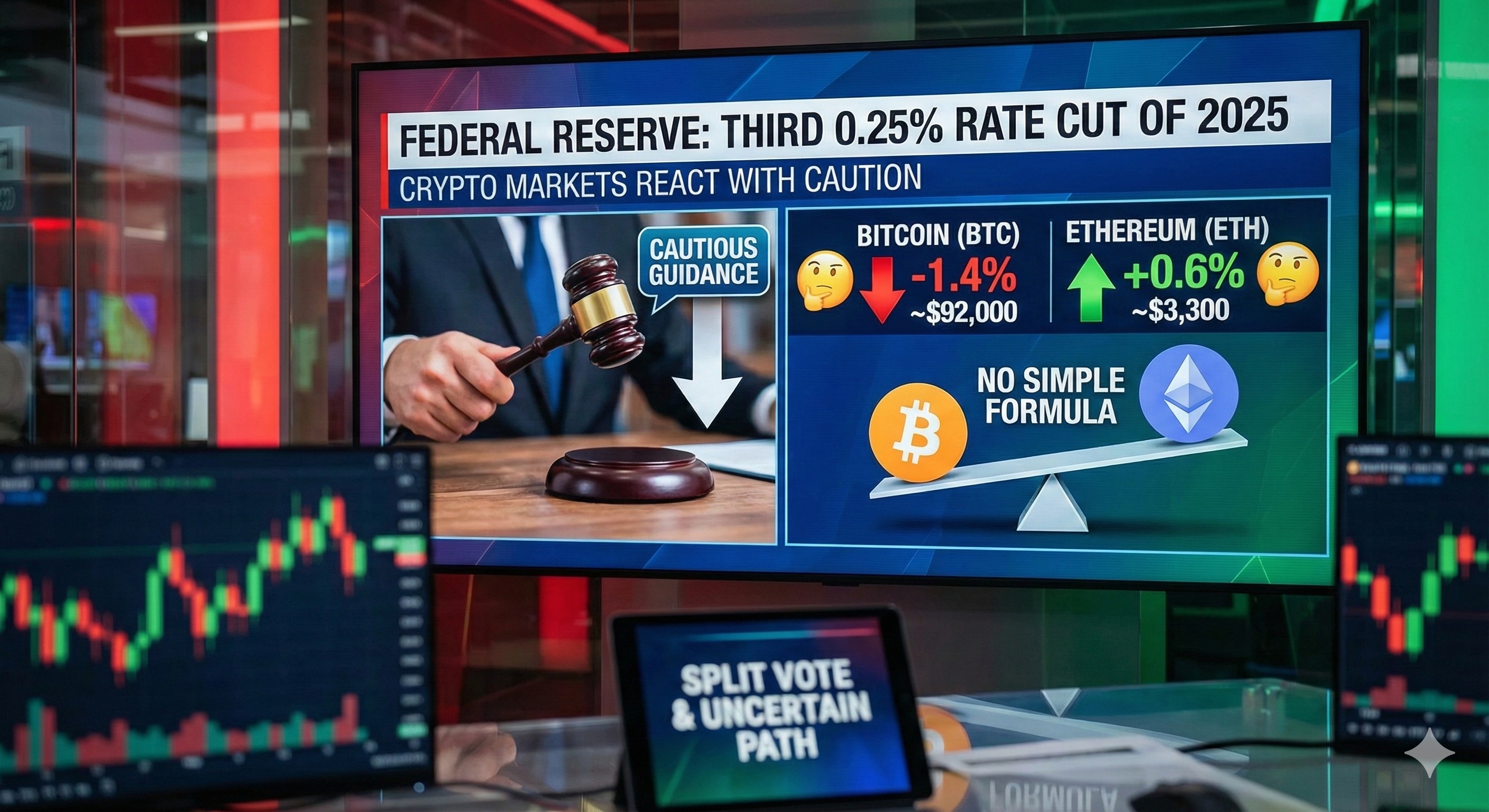
TL;DR – The Federal Reserve delivered its third 0.25% rate cut of 2025, but with cautious guidance that left crypto markets mixed rather than euphoric. Bitcoin dipped 1.4% to ~$92,000 while Ethereum gained slightly, proving there's no simple "Fed cut = crypto pump" formula when the central bank's message remains uncertain.
A familiar pattern played out on Fed day: traders front-ran the decision, the central bank did roughly what everyone expected, and Bitcoin and Ethereum whipped around the headline before settling into a narrow, uneasy range.
This time, the Fed did cut. Crypto just didn't quite know what to do with it.
The Fed's third cut—and a messy message
On December 10, the Federal Reserve lowered its benchmark rate by 0.25 percentage points, the third straight cut this year, in a move markets had largely priced in.
Under the surface, though, there was real tension:
- Split vote: Two members of the FOMC wanted to keep rates unchanged, while one pushed for a larger cut.
- No promise of a cutting cycle: Future moves will depend on "incoming data" rather than a pre-committed path.
- Balance-sheet tweak: The Fed will resume buying short-term Treasury bills to keep bank reserves "ample" on an ongoing basis — a subtle but important liquidity injection.
In updated projections, officials still penciled in two more cuts next year, but disagreement was wide.
Add in missing CPI and jobs data (delayed by the recent government shutdown) and you get a Fed that's easing with one hand and clenching the other.
How crypto actually reacted
- Bitcoin (BTC): Down ~1.4% to ~$92,000
- Ethereum (ETH): +0.6%, just above $3,300
- Solana (SOL): −3.2% (the clear laggard)
That's not a classic risk-on reaction. It's a market that expected the cut, hoped for a clearer dovish pivot, and got ambiguity instead.
Sygnum Bank CIO Fabian Dori pointed to "concern regarding a softening labor market and still-sticky inflation" as the reason the Fed refused bold promises.
Why "Fed cut = BTC moon" didn't show up
- The cut was already priced in (~89% probability on CME FedWatch).
- The guidance was cautious, not euphoric — exactly the kind of tone that keeps leveraged traders on the sidelines.
- Liquidity support is real but gradual — resuming T-bill purchases helps funding markets and leveraged crypto trading, but it's a "slow burn" rather than rocket fuel.
→ If you want to understand exactly how leverage, collateral, and professional risk management behave when the Fed shifts from hawkish to uncertain, listen to our in-depth conversation with Ledn CIO John Glover on Risk Management in Bitcoin Personal Finance — still the best companion piece to today's price action.
Politics, the next Fed chair, and the crypto angle
Jerome Powell's term expires in May 2026. President Trump is openly shopping for a replacement, with Kevin Hassett currently the heavy favorite in prediction markets (~73% on Myriad).
A more dovish, potentially pro-crypto Fed chair could extend the runway for Bitcoin and Ethereum significantly — and accelerate blockchain integration into the banking system.
What this means if you're long BTC or ETH
- Macro is moving from "high and rising" to "lower but uncertain" rates — generally friendlier than 2022–2023, but volatility stays high.
- Liquidity is quietly improving (T-bill purchases + "ample reserves" language).
- Political and regulatory headlines will keep driving swings.
For practical positioning ideas in this exact environment, explore:
- How public companies are using Bitcoin as a treasury asset in the current rate cycle (157+ companies tracked live)
- Full Bitcoin podcast archive — macro, risk management, and ETF flow episodes
Bottom line: One more Fed cut doesn't rewrite the Bitcoin or Ethereum thesis, but it does nudge the macro backdrop in a slightly more supportive direction. The hard work — position sizing, time horizon, and risk controls — still has to come from you.
Related on 21Rates:
More Articles About Federal Reserve
U.S. Government Moves $1 Billion in Seized Bitfinex Bitcoin: What It Means
The U.S. government moved 12,267 BTC ($1.01B) from a Bitfinex-hack seizure wallet on Oct 8, 2026. No sale is confirmed. What it means for BTC holders....
October 8, 2026
Samsung Wallet Is Adding USDC: What It Means for Stablecoin Holders and Bitcoin Borrowers
Samsung Wallet adds USDC for 82M U.S. Galaxy devices in late October 2026, held by Bastion and Coinbase. What it means for stablecoin holders and BTC ...
October 8, 2026
The State of Bitcoin-Backed Lending, Q3 2026: A Smaller Market With Better Habits
Crypto lending shrank to $56.16B in Q2 with no blowups. How Coinbase, Arch, Strike, Ledn and Unchained compare on rate, LTV, custody and transparency....
October 7, 2026
Podcast Conversations About Federal Reserve