
- Bitcoin Mining
- Corporate Finance
- Nasdaq Compliance
- Canaan
- Stock Market
Nasdaq Puts Canaan on Notice: Can the Bitcoin Mining Pioneer Regain Its Footing?
In the high-stakes world of Bitcoin hardware and corporate treasury management, the public markets can be a fickle partner. Canaan Inc. (NASDAQ: CAN), the Singapore-based pioneer behind the world’s first ASIC miner, finds itself back in the crosshairs of Nasdaq compliance.
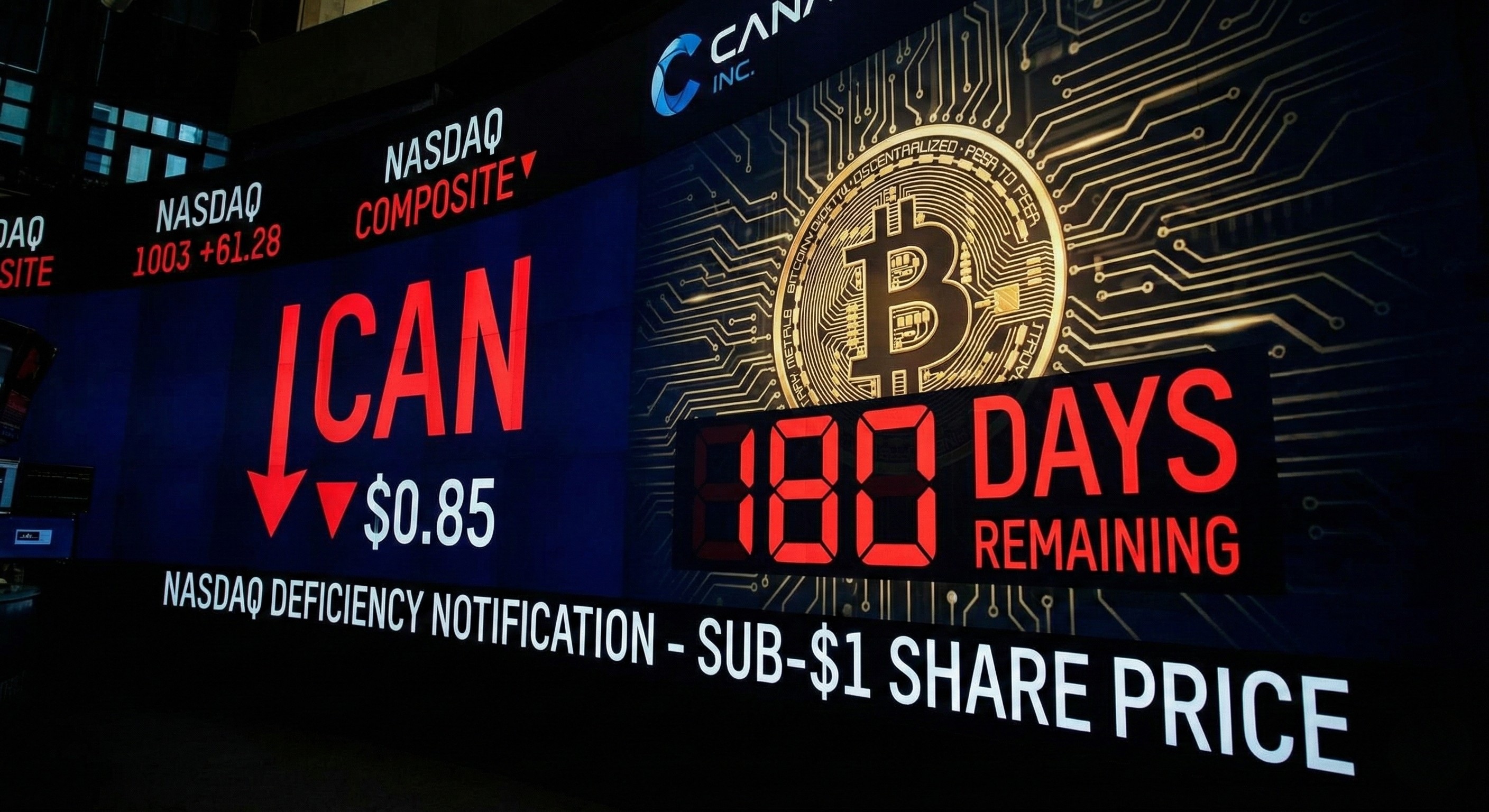
On January 14, 2026, Canaan received a formal "deficiency notification" from the Nasdaq Stock Market. The issue? A sub-$1 share price. For thirty consecutive business days, the company’s American Depositary Shares (ADSs) failed to clear the buck, triggering a violation of Nasdaq Listing Rule 5550(a)(2).
For those following the 21Rates framework on Bitcoin Treasury M&A, this isn't just a ticker update; it’s a strategic pivot point for one of the industry’s most established players.
The 180-Day Countdown
This isn't Canaan’s first rodeo with the minimum bid requirement, but the clock is ticking louder this time. According to the official SEC filing, the company has been granted a 180-day grace period, until July 13, 2026, to bring its stock price back above the $1.00 threshold for at least ten consecutive trading sessions.
While the notice doesn't immediately impact Canaan’s listing or the daily trading of "CAN" on the Nasdaq Global Market, the implications for institutional confidence are clear. To bridge the gap, the company may need to look beyond organic market rallies.
Strategy: The Reverse Split or the Bitcoin Rally?
Canaan has explicitly stated it will monitor share performance and take "all reasonable measures" to regain compliance. In the corporate finance playbook for Bitcoin companies, this usually points toward two paths:
- The Reverse Stock Split: A standard mechanical fix to consolidate shares and artificially boost the price above $1.
- The Alpha-Generating Pivot: Increasing the "Bitcoin per Share" value through improved mining efficiency or more aggressive treasury accumulation.
The company recently showcased its engineering resilience by unveiling the Avalon A16 series, which pushes the boundaries of J/TH efficiency. However, hardware excellence hasn't yet translated into equity stability.
The Valuation Gap: Bitcoin Holdings vs. Equity Price
What makes the Canaan story particularly interesting from a 21Rates perspective is the disconnect between its market cap and its underlying assets. According to BitcoinTreasuries.net, Canaan currently ranks among the top corporate Bitcoin holders, ending 2025 with 1,750 BTC and 3,951 ETH on its balance sheet.
Despite an analyst's "multi-dollar" average price target, the equity market has remained sluggish. This "valuation gap" is a recurring theme we’ve discussed on the Bitcoin Treasury M&A Podcast: public markets often struggle to price the volatility of hardware manufacturing alongside the appreciating value of a company's BTC reserves.
The Bottom Line
Canaan remains a cornerstone of the mining ecosystem. With its recently announced 4.5 MW contracts and a storied history in the Avalon series, the hardware fundamentals are there. However, the next six months will be a masterclass in "Public Market Survival 101."
If Canaan fails to hit the July deadline, they may qualify for a second 180-day window, provided they meet other initial listing standards. But for a company that helped build the Bitcoin network’s backbone, the goal isn't just to stay listed—it’s to prove that a Bitcoin hardware pioneer can still trade like a tech heavyweight.
Stay tuned to 21Rates as we track the intersection of Bitcoin treasury strategies and public equity performance.
Related on 21Rates:
More Articles About Bitcoin Mining
Best Bitcoin ETFs in Q4 2026
Grayscale's BTC leads on fees at 0.15%, IBIT leads on size at $67.3B, GBTC has the longest record. All 10 US spot bitcoin ETFs compared....
October 15, 2026
Best Bitcoin Exchanges and Apps in Q4 2026
Where to buy bitcoin in the US in Q4 2026: one-time fees, free recurring buys, spreads and free withdrawals at 9 exchanges and apps....
October 10, 2026
Morgan Stanley Just Launched the Cheapest Bitcoin ETF. That's Not the Real Story.
Morgan Stanley launched the cheapest spot Bitcoin ETF at 0.14%. It pulled $100M in week one. But the real story is 16,000 advisors managing $6.2 trill...
April 20, 2026
Podcast Conversations About Bitcoin Mining