
- Bank Failure
- Polymarket
- FDIC
- Financial Regulation
- Prediction Markets
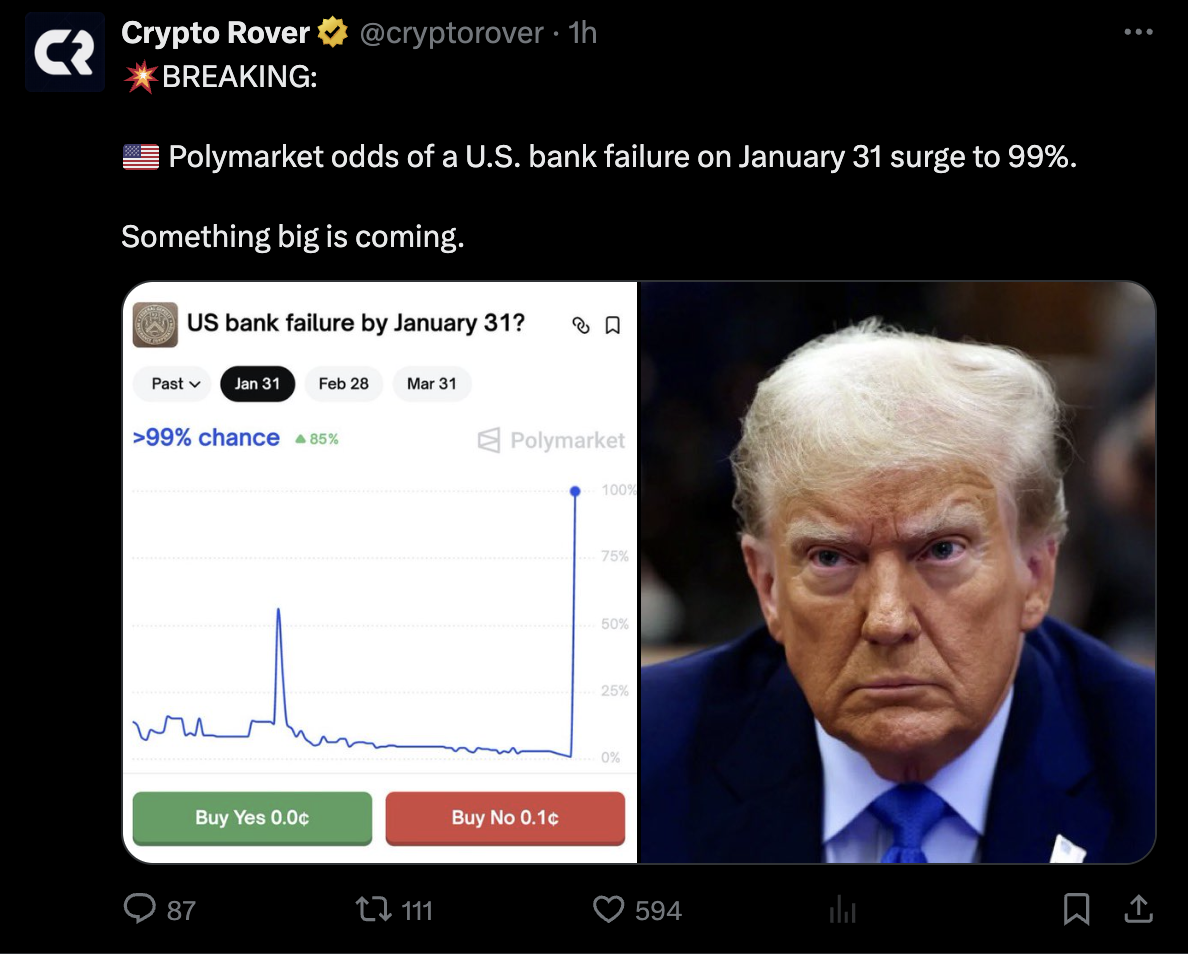
TL;DR – Metropolitan Capital Bank & Trust failed today, making Polymarket's "US bank failure by January 31" market spike to 99%. The FDIC executed a swift Friday-to-Monday resolution, showing they learned from the 2023 banking chaos, while highlighting how small banks with concentrated business models face different risks than major institutions.
That Polymarket screenshot making the rounds? It's real. And if you're wondering why the "US bank failure by January 31" market just spiked to over 99%, it's because a Chicago bank actually failed today.
Metropolitan Capital Bank & Trust got shut down by Illinois regulators this afternoon. The FDIC stepped in, Detroit-based First Independence Bank took over the deposits, and customers won't lose a dime. Branch reopens Monday like nothing happened.
The Basics
Metropolitan Capital was a $261 million bank with a single branch in Chicago's River North. But this wasn't your typical sleepy community bank giving out car loans and mortgages. They called themselves a "universal bank" (fancy!) serving business owners and wealthy entrepreneurs across Chicago, New York, and San Francisco. Clients in 46 states and 10 countries, all from one physical branch. Very 2020s.
The Illinois regulators cited "unsafe and unsound conditions and an impaired capital position." In plain English: they ran out of money and couldn't operate safely anymore.
Cost to the FDIC's insurance fund? About $19.7 million. For a quarter-billion dollar bank, that's actually a pretty clean failure. Could've been way messier.
The Warning Signs Were Flashing Red
Back in August 2019, regulators already had Metropolitan Capital on the naughty list. Consent order requiring them to maintain capital levels, charge off bad loans, stop paying dividends to shareholders. That's regulatory speak for "we're watching you very closely and you need to fix your shit."
By Q3 2025, they had $43 million in liabilities from Federal Home Loan Bank advances. For context, when a bank is borrowing that heavily from the FHLB system, it's like maxing out your credit cards to make rent. Not a sign of financial health.
Why This Actually Matters
This is the first bank failure of 2026. Last year we had just two small banks go under (Pulaski Savings at $49.5M in January, Santa Anna National at $63.8M in June, both involving suspected fraud). Metropolitan Capital is bigger than both combined and didn't involve obvious fraud, just good old-fashioned undercapitalization and concentration risk.
The swift Friday-to-Monday resolution shows the FDIC learned some expensive lessons from 2023. Remember Silicon Valley Bank? After it failed, it bled $67 billion in deposits while operating as a bridge bank. That's more than half its deposit base evaporating in weeks. Signature Bank lost nearly half too. Turns out customers don't love banking with a corpse, even one with FDIC insurance.
FDIC Chair Travis Hill has basically said "we're not doing that again." Sell failed banks immediately, don't let them become zombie institutions bleeding value. This execution shows they meant it.
What This Tells Us
Small banks with concentrated business models are playing a different game than the big guys. Metropolitan Capital focused on lending to business owners in three expensive cities. When your entire loan book is basically "rich entrepreneurs in SF, NYC, and Chicago," you better hope those markets stay healthy. They didn't have 500 branches across rural America to cushion the blow.
For those of us watching traditional finance from the Bitcoin world, this is a useful data point. The banking system isn't one thing. JPMorgan and Citi have regulatory capital buffers that would make a fortress jealous. A $261 million bank in Chicago with concentrated exposure? Different universe.
The good news is the system did what it's supposed to do. Depositors got made whole, healthy bank took over, branch opens Monday. No contagion, no panic, just a quiet Friday afternoon execution. Most Metropolitan Capital customers probably found out from a letter in the mail, not a bank run.
And yeah, Polymarket called it before the news even broke wide. Nothing like real money on the line to create the ultimate news aggregation mechanism. Traditional media is still writing headlines, and the prediction markets already paid out.
Related on 21Rates:
More Articles About Bank Failure
Coinbase Just Launched 21 Products in a Single Day. Here's What Actually Matters.
Stocks, AI investment advice, Bitcoin-backed mortgages, prediction markets, and pre-IPO access to SpaceX - all from your crypto exchange. Coinbase's E...
June 16, 2026
Bitcoin Drops Below $69K as Trump Gives 48-Hour Ultimatum on Iran Power Plants
A 24-hour policy reversal - from winding down to obliterate - erased a week of BTC gains and triggered $299M in liquidations. The market is trading Ho...
March 24, 2026
Whale Deploys $194M in Bitcoin Leveraged Bets Amid Infrastructure Boom
A whale trader deployed $194M in leveraged Bitcoin and Ethereum positions on HyperliquidX, betting on Bitcoin breaking $75K amid major crypto infrastr...
March 11, 2026
Podcast Conversations About Bank Failure