
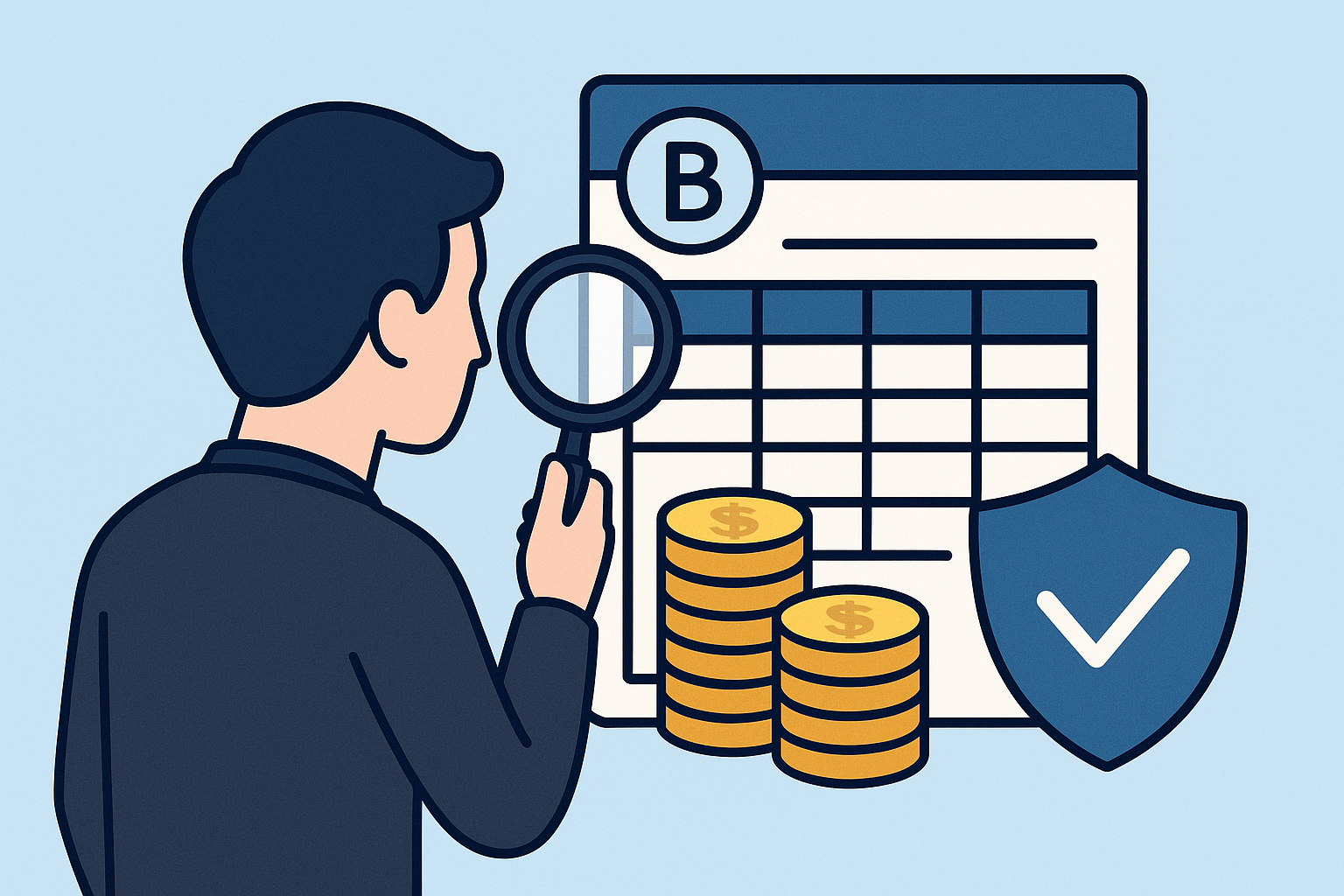
Proof of Reserves: What It Is, How It Works, and How to Verify It
TLDR: A credible Proof of Reserves (PoR) demonstrates—at the same timestamp—that a platform controls the assets it claims and owes no more to customers than those assets can cover. Assets-only screenshots aren’t enough; liabilities and controls must be part of the picture.
1 Plain-English basics: reserves, liabilities, solvency
Reserves (assets): Coins the platform actually controls (addresses it can sign from) plus off-chain cash/T-bill reserves held with banks or custodians.
Liabilities: Customer balances the platform owes spot, margin, staking/earn IOUs, and derivative exposures.
Solvency: Assets ≥ Liabilities at the same point in time.
Why PoR ≠ solvency by default: If you only prove assets, you can still be insolvent. If you only list liabilities, you might not own the backing. Both must be proven together, with controls that prevent gaming (e.g., borrowing coins for a photo-op).
2 What actually counts as “proof”? (Three ingredients)
Asset ownership (on-chain):
- Disclose address sets (hot/warm/cold) per chain.
- Sign messages from those addresses to prove control (balances alone aren’t proof).
- Document any custodians and the segregation model (e.g., multi-sig with named key agents).
Liabilities (privacy-preserving):
- Build a Merkle tree (or zk system) of all user balances.
- Give each customer a leaf (anonymized, salted) so they can verify inclusion.
- Publish the root hash and the total liabilities that the tree sums to.
A solvency statement with controls:
- Show Assets ≥ Liabilities at a specific timestamp, ideally attested by an independent professional.
- Include process controls that block “window dressing” (surprise checks, change-management for wallet lists, reconciliation to bank/custodian confirms).
Miss any one of these and you don’t have Proof of Reserves—you have proof of something.
3 How Merkle-tree liabilities work (and how you verify your own leaf)
Goal: Prove the platform didn’t alter or omit your account without exposing anyone else’s balance.
- Your balance is salted and hashed into a leaf.
- Leaves combine pairwise into parent hashes, forming a Merkle tree.
- The single root hash commits to every leaf.
- You receive: your leaf + the minimal set of “sibling” hashes needed to recompute the root.
- If your recomputed root = the published root, your account was included unchanged.
| What you get | What it proves |
|---|---|
| Leaf + path | Your balance is included and unmodified. |
| Root + liabilities sum | Everyone’s balances sum to the disclosed number; altering any included balance breaks the root. |
Limits: Merkle alone can’t prove the platform didn’t omit accounts or hide negative balances hence the push for zero-knowledge proofs and auditor controls.
4 Modern upgrades: Zero-knowledge Proof-of-Liabilities (zk-PoL)
Zero-knowledge (ZK) systems let a platform prove that:
- The sum of all customer balances equals the disclosed liabilities;
- No account is negative (range proofs);
- Inclusion rules (“all active accounts at time T”) were followed
all without revealing individual balances.
ZK-PoL closes two classic gaps of Merkle-only approaches: omission risk and hidden negatives.
5 From PoR theater to real assurance: Proof of Solvency (gold standard)
Look for:
- Assets: On-chain signatures from disclosed addresses + bank/custodian confirmation letters.
- Liabilities: Public Merkle root and zk-PoL (or equivalent); customer self-checks enabled.
- Timing: Assets and liabilities captured simultaneously; explicit anti-window-dressing controls.
- Scope: Spot, margin, staking/earn, derivatives, and fiat everything owed.
- Independence: Third-party attestation with crypto-native competence and transparent workpapers.
- Cadence: Recurring (ideally surprise) attestations, not once-a-year PDFs.
- Open source: Verifier tools so the public can recompute roots and validate proofs.
6 Common failure modes (and how to spot them)
| Failure mode | Why it’s dangerous | Red flags |
|---|---|---|
| Borrowed reserves | Assets “rented” for the snapshot; vanish afterward | Big inflows/outs around the attestation; no surprise checks |
| Omitted accounts | Liabilities understated | No self-verification portal; vague population definition |
| Hidden negatives | Understates true liabilities | No range proofs; derivatives excluded |
| Unsigned wallets | Balances ≠ control | No message signatures; unnamed custodians |
| Rehypothecation | Same coins pledged multiple times | No custodian letters; no segregation detail |
| Point-in-time only | Solvent today, insolvent tomorrow | No recurring cadence; weak controls report |
7 Verify your platform in 60 seconds
- Find the PoR page and note the timestamp.
- Download your leaf and verify the Merkle path to the published root.
- Confirm a clearly stated total liabilities figure next to the root.
- Open the address list; check for recent signed messages.
- Ensure margin/staking and off-chain fiat are included.
- Identify who performed the attestation and whether tooling is open-source.
If any step is missing, treat the PoR as marketing, not assurance.
8 Why PoR matters (beyond exchange blow-ups)
- Market discipline: Enforces cleaner treasury segregation and access controls.
- User sovereignty: Lets customers individually confirm inclusion—no blind trust.
- Regulatory bridge: Creates a cryptographic layer traditional audits can reference.
- Trust premium: Platforms with recurring, robust PoR often earn tighter spreads and stickier deposits.
9 PoR by business type (quick guide)
| Business model | What good PoR includes |
|---|---|
| Centralized exchange | Signed on-chain assets + zk-PoL for all balances (spot, margin, earn); custodian letters; surprise cadence |
| Qualified custodian | Segregated client-asset attestations; multi-institution key control; named sub-custodians |
| Lender/prime broker | Collateral rehypothecation rules; borrower concentrations; stress-tested liquidity runway |
| Stablecoin issuer | Reserve composition (cash, T-bills); independent confirms; on-chain mint/burn reconciliation |
10 Bottom line
A credible Proof of Reserves is not a tweet or a one-time dashboard. It’s a system: cryptographic proofs for assets and liabilities, independent controls to prevent gaming, and tools that let you verify the math. If your platform treats PoR as a living practice rather than a publicity stunt, you’ve found something rare in finance a trust model you can check instead of merely believe.
Written by the 21Rates Editorial Team, Sept 3rd, 2025.