
- SEC
- Cryptocurrency Regulation
- Digital Assets
- Howey Test
- Paul Atkins
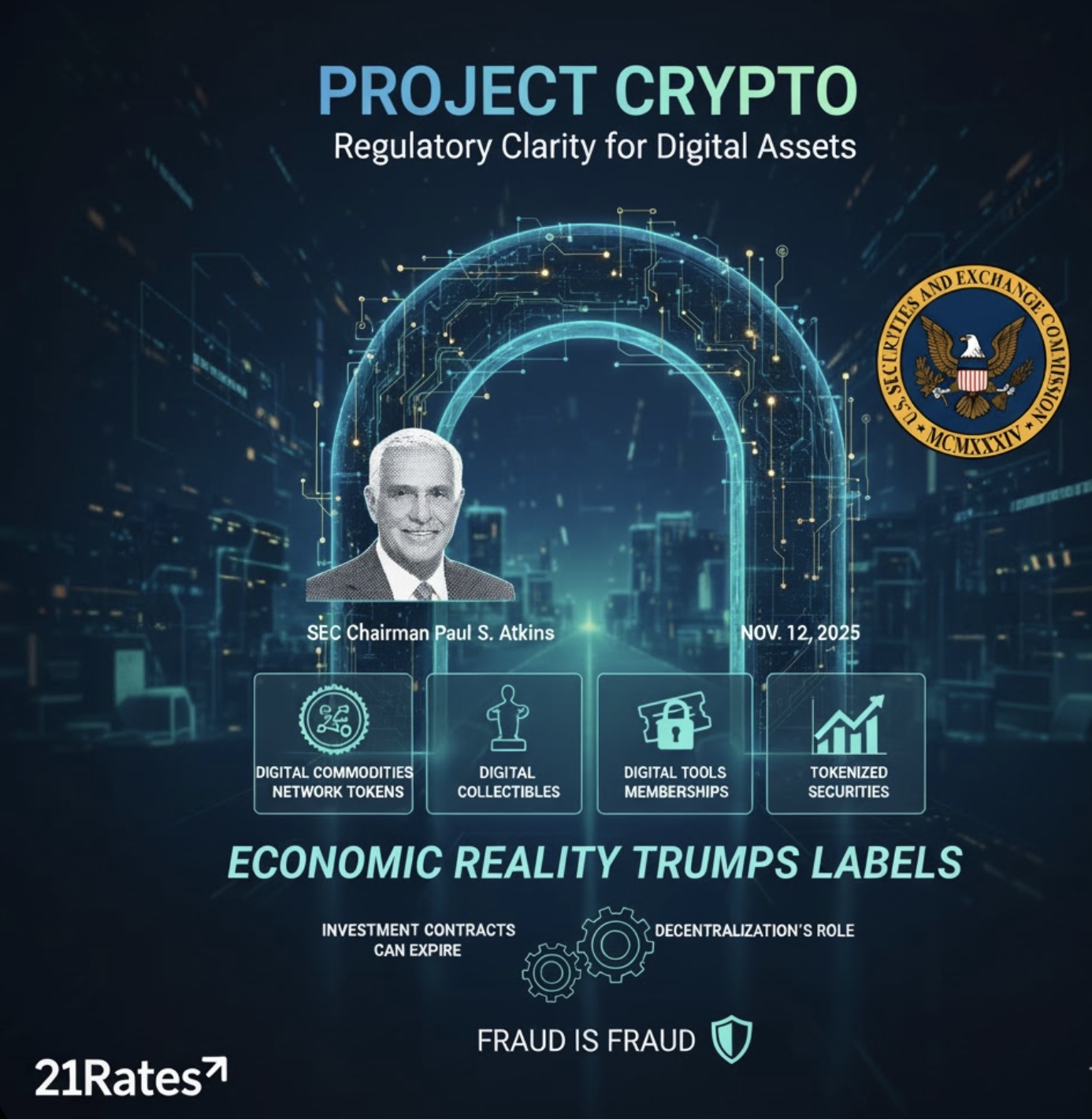
TL;DR SEC Chairman Paul Atkins unveiled "Project Crypto," a comprehensive initiative to provide regulatory clarity for digital assets by distinguishing between different token types and reinterpreting when investment contracts expire. This framework could end over a decade of uncertainty by allowing mature, decentralized networks to operate without SEC oversight while maintaining strong fraud enforcement.
In a landmark address at the Philadelphia Fed Fintech Conference, SEC Chairman Paul S. Atkins delivered a speech titled "The Securities and Exchange Commission's Approach to Digital Assets: Inside 'Project Crypto'" on November 12, 2025. This initiative signals a shift toward a more innovation-friendly regulatory framework, aiming to resolve over a decade of uncertainty in the crypto space.
Building on the foundational work of Commissioner Hester Peirce—often referred to as "Crypto Mom" for her advocacy of balanced regulation—the project seeks to foster American innovation while ensuring investor protection.
For the full text of Chairman Atkins's speech, visit the official SEC page.
Critiquing the Past and Embracing Economic Reality
Chairman Atkins critiqued the SEC's historical stance, rejecting the notion that a crypto token sold as part of an investment contract remains a security indefinitely. He described this view as "unsustainable" and inconsistent with legal precedents, arguing it has stifled innovation and pushed projects overseas.
Instead, the emphasis is on "economic reality trumps labels," where the true nature of a transaction, regardless of technology or terminology like "token" or "NFT," determines its regulatory status.
This approach aligns with ongoing industry discussions about regulatory clarity. For more on how past regulations have impacted Bitcoin's inclusion in retirement plans, check out our article on Why Bitcoin Has Been Kept Out of 401(k)s.
A New Token Taxonomy for Clarity
Atkins proposed a taxonomy for digital assets, asserting that most tokens trading today are not securities:
- Digital Commodities / Network Tokens: Not securities if tied to a functional, decentralized network where value doesn't rely on the "essential managerial efforts of others."
- Digital Collectibles: Generally not securities, as buyers aren't expecting profits from an issuer's efforts.
- Digital Tools: Exempt when serving practical purposes, such as memberships, tickets, or identity badges.
- Tokenized Securities: These remain securities, representing traditional assets like stocks or bonds on a blockchain.
This framework could open doors for broader adoption, similar to how energy companies are integrating Bitcoin into their treasuries. Explore related insights in our podcast episode Why Energy Companies Are Buying Bitcoin.
Reinterpreting the Howey Test
A core element of the speech was a fresh take on the Howey Test, which defines investment contracts:
Investment Contracts Can Expire
Atkins argued that these are temporary relationships based on issuer promises. Once fulfilled or decentralized, the contract ends.
The Citrus Grove Analogy
Drawing from the original Howey case involving citrus groves, he noted that the land itself was never a security—only the scheme was. Similarly, tokens aren't eternally securities.
Decentralization's Role
As networks mature and issuers step back, tokens should be able to trade freely without SEC oversight.
This perspective could influence how Bitcoin lenders operate, with a greater emphasis on proof of reserves. Watch our video discussion on Prioritizing Proof of Reserves: Table Stakes for Bitcoin Lenders for more on building trust in crypto finance.
Upcoming Regulatory Initiatives
Atkins directed SEC staff to develop:
- A Tailored Offering Regime: Streamlined exemptions for crypto capital raises, balancing innovation and investor safeguards.
- Rules for Trading on Alternative Platforms: Allowing tokens to migrate to CFTC- or state-regulated venues post-capital raise.
These steps echo recent executive actions on crypto integration. Read our breakdown of Trump's Executive Order on 401(k)s and Bitcoin for context on evolving policies.
Enforcement Stays Strong, Congress Urged to Act
While promoting clarity, Atkins stressed that "fraud is fraud," with continued enforcement against bad actors. He also endorsed congressional legislation for a comprehensive crypto market structure to prevent future regulatory overreach.
For insights into regulated prediction markets and fintech, see our guide to Trump Media & Technology Group (TMTG) 101.
Related Videos from 21Rates
To dive deeper into Bitcoin's regulatory landscape and financial strategies:
- Bitcoin Exposure is Not Bitcoin Ownership – Exploring true ownership vs. exposure in a regulated world.
- Do You Have a Bitcoin Yield Strategy? – Discussing yield in compliant crypto services.
'Project Crypto' represents a potential turning point for the U.S. crypto industry, promoting growth while maintaining safeguards. Stay tuned to 21Rates for updates on how this evolves Bitcoin treasuries, lending, and more.
More Articles About SEC
Understanding Financial Liquidity: What the Financial Liquidity Proxy Tells Us
The Financial Liquidity Proxy is a proprietary framework from Skylark Digital Assets for reading broader financial liquidity conditions as market-cycl...
October 1, 2026
The Acting Attorney General and the FBI Director Are Speaking at Bitcoin 2026. Read That Again.
Acting AG Todd Blanche and FBI Director Kash Patel headline Bitcoin 2026 with a session called Code is Free Speech: Ending the War on Bitcoin. The DOJ...
April 22, 2026
Morgan Stanley Just Launched the Cheapest Bitcoin ETF. That's Not the Real Story.
Morgan Stanley launched the cheapest spot Bitcoin ETF at 0.14%. It pulled $100M in week one. But the real story is 16,000 advisors managing $6.2 trill...
April 20, 2026
Podcast Conversations About SEC