
There are now more than a dozen spot Bitcoin ETFs trading on U.S. exchanges. They all hold actual bitcoin. They all track roughly the same benchmark. The performance gap between any two of them over the past year is basically a rounding error.
So why does picking one feel so complicated?
Because the marketing is loud and the differences are subtle. This guide cuts through that. We're using live data from the 21Rates ETF Tracker to compare the funds that actually matter - and we're skipping the ones that don't.
Data current as of May 2026. Source: 21Rates ETF Tracker and fund prospectuses.
Quick primer: what's a spot Bitcoin ETF?
A spot Bitcoin ETF holds real bitcoin in cold storage. You buy shares on a stock exchange and get exposure to bitcoin's price without needing a crypto exchange, wallet, or private keys. The fund issuer handles all of that.
This is different from futures-based products like BITO, which hold contracts instead of actual coins. Futures ETFs have roll costs that eat into your returns over time. For anything longer than a short-term trade, spot is the better product.
The SEC approved the first batch in January 2024. Combined assets across all U.S. spot Bitcoin ETFs have since crossed $100 billion.
Compare Bitcoin custody providers on 21Rates
Every spot Bitcoin ETF, ranked by fee
Here's the full lineup, cheapest to most expensive. Live AUM from the 21Rates ETF Tracker.
| ETF Name | Ticker | Fee | AUM | Custodian | Exchange |
|---|---|---|---|---|---|
| Morgan Stanley Bitcoin Trust | MSBT | 0.14% | New (April 2026) | Coinbase + BNY Mellon | NYSE Arca |
| Grayscale Bitcoin Mini Trust | BTC | 0.15% | $4.0B | Coinbase | NYSE Arca |
| Franklin Bitcoin ETF | EZBC | 0.19% | $477M | Coinbase | Cboe BZX |
| Bitwise Bitcoin ETF | BITB | 0.20% | $2.9B | Coinbase | NYSE Arca |
| VanEck Bitcoin ETF | HODL | 0.20%* | $1.3B | Gemini | Cboe BZX |
| ARK 21Shares Bitcoin ETF | ARKB | 0.21% | $2.8B | Coinbase | Cboe BZX |
| BlackRock iShares Bitcoin Trust | IBIT | 0.25% | $61.9B | Coinbase | NASDAQ |
| Fidelity Wise Origin Bitcoin Fund | FBTC | 0.25% | $14.2B | Fidelity Digital Assets | Cboe BZX |
| Invesco Galaxy Bitcoin ETF | BTCO | 0.25% | $516M | Coinbase | Cboe BZX |
| WisdomTree Bitcoin Fund | BTCW | 0.25% | $171M | Coinbase | Cboe BZX |
| CoinShares Valkyrie Bitcoin Fund | BRRR | 0.25% | $490M | Coinbase | NASDAQ |
| Grayscale Bitcoin Trust | GBTC | 1.50% | $11.5B | Coinbase | NYSE Arca |
*VanEck has waived the HODL expense ratio through July 2026 on the first $2.5B in assets.
See live prices and flows on the 21Rates ETF Tracker
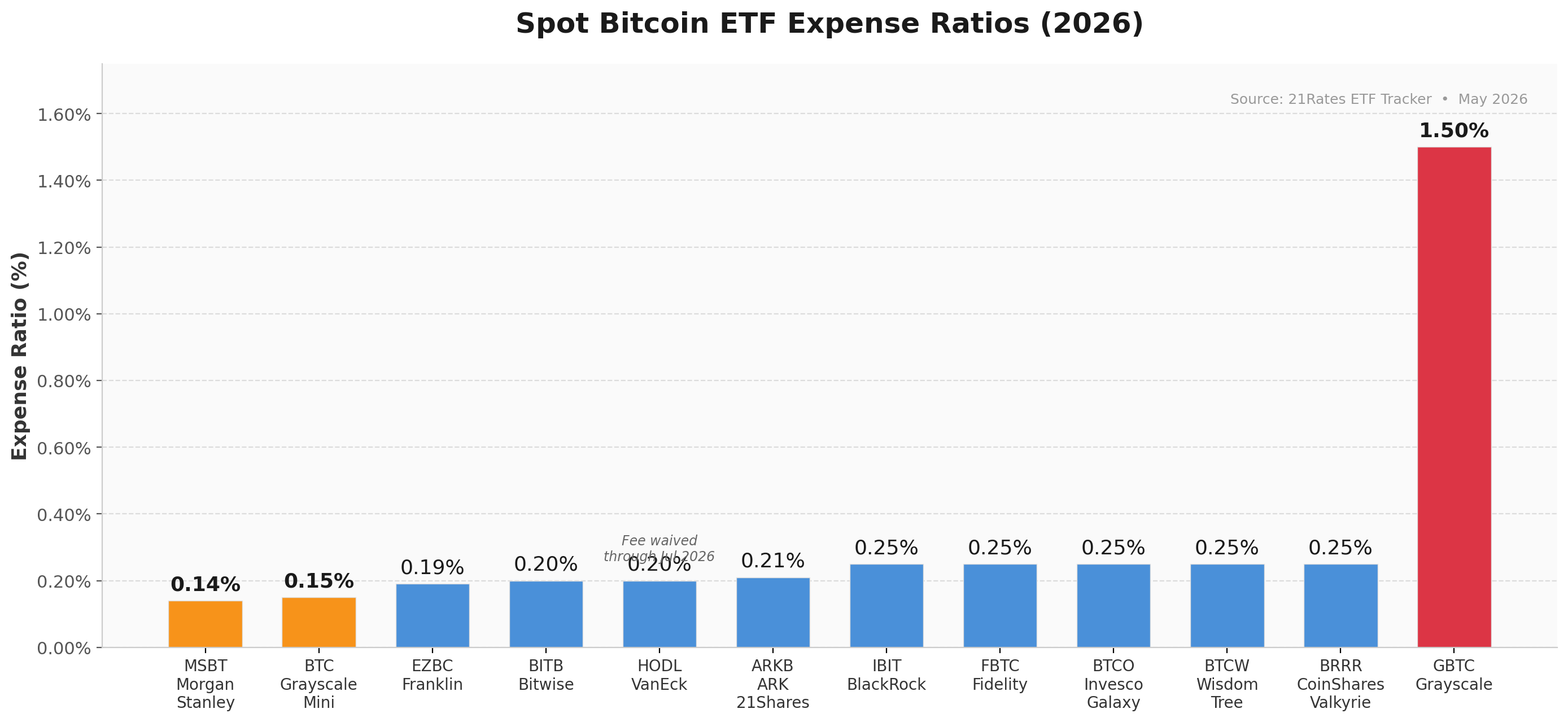 Expense ratios and AUM compared. Source: 21Rates ETF Tracker.
The six worth looking at
Half of these ETFs don't have enough liquidity or scale to matter. BTCW has $171 million in assets. BRRR has $490 million. EZBC is under $500 million. They're fine products, but the trading volume is thin and the spreads are wider. Unless you have a specific reason to use one of them, stick with the six below.
IBIT (BlackRock) - the default
$61.9 billion in assets. More than every other spot Bitcoin ETF combined. $8.4 billion in net inflows in Q1 2026 alone. The tightest bid-ask spreads in the category.
There's not much to debate here. If you want one Bitcoin ETF and don't want to think about it again, IBIT is the answer. BlackRock's name removes the career risk for advisors recommending it, the liquidity is best-in-class, and at 0.25% the fee isn't the cheapest but it's not a problem either. On a $50,000 position, 0.25% costs you $125 a year.
The only real knock on IBIT is that it uses Coinbase for custody - the same custodian as most of its competitors. If Coinbase Custody ever had a serious issue, IBIT would be in the same boat as ARKB, BITB, and several others.
FBTC (Fidelity) - the custody hedge
Same 0.25% fee as IBIT. $14.2 billion in assets. But here's the thing that actually matters: Fidelity custodies its own bitcoin. They built the infrastructure in-house through Fidelity Digital Assets, which they launched back in 2018.
Every other major ETF on this list uses Coinbase. FBTC doesn't. That makes it the obvious second position if you already own IBIT and want to spread your exposure across two separate custody systems. Is that paranoid? Maybe. But custody risk is the kind of thing that doesn't matter until it's the only thing that matters.
If you're on Fidelity's brokerage platform already, FBTC also trades commission-free, which is a nice bonus.
MSBT (Morgan Stanley) - cheapest fee, biggest distribution moat
0.14%. That's the lowest permanent expense ratio of any spot Bitcoin ETF. On a $1 million allocation, you're saving $1,100 a year versus IBIT.
But the fee isn't really the story. MSBT is the first spot Bitcoin ETF issued by a major U.S. bank - not an asset manager, a systemically important financial institution. Morgan Stanley's compliance and legal teams signed off on this. That signal matters for pension funds, endowments, and family offices in a way that another crypto-native launch doesn't.
The distribution angle is equally important. Morgan Stanley has roughly 16,000 advisors managing $9.3 trillion. When those advisors sit down with wealth management clients and the conversation turns to Bitcoin, the in-house product is going to be the default recommendation. That's a very different sales motion than a retail investor scrolling through ticker symbols on Schwab.
MSBT also uses dual custody - Coinbase plus BNY Mellon, the world's largest custodian bank. That's unique among spot ETFs.
The fund just launched in April 2026, so it doesn't have the track record or liquidity of IBIT yet. Give it time.
ARKB (ARK 21Shares) - the quiet fee saver
0.21%. Four basis points cheaper than IBIT and FBTC. That won't change your life on a $25,000 position, but on $100,000 held for 10 years it's roughly $400 in savings. Not nothing.
ARK Invest has been one of the loudest institutional Bitcoin bulls, which attracts a certain type of investor. If you follow Cathie Wood's macro thesis, ARKB gives you exposure at a slightly better price than the big two. There's not a lot more to say about it - it's a solid, competitively priced fund without a major differentiator beyond the fee.
BITB (Bitwise) - the one that gives back
0.20% fee, $2.9 billion in assets, and the only spot Bitcoin ETF that donates 10% of fund profits to Bitcoin open-source development. Core protocol work, Lightning, privacy tools, developer grants.
No other ETF does this. If you think supporting the actual infrastructure behind Bitcoin matters - and not just profiting from the price - BITB is the only way to do that through a fund.
Bitwise has also been in crypto since 2017, which is longer than most of the traditional asset managers on this list have been paying attention to the space.
HODL (VanEck) - free until July
VanEck waived the 0.20% fee through July 2026 on the first $2.5 billion in assets. Right now, HODL is literally free. Hard to beat that for a short-to-medium-term position.
The other angle: Gemini custody. HODL is the only fund here that doesn't use Coinbase or Fidelity. If you're building a three-custodian setup (IBIT for Coinbase, FBTC for Fidelity, HODL for Gemini), this is the third leg.
After the waiver expires, 0.20% is still competitive. You're not getting locked into a bad deal.
Don't buy GBTC
Grayscale's original Bitcoin Trust still holds $11.5 billion, but it charges 1.50% - roughly 7x to 10x more than everything else on this list. Most of that AUM is from long-term holders who'd face a big tax hit from selling. If that's you, run the math on whether the annual fee drag is worse than the capital gains bill.
But if you're making a new purchase, there's no reason to pick GBTC. Grayscale's Mini Trust (ticker: BTC) charges 0.15% and is a perfectly fine alternative if you want to stay in the Grayscale ecosystem.
How to actually decide
Stop trying to find the "best" Bitcoin ETF. They all hold bitcoin. They all track within fractions of a percent of each other. Here's what to think about instead:
How big is the position? Under $50K, the fee differences amount to tens of dollars a year. Just buy IBIT for the liquidity and move on. Over $500K, the compounding savings from MSBT's 0.14% start to add up.
Do you already own one? Your second fund should use a different custodian. IBIT is Coinbase. FBTC is Fidelity. HODL is Gemini. Spread it out.
Who's your broker? Morgan Stanley clients will get steered toward MSBT. Fidelity clients trade FBTC commission-free. Check what your platform charges before picking.
Do you care about Bitcoin beyond price? BITB is the only fund that supports open-source development. Everything else is purely a financial product.
Short-term trade? HODL is free through July. No reason to pay a fee you don't have to.
Compare all funds live on the 21Rates ETF Tracker
FAQ
Which Bitcoin ETF has the lowest fees? MSBT at 0.14%, permanently. HODL is free through a waiver that expires July 2026.
Are all these ETFs basically the same? In terms of what they hold, yes. In terms of fees, custodians, and liquidity, no. The differences are small but they compound over time, especially on larger positions.
Should I own more than one? If the position is large enough to justify it, yes. Owning IBIT and FBTC gives you two deep liquidity pools across two separate custody systems. That's better risk management than putting everything in one fund.
Spot ETF vs. futures ETF? Spot holds actual bitcoin. Futures holds contracts. Spot tracks price more accurately and doesn't have roll costs dragging returns. For anything buy-and-hold, spot wins.
Do Bitcoin ETFs pay dividends? No. Bitcoin doesn't produce income, so the ETFs don't distribute anything. Your return is entirely from price movement.
ETF or actual bitcoin? Different tools. ETFs live in brokerage and retirement accounts with clean tax reporting. Actual bitcoin gives you self-custody and sovereignty but requires managing your own keys. A lot of people do both.
Are these funds safe? The bitcoin is in regulated cold storage. The funds are SEC-registered and trade on major exchanges. The risk is bitcoin's volatility, not the ETF wrapper. More on custody: 21Rates custody comparison.
This article is for informational purposes only. It's not financial advice. Do your own research.
Data from the 21Rates ETF Tracker and fund prospectuses. Last updated May 2026.
21Rates is an independent Bitcoin financial services comparison platform. Compare ETFs, custody providers, lenders, and more.
Follow @21RatesHQ and @DailyStackHQ for daily Bitcoin news and analysis.