

The IRS isn't guessing anymore. Starting with the 2025 tax year (filed in 2026), centralized exchanges like Coinbase and Kraken are issuing Form 1099-DA directly to the IRS. They're reporting your gross proceeds, and starting in 2026, they'll report your cost basis too.
If your exchange data doesn't match what the IRS has on file, you're going to hear about it. The days of "I'll figure it out later" are done.
Crypto tax software pulls your transaction history from exchanges, wallets, and DeFi protocols, calculates your gains and losses, and spits out the forms you need to file. The good ones handle staking rewards, wrapped tokens, LP positions, and NFT sales without breaking. The bad ones choke on anything beyond a simple Coinbase buy-and-hold.
We compared eight platforms. Here's what's actually worth your money.
Data current as of May 2026. For the full breakdown of what's taxable, see the 21Rates Bitcoin Taxes Guide.
The 1099-DA Changed Everything
Before we get into software - here's why 2026 is different from every year before it.
The IRS introduced Form 1099-DA for the 2025 tax year. Your Coinbase, Kraken, Gemini - they now report your digital asset sale proceeds straight to the IRS. Think of it as the crypto version of what stock brokers have done with 1099-B forever.
Two things matter here. For 2025 transactions, brokers report what you sold but not what you paid. The IRS knows your proceeds. You're on the hook for proving cost basis. Can't prove it? The IRS can assume you paid zero - and you owe taxes on the full sale amount.
Starting January 2026, brokers also report cost basis. And the IRS killed the "universal method" that let you pool the same asset across wallets. It's now per-wallet, per-account tracking. If you've been moving Bitcoin between exchanges and cold storage for years, your spreadsheet probably can't handle this anymore.
That's the problem crypto tax software solves. More on how these rules work in Chapter 2 of the Bitcoin Taxes Guide.
Every Platform, Ranked by Price
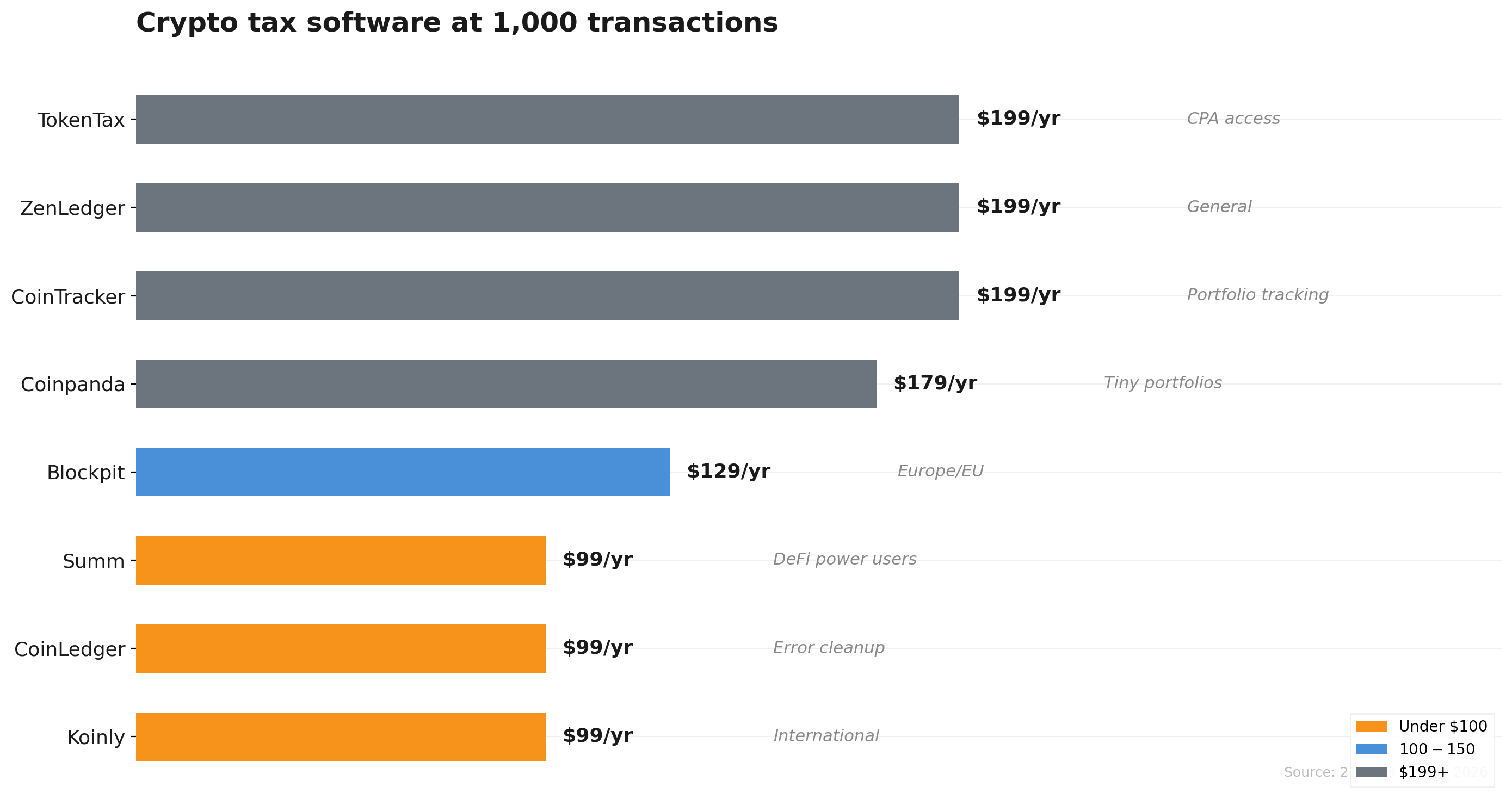
Free tiers are for previewing your liability. None of them let you download actual tax reports without paying.
| Platform | Free Tier | 100 Txns | 1,000 Txns | 3,000+ Txns | DeFi/NFT Support | TurboTax Integration |
|---|---|---|---|---|---|---|
| Coinpanda | 25 txns free | $79 | $179 | $249 | Yes | Yes |
| CoinLedger | Preview only | $49 | $99 | $199 | Yes | Yes |
| Koinly | Preview only | $49 | $99 | $179 | Yes | Yes |
| CoinTracker | Preview only | $59 | $199 | $599 | Yes | Yes |
| Summ (CryptoTaxCalculator) | Preview only | ~$49 | ~$99 | ~$199 | Best-in-class | Yes |
| Blockpit | Preview only | $49 | $129 | $199 | Yes | No |
| ZenLedger | Preview only | $49 | $199 | $399 | Yes | Yes |
| TokenTax | None | $65 | $199 | $1,999 | Yes | No |
Pricing in USD per tax year. Some platforms charge per calendar year instead. Confirm current pricing on the provider's site.
The Short Answer
If you want a recommendation without reading 2,000 words: use Koinly if you file outside the US or have a clean portfolio. Use CoinLedger if your transaction history is a mess and you file with TurboTax. Use Summ if you're deep in DeFi. Everything else is a niche pick.
Now here's why.
Koinly
$49-$279 per tax year. Supports 20+ countries. 800+ exchange and wallet integrations.
Koinly is the default recommendation for most people, and the reason is simple: it works in more countries than anything else. Filing in Canada, Australia, the UK, or Germany? Koinly generates country-specific forms. Most competitors give you a US-centric report and wish you luck.
The free tier lets you import up to 10,000 transactions and preview your tax liability before paying. That's a real try-before-you-buy, not a teaser.
The weak spot is transaction categorization. DeFi transactions - wrapping, bridging, LP entries and exits - sometimes get mislabeled, and fixing them one by one is tedious. If your portfolio is mostly exchange buys and sells, this won't matter. If you're farming yield across five chains, you'll feel it.
CoinLedger
$49-$199 per tax year. Unlimited tier at $499.
The reason to pick CoinLedger over Koinly is error reconciliation. Import transactions from five exchanges and three wallets and things will break. Transfers get tagged as sales. Internal movements create phantom gains. Cost basis gets scrambled across platforms.
Every tool has this problem. CoinLedger just handles the cleanup better. Its reconciliation engine flags suspicious transactions and lets you fix them without nuking your entire import. If you've been in crypto for more than a couple years and your history is scattered across dead exchanges and old wallets, this is the one.
TurboTax integration is also the smoothest in the category. If that's how you file, CoinLedger is the path of least resistance.
Summ
Formerly CryptoTaxCalculator. Paid plans from ~$49. 3,500+ transaction sources.
If you're yield farming, providing liquidity, bridging between chains, and using DEX aggregators, Summ is the only tool that won't make you want to quit. It was built for the transactions that break other platforms - wrapped tokens, synthetic assets, multi-step swaps through aggregators, perpetual futures.
Koinly and CoinTracker struggle with this stuff. They'll import the transactions, but you'll spend hours manually reclassifying them. Summ gets it right more often out of the box.
The rebrand from CryptoTaxCalculator to Summ happened in late 2025 and confused people. Same product, shorter name. The interface is also less polished than the competition - it's a power tool, not a consumer app. If you just buy BTC on Coinbase and hold, you don't need this. If you know what an AMM is, you probably do.
CoinTracker
$59-$599 per year.
CoinTracker started as a portfolio tracker, and it shows. The real-time portfolio dashboards are the best in the category. If you want to monitor your crypto holdings year-round and generate tax reports from the same tool, this is the cleanest experience.
The tax-loss harvesting feature on Prime plans and above is also worth calling out - it identifies unrealized losses you could harvest to offset gains before year-end. If you're actively managing your tax position, that pays for itself.
The problem is price. At 1,000 transactions, CoinTracker charges $199 where CoinLedger and Koinly charge $99. Double the cost for weaker error reconciliation and roughly equivalent DeFi support. Unless you really value the portfolio tracking, it's hard to justify.
TokenTax
$65-$3,499 per year. CPA consultations at VIP tier. Full-service filing from ~$999.
TokenTax is a different animal. It's half software, half accounting firm. At the VIP level ($3,499), you get CPA consultations and can hand off your entire filing.
That sounds expensive because it is. But if you have multiple entities, mining operations, international transactions, and serious DeFi exposure, $3,500 for software plus CPA support can be cheaper than hiring a crypto-specialized accountant independently. Those people bill $400-$600/hour.
For everyone else - meaning anyone with under 1,000 transactions and a single tax jurisdiction - this is massive overkill. Use Koinly or CoinLedger and save $3,400.
Blockpit
$49-$599 per tax year. Pre-filled forms for 10+ European countries.
Blockpit exists for European filers. It generates pre-filled tax forms for Germany, Austria, France, Spain, Switzerland, and others. Where Koinly supports these countries, Blockpit goes deeper on the compliance details.
The "Tax Optimizer" is the standout feature - it runs your transactions through different cost basis methods (FIFO, LIFO, etc.) and tells you which one results in the lowest liability in your jurisdiction. In Germany, crypto held over one year is tax-free, and the optimizer accounts for that automatically.
No TurboTax integration, so US-only filers should look elsewhere. But EU users should have this on their shortlist next to Koinly.
How to Actually Pick
Forget feature matrices. Three things matter.
First, how messy is your history? Multiple exchanges, wallet transfers, DeFi activity, years of accumulated transactions? CoinLedger for the cleanup tools, or Summ if the mess is DeFi-specific.
Second, where do you file? US with TurboTax - CoinLedger, Koinly, or CoinTracker. Europe - Blockpit or Koinly. Multiple countries - Koinly.
Third, how many transactions? Under 1,000, everything costs $49-$99 and works roughly the same. Over 3,000 is where pricing diverges hard - CoinLedger's unlimited at $499 beats CoinTracker's $599 for 10,000 transactions.
Don't overthink the free tiers. They all let you preview your liability. The differences show up when you hit download.
Full walkthrough of taxable events and filing mechanics in the 21Rates Bitcoin Taxes Guide - especially Chapter 3 on capital gains and Chapter 5 on DeFi.
FAQ
Do I still need tax software if my exchange sends a 1099-DA?
Yes. The 1099-DA reports what you sold. It doesn't calculate gains and losses, doesn't account for other exchanges or wallets, and doesn't generate Form 8949. You need software or an accountant for the actual math.
What's the cheapest option?
CoinLedger and Koinly at $49 for under 100 transactions. Coinpanda gives you 25 free transactions with full report access if your portfolio is tiny. At high volumes, CoinLedger's $499 unlimited plan is the best deal.
Can these handle DeFi?
To varying degrees. Summ is the clear leader for complex DeFi - wrapped tokens, synthetic assets, multi-step aggregator swaps. The rest handle basic DeFi fine but require manual cleanup on complicated transactions.
What if I don't file?
The IRS gets your 1099-DA data directly now. Mismatch = CP2000 notice. Penalties are 20% of the underpayment plus interest. Intentional non-reporting is fraud territory. More in Chapter 8 of the Bitcoin Taxes Guide.
Software or CPA?
If you'd be comfortable doing your stock taxes yourself, crypto tax software is fine - $49 to $199. If you have multiple entities, mining income, international obligations, or your DeFi activity gives your accountant nightmares, look at TokenTax's full-service tier or hire a crypto-specialized CPA directly.
This article is for informational purposes only and does not constitute tax advice. Consult a qualified tax professional for guidance on your specific situation.
Last updated May 2026.
About 21Rates: 21Rates is an independent Bitcoin financial services comparison platform. Compare Bitcoin ETFs, custody providers, lenders, and more with real-time data and unbiased research.
For the latest Bitcoin news and analysis, follow @21RatesHQ and @DailyStackHQ.