- Bitcoin
- Bitcoin Rewards
- Credit Cards
- Custody
- Personal Finance
Short answer
If you pay your balance in full every month, a bitcoin rewards credit card can be worth it. You avoid interest, and every purchase converts into bitcoin you would otherwise not have accumulated. It is worth it only if three things are true at once. You must reliably pay the full statement balance by the due date. You must want the rewards in bitcoin rather than cash back. And you must be comfortable with rewards sitting in a provider's custodial account under terms the provider can change.
If any of those three is not true, the answer changes. Carrying a balance on a crypto rewards card erases the value of the rewards quickly, because the purchase APR is a variable rate and interest compounds in dollars while rewards arrive in a volatile asset. And if you do not want platform custody, a rewards card is the wrong tool; you would be better off buying bitcoin directly and holding it however you choose.
Two structures, not one product
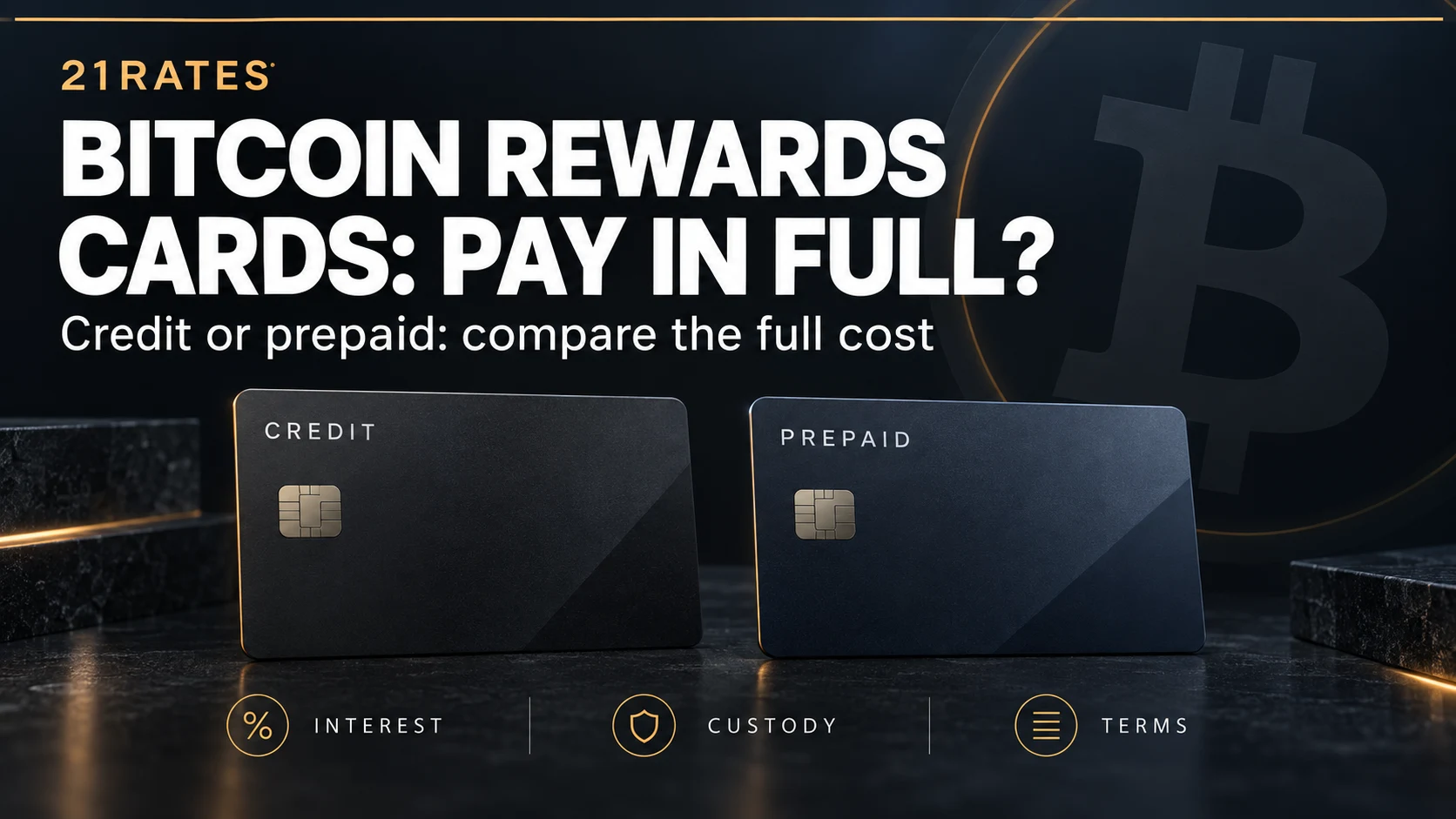
The market has two different card structures, and the difference matters more than the advertised rewards rate.
Credit card structure: Gemini. WebBank issues the Gemini Mastercard Credit Card. Gemini advertises the card with no annual fee and no foreign transaction fees, and up to 4% crypto back in stated spending categories, with category limits and eligibility applying. Rewards can be selected in bitcoin or other eligible crypto assets and are deposited to your Gemini account. The cardholder agreement states a variable purchase APR and says no interest is charged on purchases when the entire balance is paid by the payment due date. This is the structure that matches your question: paying in full is exactly the condition under which the APR never applies.
Prepaid debit structure: Fold. Fold describes its card as a prepaid debit card and spending-account product, funded in dollars before spending. There is no revolving balance, no APR, and no due date, because you are spending money you already loaded. Eligible purchase rewards are deposited to the Fold balance. Fold identifies bank issuers for its spending account and prepaid debit card, states that bitcoin custody and exchange services are provided by BitGo, and says bitcoin and rewards are not FDIC or SIPC insured.
A prepaid card must be funded before spending. That is a real operational difference: you move dollars onto the platform first, then spend. Some readers prefer that discipline. Others find it adds a step a credit card does not have.
Full-cost comparison framework
Do not compare cards on the rewards rate alone. Compare the full account structure across these five factors.
| Factor | What to check | Why it changes the answer |
|---|---|---|
| Interest and fees | Annual fee, foreign transaction fees, cash-advance, late-payment, and returned-payment fees | The Gemini agreement discloses cash-advance, late-payment, and returned-payment fees. A single late payment can cost more than a year of rewards. |
| Rewards structure | Rate per category, caps, eligible assets, where rewards land | The advertised rate does not apply to every purchase. Gemini's up to 4% applies to stated categories with limits. |
| Program flexibility | Can terms, rates, eligible assets, or fees change? | Gemini says rewards terms, percentages, eligible assets, and program fees may be changed or limited. Fold describes pending periods and reversals for rewards tied to refunded, disputed, reversed, or reduced transactions. |
| Custody and withdrawal | Who holds the bitcoin, and what must you complete to withdraw? | A Gemini account and eligible Gemini card are required for the program, and Gemini says required identification must be complete before a customer withdraws rewards. Fold's bitcoin custody is via BitGo, per Fold's disclosures. |
| Insurance coverage | What is insured and what is not | Fold says FDIC insurance applies only to eligible deposit balances and does not cover bitcoin, rewards, or other non-deposit products. Do not assume rewards balances carry deposit protection. |
Also check the spending restrictions. The Gemini cardholder agreement says the card may not be used to purchase crypto or fund a Gemini account directly or indirectly. That is a common restriction and it means the card is for everyday spending, not for moving credit into bitcoin.
What paying in full actually buys you
The cardholder agreement for the Gemini card states that no interest is charged on purchases when the entire balance is paid by the payment due date. That is the whole economic case for a rewards credit card in your situation: you get the rewards without the interest cost. The trade-offs that remain are custody, program change risk, and reward reversals on returns or disputes. Those do not disappear because you pay in full.
With the Fold prepaid structure, the interest question is moot. The trade-offs are the funding step, exchange-rate margins, and custody. Fold says exchange rates may include a margin or spread charged by its exchange-services provider, Fold, or both. Check how rewards conversion is priced before assuming the headline rate is what you receive.
What to do next
- Confirm your own payment behavior over the last 12 months. If you have carried a balance in any of those months, a rewards credit card is not the right tool yet.
- Read the current cardholder agreement and rewards program terms, not the marketing page. Both Gemini and Fold disclose the conditions that matter: category limits, program changes, reversals, and withdrawal requirements.
- Decide how you feel about custodial rewards. Rewards arrive on the provider's platform in both structures covered here. If you want rewards moved off-platform, check the withdrawal process and identification requirements before you apply.
- Compare against your best cash-back alternative. A bitcoin rewards card is worth it relative to the cash-back card you would otherwise use, not in a vacuum.
For provider-by-provider detail, see our comparisons of card issuers and how each structures rewards and custody, our custody guide for what holding rewards on a platform means, and our exchanges coverage if you would rather buy directly and skip the card entirely.
Frequently asked questions
Do I pay interest on a bitcoin rewards credit card if I pay in full?
No, under the terms Gemini discloses. The cardholder agreement states no interest is charged on purchases when the entire balance is paid by the payment due date. Late payments and cash advances are a different matter and carry disclosed fees.
Is a prepaid bitcoin debit card the same as a rewards credit card?
No. Fold's card is a prepaid debit product funded in dollars before spending, so there is no borrowing, no APR, and no payment due date. A credit card lets you spend borrowed money and requires full payment by the due date to avoid interest.
Are bitcoin rewards FDIC insured?
No. Fold says FDIC insurance applies only to eligible deposit balances and does not cover bitcoin, rewards, or other non-deposit products. Fold also states bitcoin and rewards are not FDIC or SIPC insured.
Can I move my rewards off the platform?
Withdrawal is possible but conditional. Gemini says required identification must be complete before a customer withdraws rewards, and a Gemini account is required for the program. Read the withdrawal process before you apply, not after rewards accumulate.
Can the rewards terms change after I get the card?
Yes. Gemini says rewards terms, percentages, eligible assets, and program fees may be changed or limited. Fold describes pending periods and reversals for rewards connected to refunded, disputed, or reversed transactions. Treat the advertised rate as current, not permanent.
More Articles About Bitcoin
Best Bitcoin Exchanges and Apps in Q4 2026
Where to buy bitcoin in the US in Q4 2026: one-time fees, free recurring buys, spreads and free withdrawals at 9 exchanges and apps....
October 10, 2026
Ledger Pauses Reseller CryptoBilis After Reports of $86 Million in Drained Wallets
Ledger asked reseller CryptoBilis to pause sales while it probes lost funds. An analyst puts drains at $86M+, including 211 BTC. What's known so far....
October 9, 2026
Best Bitcoin Lending Platforms in Q4 2026
Ledn, Arch, Strike, Figure, SALT and more compared on rate, LTV, minimum loan and how your bitcoin is held. Rates checked Oct 8, 2026....
October 9, 2026
Podcast Conversations About Bitcoin


