
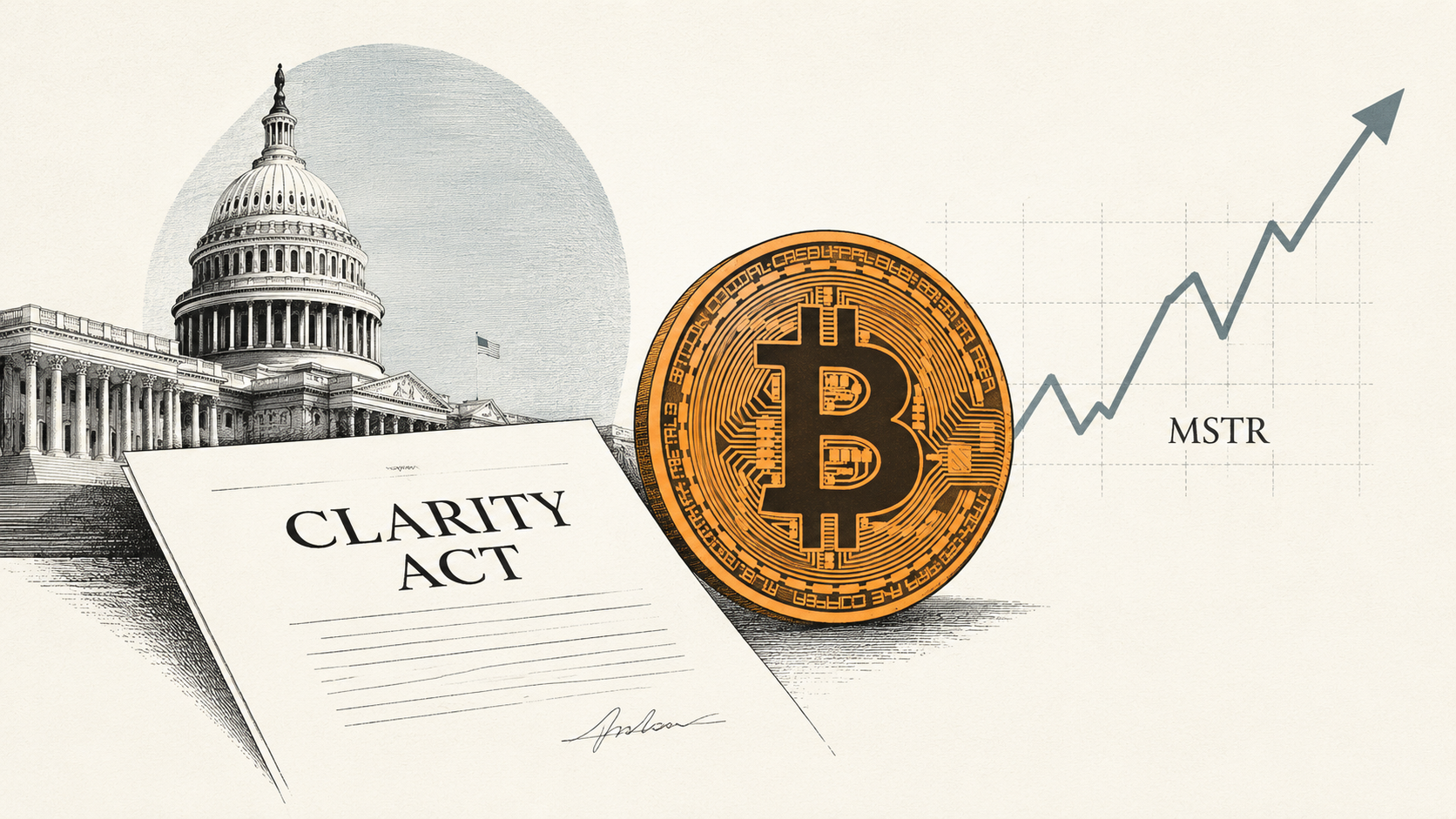
TL;DR - The Clarity Act would give Bitcoin permanent commodity status and allow banks to offer full custody/lending services, but it faces a Thursday vote that could kill it over ethics concerns about Trump family crypto profits. If it passes with bipartisan support, expect a similar run to when MSTR doubled during the GENIUS Act passage.
Article for Dummies
What is this bill? The Clarity Act is 309 pages of legislation that would give Bitcoin and crypto the clearest legal protections they've ever had in the United States. The Senate Banking Committee votes on it Thursday.
What does it do for me? If you hold Bitcoin, it can never be reclassified as a security. Your bank can custody it and lend against it like any other asset. Self-custody is legally protected. Staking is legally protected. The regulators who have been fighting over jurisdiction for years get permanent lanes.
Why might it fail? Democrats want ethics rules preventing government officials from profiting off crypto. The Trump family has made over $1.4 billion in crypto while the White House shapes policy. Republicans stripped the ethics language because the White House threatened to veto any bill that singles out the President. Over 100 amendments have been filed, including one that would ban crypto as legal tender entirely.
What does this mean for prices? When the GENIUS Act (a smaller, stablecoin-only bill) passed through the same process last year, MSTR doubled and Bitcoin hit $123K over four months. The Clarity Act is significantly broader in scope. A strong bipartisan vote Thursday could start a similar run. A weak vote or delay means the market reprices for a longer timeline.
What should I do? Watch the vote Thursday at 10:30 AM Eastern. If Senator Gallego (AZ) votes yes, the bill has real momentum. If he holds out, expect a longer wait. Call your senator before Thursday if you want this to pass. Phone numbers are at the bottom of this article.
One of the 100+ amendments filed for Thursday's Clarity Act markup would ban cryptocurrency as legal tender in the United States. Not regulate it, not restrict it. Ban it outright. Senator Jack Reed dropped that language into a bill that simultaneously offers Bitcoin the most favorable legal framework any government on earth has ever proposed. Both of those things are real, and both get resolved Thursday morning at 10:30 AM when the Senate Banking Committee votes.
MSTR holders already know what a legislative catalyst looks like. The GENIUS Act cleared committee in March 2025, and MSTR ground from the low $200s to $457.22 over four months while Bitcoin topped $123,000. That was a stablecoin bill. The Clarity Act permanently classifies Bitcoin as a commodity under federal statute and opens bank-level custody and lending infrastructure to every financial institution in the country. MSTR sits around $186 today with a Wall Street consensus target of $380, and if Thursday produces a bipartisan vote, the same four-month countdown starts again. UBS built a $1.12 billion position during the last window like this. A party-line vote or another delay, and Galaxy warns the whole thing could stall until 2027.
So the question is whether Thursday's vote carries the bipartisan margin that moves institutional capital, or whether 309 pages of the most consequential Bitcoin legislation ever written dies over a fight about one family's business dealings.
What Changes if This Passes
The headlines are going to tell you this bill "creates regulatory clarity." That framing undersells what's actually in the text by a factor of about ten.
Start with the provision that matters most to anyone holding BTC. Any token backing a spot ETP as of January 1, 2026 receives permanent commodity classification under federal statute. Not agency guidance that expires when a new SEC chair gets appointed. Not a no-action letter that some future commissioner can revoke over a long weekend. Federal law. The single biggest regulatory overhang suppressing institutional adoption for the past decade gets eliminated with one signature. Every compliance officer at every fund who has been writing "regulatory uncertainty" into their risk memos finally loses that excuse.
Then there's what happens at banks. Section 401 lets every national bank, state bank, and credit union offer crypto custody, lending against digital assets, payment processing, and market making as normal banking activity. (See which brokerages already offer Bitcoin). No applications, no special permissions, no months-long approval process where regulators slow-walk your filing until you give up. If your bank wants to hold your Bitcoin and lend against it, this bill says go ahead. For anyone running a Bitcoin treasury strategy, cheaper institutional leverage from real bank-level prime brokerage changes the entire cost structure overnight.
Staking gets full federal protection across every form: self-custody, liquid staking, custodial staking through exchanges. All classified as non-securities activity. The SEC and CFTC stop their jurisdictional knife fight because the bill draws a permanent line between them. Digital commodities go to the CFTC, investment contract assets stay with the SEC. (Read our CFTC analysis). Self-custody is enshrined in law through the Keep Your Coins Act language. DeFi developers get explicit protection for peer-to-peer transfers.
Every single regulatory ask the Bitcoin and crypto industry has made for five years is sitting in these 309 pages. And the whole package might crater on Thursday because of a provision that isn't even in the bill.
The Ethics Fight That Could Kill It
The September 2025 draft had conflict-of-interest language restricting government officials from profiting off crypto. Twelve Senate Democrats demanded it. By January 2026, that language was watered down. In Tuesday's final text, it's gone entirely. Republican leadership stripped it because the White House made something clear: any provision singling out the President triggers a veto.
White House crypto adviser Patrick Witt said they'd accept ethics rules that apply "across the board, from the president all the way down to the brand new intern on Capitol Hill." Anything targeting a specific officeholder gets killed on arrival.
Democrats are not buying that framing. Warren released a statement calling the bill a vehicle for corruption and cited $1.4 billion in Trump family crypto gains, including World Liberty Financial and the TRUMP memecoin. She filed over 40 amendments for Thursday's markup. Reed filed the legal tender ban. Schiff wants provisions targeting the Trump family's ventures by name.
Gillibrand, whose name is literally on Title I of the bill, stood on stage at Consensus Miami and said the ethics provision will be part of this bill or it will not go forward, because they cannot let greed and corruption in Washington tear this industry down.
Here's what makes this genuinely difficult. Gillibrand's concern is legitimate. The Trump family has cleared over a billion dollars in crypto while the White House actively shapes crypto policy. You don't have to be a partisan to look at those numbers and feel uncomfortable about the arrangement. The AFT, representing 1.8 million teachers and public employees, came out against the bill in the last 48 hours, giving every wavering Democrat cover to vote no without looking anti-innovation. Gillibrand's own polling shows 73% of voters support crypto ethics restrictions.
But the result is that the most comprehensive pro-Bitcoin legislation ever written is hostage to a fight about one family's profits. Every day this bill sits in limbo, exchanges operate without clear rules, institutions keep capital parked on the sidelines, and Bitcoin holders absorb a regulatory risk premium that these 309 pages were specifically designed to eliminate. Democrats have the political cover, the polling, and the leverage. Whether they use that leverage to improve the bill or to bury it is the only question that matters heading into Thursday.
The Vote Math
Chairman Scott holds 13 Republicans and can technically pass this on a party-line vote without a single Democrat. But 13-11 and 16-8 send wildly different signals to the full Senate where 60 votes are needed to get anything through. Thursday's margin tells you more about this bill's future than Thursday's outcome.
Angela Alsobrooks co-wrote the Section 404 stablecoin compromise and is the closest thing to a lock on the Democratic side. Ruben Gallego runs the Digital Assets Subcommittee and was originally counted as a reliable yes, but he went public last week demanding bipartisan agreement on ethics before he'll move forward. That shift from reliable to conditional tightens the math in a way that changes the entire calculus for leadership. Warner, Cortez Masto, Kim, and Warnock all voted yes on the GENIUS Act and all want ethics language before committing again. Lisa Blunt Rochester voted against the GENIUS Act and represents the hardest swing vote on the committee. Reed, Warren, Smith, and Van Hollen are firm no votes who aren't moving.
Schumer attended a Democratic members' meeting and reportedly pushed members to find a path to yes while stressing that ethics negotiations need to go further before Thursday. That tells you Democratic leadership wants this bill alive. They want the bipartisan margin that gives the full Senate a reason to take it seriously. They just need a face-saving ethics compromise that gives their caucus cover to vote for a bill the White House won't veto.
Watch Gallego Thursday morning. If he crosses, the bill has real momentum heading into the full Senate and you're looking at a four-month timeline to law based on everything the GENIUS Act taught us last year. If he holds out, the timeline extends and the market reprices accordingly. You'll know which world you're living in by lunchtime.
Bottom Line
309 pages containing permanent commodity status for Bitcoin, bank-level custody and lending, self-custody rights, DeFi protections, staking protections, and jurisdictional clarity. Over 100 amendments standing between all of it and the Senate floor. Thursday morning at 10:30 AM Eastern decides whether this bill leaves committee with the kind of bipartisan signal that pulls institutional capital off the sidelines, or whether the most important Bitcoin legislation ever drafted stalls out over ethics language nobody could agree on.
Make Your Voice Heard Before Thursday
If this bill matters to you, the people listed below have staff who are counting constituent calls right now. Wednesday is the last day to reach them before the markup. Keep the call short and specific: your name, your state, and that you support the Clarity Act passing committee with bipartisan support. Staff tally these calls, and volume matters more than eloquence.
Sen. Ruben Gallego (AZ) - the swing vote that matters most right now. Washington: (202) 224-4521 | Phoenix: (480) 697-3600 gallego.senate.gov/contact
Sen. Angela Alsobrooks (MD) - co-author of the stablecoin compromise. Washington: (202) 224-4524 | Bowie: (301) 860-0414 alsobrooks.senate.gov/contact
Sen. Mark Warner (VA) - conditional yes, wants stronger ethics language. Washington: (202) 224-2023 warner.senate.gov/contact
Sen. Catherine Cortez Masto (NV) - rated "strongly supportive" by Stand With Crypto. Washington: (202) 224-3542 cortezmasto.senate.gov/contact
Sen. Andy Kim (NJ) - conditional yes, rated neutral by Stand With Crypto. Washington: (202) 224-3224 kim.senate.gov/contact
Sen. Raphael Warnock (GA) - voted yes on the GENIUS Act, still undecided here. Washington: (202) 224-3643 warnock.senate.gov/contact
Sen. Lisa Blunt Rochester (DE) - the hardest swing vote on the committee. Washington: (202) 224-2441 bluntrochester.senate.gov/contact
Senate switchboard connects you to any office: (202) 224-3121.
21Rates.com provides Bitcoin financial product research and comparison tools. This article is for informational purposes only and does not constitute financial advice.


