
Minnesota Just Gave Your Local Bank Permission to Hold Your Bitcoin
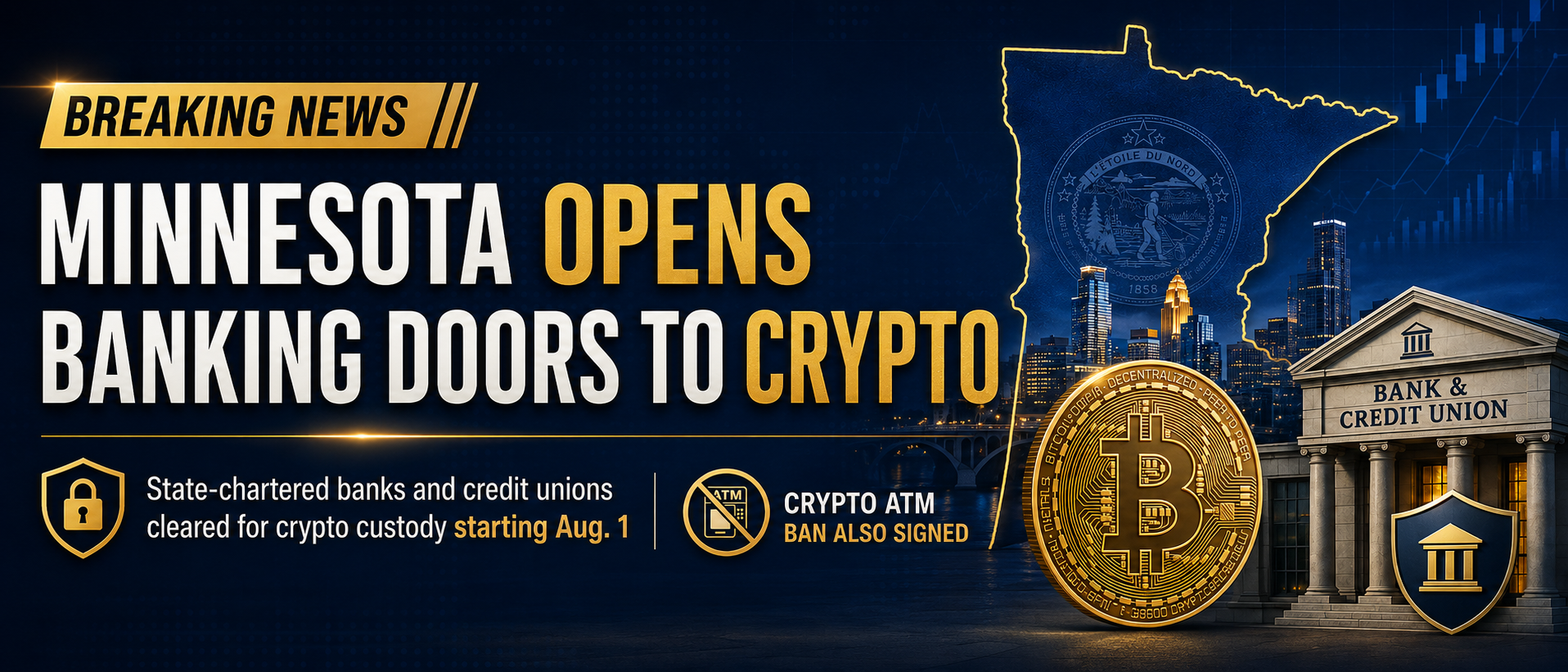
You probably weren't watching the Minnesota state legislature last week, and neither was most of crypto Twitter. Governor Tim Walz quietly signed HF 3709 into law on May 15, making Minnesota the first state in the Midwest to give banks and credit unions the legal authority to custody Bitcoin and other digital assets for their customers. The law takes effect August 1.
The numbers behind the bill tell a story on their own. The House passed it 130 to 4. The Senate cleared it 51 to 16. The House then concurred with Senate amendments 119 to 6. In a political environment where people can barely agree on lunch, crypto custody sailed through with almost zero opposition. Representative Bernie Perryman, one of the bill's sponsors, framed it simply: Minnesota institutions need to keep pace with what their customers already want.
And those customers are already out there. St. Cloud Financial Credit Union told lawmakers that roughly 20% of its members already own crypto but have no trusted, regulated local option for storing it. They're using offshore exchanges, out-of-state platforms, or self-custodying with varying degrees of competence. One of the bill's authors, Representative Steve Elkins, put it bluntly when he said he personally knows people who have lost access to their crypto because they misplaced a password or account ID. The law is designed to solve exactly that problem through institutions people already trust with their checking accounts.
What the Law Actually Allows
Minnesota's 240 state-chartered banks and 82 credit unions can now offer virtual currency custody services starting August 1, 2026. State-chartered banks can provide custody in either a fiduciary or nonfiduciary capacity, while credit unions are limited to custodial nonfiduciary roles. Institutions can also bring in qualified third-party subcustodians to handle the actual storage infrastructure, though they remain fully responsible for oversight and compliance.
The compliance requirements are serious. Before launching any custody services, institutions must have written policies covering cybersecurity, internal controls, business continuity, and risk management. They also need to notify the Minnesota Commissioner of Commerce at least 60 days before going live, complete with documentation of their risk frameworks. Customer assets must stay legally and operationally segregated from the institution's own holdings at all times, and can never be treated as the bank's property.
For context on the scale here, U.S. Bancorp, the seventh largest bank in America by total assets, is headquartered in Minneapolis. Minnesota's banking sector collectively holds around $128 billion in assets. Even if only a fraction of those institutions move on custody, the aggregate capacity entering the market is significant.
The Other Side of August 1
Minnesota's approach to crypto regulation has a clear philosophy: bring custody into the banking system, push unregulated retail access points out. On the same day custody services go live, a separate law banning all crypto ATMs and kiosks across the state also takes effect. Governor Walz signed that bill on May 5 after lawmakers tied the machines to a pattern of consumer fraud targeting older residents. No new kiosks can be installed after August 1, and every existing machine must be removed by December 31.
The contrast is intentional and worth paying attention to. Minnesota is not broadly anti-crypto. The state just decided that your credit union is a better gateway to digital assets than a kiosk at a gas station, and they structured the regulatory calendar to make that point explicitly.
Why This Matters Beyond Minnesota
At least 40 states and Puerto Rico had digital asset bills introduced or pending during the 2026 legislative session, covering everything from custody to money transmission to consumer protection. Wyoming pioneered special-purpose depository institution charters years ago. Nebraska built a digital asset banking framework. Virginia and New York already have custody pathways in place. Minnesota's version is narrower than some of those, extending authority to existing institutions rather than creating entirely new charter types, but the bipartisan margin and the Midwest geography make it significant.
While Congress continues working through a national framework, states are deciding for themselves how crypto enters the banking system. Minnesota just made its position clear with a 130 to 4 vote: regulated institutions should be the ones holding your Bitcoin, and they should start doing it now.
The real test comes after August 1, when banks and credit unions have to actually build the products. Vendor reviews, security audits, board-level approvals, and 60-day notice periods all stand between the law's effective date and the first customer deposit. Some institutions will move quickly and others will wait for more federal clarity before committing resources. But the legal permission is no longer the bottleneck, and in crypto regulation, that shift tends to matter more than people expect.