
- Financial Liquidity
- Market Cycles
- Digital Assets
- Macro
Financial liquidity is one of the most important forces influencing asset markets, but it is also one of the most difficult to measure. Investors often look at interest rates, money supply, central-bank balance sheets, credit conditions, or currencies individually, yet no single measure captures the full environment.
A composite view of financial conditions
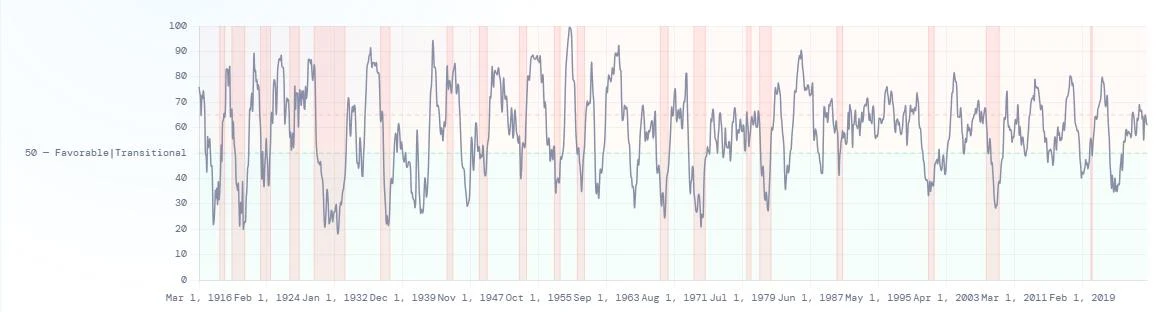
The Financial Liquidity Proxy, or FLP, was developed by Skylark Digital Assets as a proprietary framework for evaluating liquidity conditions across the broader financial system. It stands on two first principles: that global financial markets are fundamentally and inextricably interconnected, and that financial markets are inherently cyclical, with those cycles capable of being observed and measured. Rather than relying on one variable, it consolidates multiple market signals into a single composite reading designed to show whether liquidity conditions are relatively compressed, expanding, or becoming increasingly extended.
Reading the liquidity regime
The FLP is best understood as a market-cycle regime indicator, not a standalone trading signal. Its purpose is to provide context around the environment in which asset prices are moving. In its present form, the FLP is organized into three broad regimes: Favorable below 50, Transitional from 50 to below 65, and Defensive at 65 or above. These classifications are intended to describe the prevailing liquidity regime, not to function as standalone buy or sell signals.
Just as important as the absolute reading is the direction of travel. Improving liquidity from depressed levels can create a very different backdrop from one in which conditions are already extended and beginning to lose momentum.
Liquidity also does not affect every asset at the same time. Different markets can respond at different speeds, which means price action in one asset may not immediately reflect broader changes in financial conditions.
The FLP is designed to make those shifts easier to observe without reducing liquidity analysis to a single monetary variable. It is also adaptive by design, recognizing that the dominant sources and transmission mechanisms of financial liquidity have evolved considerably over the past 110 years.
The overall objective is simple: to provide a clearer view of the financial environment surrounding markets before focusing on the behavior of any individual asset.
About Skylark Digital Assets
Skylark Digital Assets LLC is an independent quantitative research firm focused on global liquidity, cross-asset relationships, market regimes, and digital assets.
More Articles About Financial Liquidity
The Fed Just Projected a Rate Hike for the First Time Since 2023. Here's What That Means for Bitcoin.
The Fed dot plot shifted hawkish with 9 of 18 members projecting a rate hike. Bitcoin dropped to $63,908. Three channels explain why monetary policy m...
June 23, 2026
The Acting Attorney General and the FBI Director Are Speaking at Bitcoin 2026. Read That Again.
Acting AG Todd Blanche and FBI Director Kash Patel headline Bitcoin 2026 with a session called Code is Free Speech: Ending the War on Bitcoin. The DOJ...
April 22, 2026
Arch Lending Review 2026: TaxShield vs. Perpetual Income
Stop selling your Bitcoin to cover tax bills. Discover two new 2026 strategies from Arch Lending to offset taxes and generate tax-advantaged passive i...
March 26, 2026
Podcast Conversations About Financial Liquidity