
- Bitcoin
- ETFs
- Regulations
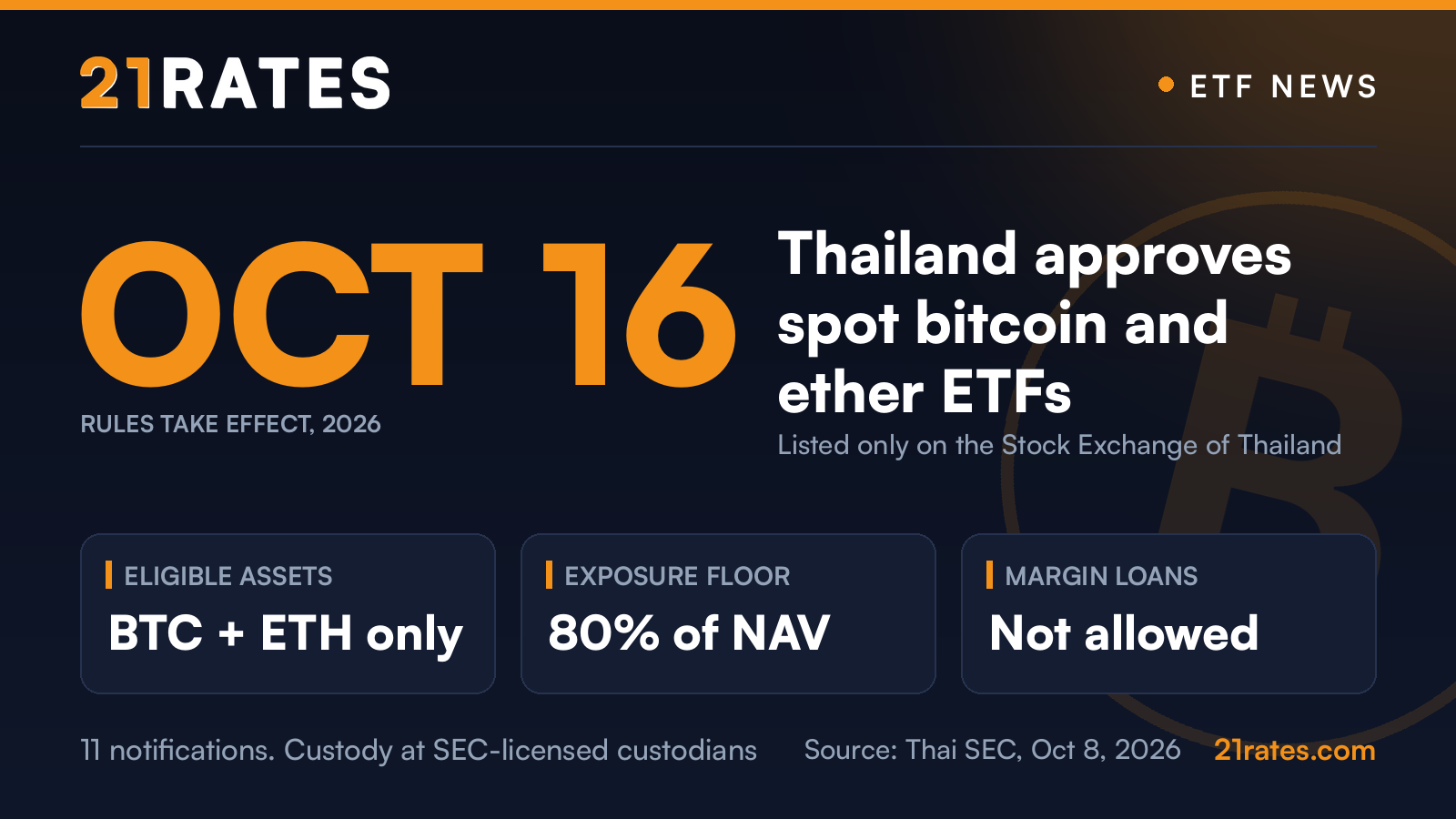
Thailand's Securities and Exchange Commission issued its final rules for crypto exchange-traded funds on Thursday, October 8, 2026. From October 16, Thai asset managers can launch ETFs that hold bitcoin or ether and list them on the Stock Exchange of Thailand. The framework runs to 11 notifications, and only bitcoin and ether qualify at the start, according to the SEC's statement.
Key takeaways
- Rules take effect October 16, 2026. That is the date managers can start, not a date a fund trades.
- Bitcoin and ether are the only eligible assets for now. The SEC will add others based on liquidity, market acceptance, network security and investor protection.
- Every fund is passive, tracks one asset, and must keep average net exposure of at least 80% of NAV over each accounting year.
- Coins must sit with a custodian licensed by the Thai SEC. Funds list only on the SET.
- No margin loans to buy crypto ETFs, and investors must confirm they understand the risks before their first trade.
What did Thailand's SEC actually approve?
The SEC consulted on the principles in April and May and on the drafts in August and September, and says most respondents backed them. Thursday's release turns those drafts into rules.
Until now, Thai investors had no domestic crypto ETF. In 2024 the regulator let institutions and ultra-high-net-worth investors buy foreign spot bitcoin ETFs, as CoinDesk reported at the time, while retail was left to direct crypto trading. The new framework puts bitcoin and ether inside the country's normal mutual fund and exchange rules, with extra safeguards on top. CoinDesk and The Block both covered the release on Friday morning.
What are the rules for a Thai crypto ETF?
An asset manager has to show it has the staff, systems and service providers to run the fund before approval, and can outsource the digital asset side only to a licensed digital asset fund manager.
The fund is a passive tracker of one crypto asset, with average net exposure of at least 80% of NAV across each accounting year. Custody stays with an SEC-licensed digital asset custodian, even when a sub-custodian is used. Foreign custodians may get a path later.
Trading is SET-only. Brokers must walk clients through the risks and get an acknowledgment before the first trade, and they cannot lend against a crypto ETF purchase, the same rule Thailand applies to buying crypto on local exchanges.
Two more changes ride along. Thai mutual funds and private funds can now hold domestic crypto ETFs, within existing limits. And for the initial phase the SEC is blocking depositary receipts on foreign crypto ETFs and barring brokers from routing retail clients into overseas funds. The home market gets the first shot.
Why does this matter for bitcoin holders and borrowers?
A regulated wrapper in a market with real retail depth is a new source of bitcoin demand, even if early flows are small. Thai mutual funds and private funds now have a compliant way in too, which is where the steadier money usually comes from.
The 80% exposure floor and the single-asset rule also mean these are clean spot products, not actively managed baskets. For anyone comparing a fund wrapper with holding their own coins, the trade-offs are the same ones we track on our bitcoin ETF comparison and custody comparison: fees, who holds the keys, and what you can do with the position.
That last point is the gap. A Thai ETF share cannot be bought on margin, and the rules say nothing about borrowing against it. Spot bitcoin can be posted as collateral today with the lenders on our bitcoin lending rate comparison. Different tools, different jobs.
What do the numbers say?
Bitcoin traded at about $82,438 at 7:15 AM ET on October 9, per Yahoo Finance. The Thai rules land in a soft week for U.S. ETF flows. Farside Investors data shows U.S. spot bitcoin ETFs lost $484.9 million on October 7 and another $244.1 million on October 8, putting October at a net outflow of roughly $407 million through October 8.
What to watch next
- The first filings. October 16 opens the door; each fund still needs its own SEC approval, so the first listing date is unknown.
- Which asset managers move first, who they name as custodian, and what they charge.
- Whether the SEC adds assets beyond bitcoin and ether, and when foreign custodians get a path in.
FAQ
When can Thai investors buy a bitcoin ETF? Not before October 16, 2026, and only once an asset manager gets a specific fund approved and listed on the SET. No launch date has been announced.
Can retail investors in Thailand buy U.S. bitcoin ETFs instead? Not through a Thai broker. Only institutional and ultra-high-net-worth clients can be routed into foreign crypto ETFs during the initial phase.
Can you borrow to buy a Thai crypto ETF? No. Securities companies cannot offer margin loans for crypto ETF purchases.
Sources: Thai SEC, No. 216/2026, CoinDesk, The Block, Cointelegraph, Crypto Briefing, Farside Investors.
More Articles About Bitcoin
Bitcoin ETFs Shed $729 Million in Two Days as BTC Hits Holders' Breakeven
US spot bitcoin ETFs shed $729M on Oct 7-8, 2026 as BTC hit the ~$81,722 average ETF cost basis. FBTC led the exits; IBIT is still up for October....
October 9, 2026
Ledger Pauses Reseller CryptoBilis After Reports of $86 Million in Drained Wallets
Ledger asked reseller CryptoBilis to pause sales while it probes lost funds. An analyst puts drains at $86M+, including 211 BTC. What's known so far....
October 9, 2026
Best Bitcoin Lending Platforms in Q4 2026
Ledn, Arch, Strike, Figure, SALT and more compared on rate, LTV, minimum loan and how your bitcoin is held. Rates checked Oct 8, 2026....
October 9, 2026
Podcast Conversations About Bitcoin


