
- Bitcoin
- ETFs
- Market Analysis
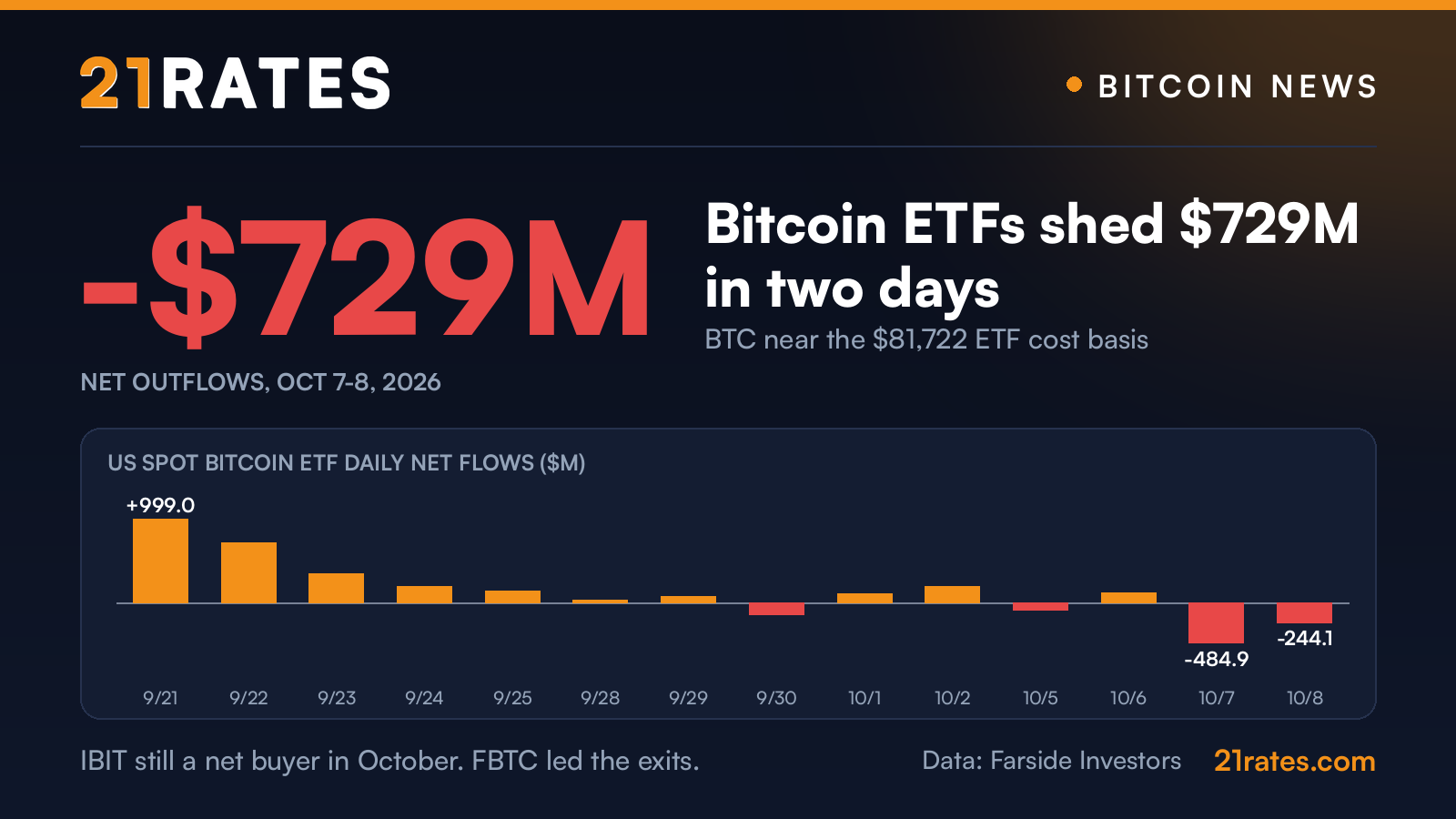
US spot bitcoin exchange-traded funds lost a net $729.0 million over Wednesday, October 7 and Thursday, October 8, 2026, according to Farside Investors flow data. The selling came as bitcoin traded around the average price ETF buyers paid for their coins, and it erased October's early inflows. Bitcoin was at about $82,304 at 3:49 p.m. Eastern Time on Friday, October 9, up roughly 0.8% on the day, per Yahoo Finance chart data.
Key takeaways
- US spot bitcoin ETFs posted net outflows of $484.9 million on October 7 and $244.1 million on October 8, per Farside. That came right after a $118.8 million inflow on October 6.
- Month-to-date net flows from October 1 to October 8 stand at minus $407.4 million.
- Fidelity's Wise Origin Bitcoin Fund (FBTC) lost $302.2 million across the two days. BlackRock's iShares Bitcoin Trust (IBIT) lost $213.2 million, almost all of it on October 7.
- Bloomberg Intelligence analyst James Seyffart estimates the average US spot bitcoin ETF holder paid $81,722 per coin, according to BeInCrypto via Yahoo Finance.
What happened with bitcoin ETF flows this week?
The week started mixed. Funds saw $89.8 million of net outflows on Monday, October 5, then $118.8 million of inflows on Tuesday, October 6, per Farside.
Then the selling picked up. On October 7, IBIT shed $207.7 million, ARK 21Shares Bitcoin ETF (ARKB) lost $101.7 million and FBTC lost $105.1 million. Grayscale Bitcoin Trust (GBTC) and Bitwise Bitcoin ETF (BITB) added $39.3 million and $27.6 million of outflows.
October 8 was smaller but more lopsided. FBTC alone lost $197.1 million of the day's $244.1 million. The only fund with a net inflow that day was Franklin Bitcoin ETF (EZBC), at $4.7 million.
Bitcoin Magazine reported the same $729 million two-day total, also citing Farside. Flow data for Friday, October 9 had not been published at the time of writing.
Why does the ETF breakeven price matter?
Seyffart's $81,722 estimate is the average entry price across US spot bitcoin ETF holders, as reported by BeInCrypto. Bitcoin dipped to around that level this week.
BeInCrypto's read is that some holders who sat through losses used the return to breakeven as a chance to get out. When enough holders sell at their cost basis, that price can act as a ceiling for a while.
The split between funds also matters. BlackRock's IBIT is still a net buyer for October, with $332.5 million of inflows from October 1 to October 8. FBTC has lost $408.1 million over the same stretch, more than the whole market's net outflow. That points to selling from specific investor groups rather than a broad exit from bitcoin exposure.
How big is the outflow compared with recent inflows?
For scale, US spot bitcoin ETFs took in more than $2.3 billion between September 21 and September 30, per Farside. Cumulative net inflows since the funds launched stand at about $57.2 billion.
Two days of outflows wiped out October's gains so far. The next few sessions will show whether buyers return above the breakeven level or keep using it as an exit.
You can track all US spot products, fees and recent moves on our bitcoin ETF comparison page. For more on how ETF access is spreading abroad, see our coverage of Thailand's new bitcoin and ether ETF rules.
What does it mean for bitcoin holders and borrowers?
ETF flows are a daily read on institutional demand, and they matter most if you borrow against bitcoin. A drop in collateral value raises your loan-to-value ratio and moves you closer to margin call and liquidation levels. Our guide to bitcoin loan LTV and liquidation risk explains how those thresholds work.
Lenders set different LTV limits and margin call rules. You can compare bitcoin lending rates and LTVs side by side, and our state of bitcoin-backed lending for Q3 2026 shows how the market has shifted this year.
What should you watch next?
- Farside's daily flow table for October 9 and the week of October 12, especially FBTC and IBIT.
- Whether bitcoin holds above the roughly $81,722 average ETF cost basis.
- Any fresh inflow streak, which would suggest buyers are absorbing breakeven sellers.
FAQ
How much did bitcoin ETFs lose this week?
US spot bitcoin ETFs saw net outflows of $729.0 million over October 7 and October 8, 2026: $484.9 million and $244.1 million, according to Farside Investors.
Which bitcoin ETF had the biggest outflows?
Fidelity's FBTC lost $302.2 million across the two days. BlackRock's IBIT lost $213.2 million, mostly on October 7, but it is still a net buyer for October.
What is the average cost basis for bitcoin ETF holders?
Bloomberg Intelligence analyst James Seyffart estimates it at $81,722 per bitcoin, according to BeInCrypto. Bitcoin traded near $82,300 on the afternoon of October 9.
Are bitcoin ETFs still positive overall?
Yes. Cumulative net inflows since launch are about $57.2 billion, and the funds took in more than $2.3 billion in the last 10 days of September, per Farside.
This article is for information only and is not financial advice. Sources: Farside Investors, BeInCrypto via Yahoo Finance, Bitcoin Magazine.
More Articles About Bitcoin
Ledger Pauses Reseller CryptoBilis After Reports of $86 Million in Drained Wallets
Ledger asked reseller CryptoBilis to pause sales while it probes lost funds. An analyst puts drains at $86M+, including 211 BTC. What's known so far....
October 9, 2026
Best Bitcoin Lending Platforms in Q4 2026
Ledn, Arch, Strike, Figure, SALT and more compared on rate, LTV, minimum loan and how your bitcoin is held. Rates checked Oct 8, 2026....
October 9, 2026
Thailand Approves Spot Bitcoin and Ether ETFs for the Stock Exchange of Thailand, Rules Take Effect Oct. 16
Thailand's SEC finalized rules for spot bitcoin and ether ETFs on the Stock Exchange of Thailand, effective Oct. 16, 2026. The rules, numbers and what...
October 9, 2026
Podcast Conversations About Bitcoin


