- Lending
- Bitcoin
- Custody
- Market Analysis
- Regulations
Bitcoin-backed lending is having a quieter year than the headlines suggest, and a healthier one. The market is smaller than it was twelve months ago. The lenders still standing are more careful with collateral, more open about their books, and more connected to mainstream finance.
Here is where things stand heading into Q4, and how five of the lenders we track compare.
What is the state of bitcoin-backed lending in Q3 2026?
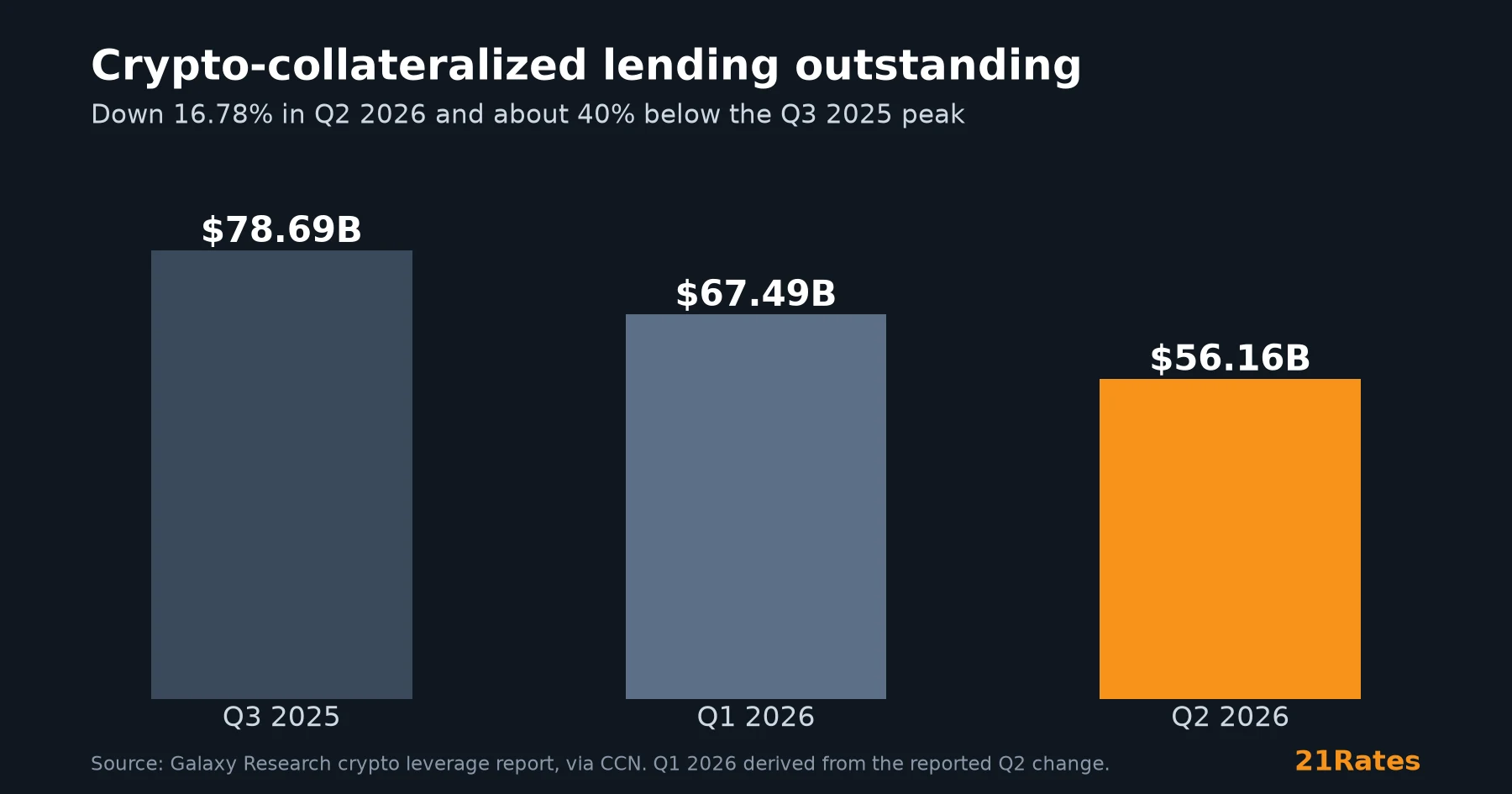
Galaxy Research's latest crypto leverage report puts total crypto-collateralized lending at $56.16 billion at the end of Q2 2026, down $11.33 billion, or 16.78%, in one quarter, as CCN reported. That leaves the market about 40% below its Q3 2025 high of $78.69 billion.
The shape of the decline says more than its size. DeFi lending fell 27.61% to $20.43 billion. CeFi loans fell just 9.62% to $22.98 billion, enough for centralized lenders to pass DeFi apps for the first time since Q3 2023. Galaxy named Coinbase, Ledn and Arch among the lenders that grew their loan books during the quarter.
Galaxy called it gradual deleveraging rather than a repeat of 2022, and noted that undercollateralized lending and widespread rehypothecation of customer collateral have largely been pushed out of common practice. That is the biggest change since the last cycle.
What changed this year
Exchanges went on-chain. Coinbase's bitcoin-backed USDC loans run through the Morpho protocol on Base. Coinbase reports over $1.4 billion in active variable-rate loans against about $3 billion in collateral, and on September 22 it added fixed-rate loans through Morpho Midnight, per Blockonomi.
Regulators drew a line around collateral. The UK's Financial Conduct Authority opened authorization applications for crypto firms on September 30, under rules expected to take effect in October 2027. As CryptoSlate reported, coins pledged as borrowing collateral have to stay safeguarded, while lending-for-yield products can use an exemption from the trust requirement.
Loan books met the rating agencies. S&P rated the senior notes of Ledn's $188 million bitcoin-backed securitization BBB-, investment grade. Bitcoin loans being packaged and rated like other consumer credit is a new step for the asset class.
Five lenders, side by side
Rates, LTVs and minimums come from 21Rates' lender data as of September 30, 2026. Coinbase rates are quotes shown in the Coinbase app in early October 2026; its website advertises loans from 5.1%. Coinbase fee, term and collateral details were checked against Coinbase's own disclosures on October 8, 2026. Other custody details come from each lender's own site.
| Lender | APR | Max LTV | Custody / rehypothecation | Proof of reserves / transparency | Min loan |
|---|---|---|---|---|---|
| Arch | 7.25%+ | 60% | Anchorage Digital, segregated wallets, no rehypothecation | Qualified custodian, $100M insurance cited | $5,000 |
| Strike | 7.75%+ | 50% | Held by Strike or its capital providers, no further rehypothecation | No public loan-book report found | $5,000 |
| Coinbase (via Morpho) | 7.94% variable, 8.41% to 8.77% fixed (in-app) | 65% | BTC moves on-chain to Morpho, out of Coinbase custody | On-chain positions on Morpho | None |
| Ledn | 9.25% to 11.49% | 50% | Qualified custodian (BitGo), collateral never lent out | Monthly Open Book Report plus Proof of Reserves | $500 |
| Unchained | 14%+ | 50% | Collaborative multisig, borrower holds a key | Collateral verifiable on-chain | $150,000 |
How do bitcoin lenders differ on rate, LTV, custody and transparency?
Arch has the lowest starting all-in APR among the custodial lenders we track at 7.25%. Arch includes its origination fee in the quoted APR rather than adding it on top. The origination fee starts at 1.49% for retail loans and declines for larger loan tiers. Collateral sits with Anchorage Digital, a federally chartered bank.
Strike starts at 7.75%, and its rates drop as loan size grows. Its standard loans give 72 hours' notice before a margin call, and a separate volatility-proof option has no price-driven liquidations as long as payments are current.
Coinbase has the highest max LTV here at 65% and no minimum loan. Each borrower's rate is set in the app: quotes in the Coinbase app in early October 2026 showed a 7.94% variable APR, 8.41% fixed due October 30, 2026, and 8.77% fixed due November 27, 2026. Those APRs include a Coinbase platform fee, about 3 percentage points based on figures shared with 21Rates, on top of the Morpho market rate. They are snapshots and can change.
The APR is not the only cost. A one-time processing fee is added to principal on day one, 2% on the first $250,000 and 1% above that, and the larger balance then accrues interest. Variable-rate loans have no due date. Fixed-rate terms run up to 90 days, must be repaid in full at maturity and cannot be rolled into a new term, and Coinbase says a matured loan can be liquidated even when its LTV is healthy. To borrow, the customer signs an on-chain transaction that moves the BTC to the Morpho protocol, where it stays locked outside Coinbase custody until the loan is repaid.
Unchained is built for large borrowers, mostly businesses. Collateral sits in a multisig vault where the borrower holds a key, so no single party can move it. Unchained lists minimums of $150,000 for business entities and $500,000 for individuals.
Which lenders show the most?
Rates are only part of the picture, and lenders differ widely in how much borrowers can see. Coinbase loan positions sit on-chain on Morpho, and Unchained collateral can be checked on-chain. Arch points to its qualified custodian and $100 million in insurance. We did not find a public loan-book report from Strike.
Ledn publishes the most. Each month it releases an Open Book Report with figures reported by the independent accounting firm The Network Firm. The September snapshot showed $757 million in BTC-backed loans outstanding against 20,769 BTC of collateral, a 46% average LTV, with 100% of collateral held in custody. Ledn states that client collateral is never lent out to earn interest, and it has run a Proof of Reserves program since 2021.
No other lender here publishes a monthly, outside-reported view of its whole loan book. Ledn pairs that with the investment-grade securitization, the lowest minimum here at $500, and Auto Top-Up, which adds collateral from a client's Transaction Account when a loan hits 70% LTV.
What should borrowers compare before taking a bitcoin-backed loan?
The rate is the easiest number to compare and the least complete. Before choosing a lender, it helps to line up:
- Where the collateral is held, and whether it can be lent out or reposted
- What someone outside the company verifies, and how often
- The starting LTV, the margin-call level and the liquidation point
- Whether the rate is fixed or variable, and what fees sit on top
- The minimum loan and who is eligible
Current rates and terms for all 21 lenders we track are on 21Rates.
More Articles About Lending
Skylark Digital Assets — Institutional Intelligence Summary: September 2026 Month-End
Michael Pierre examines competing cycle scenarios: a rollover or an extended expansion, alongside September liquidity, funding, and Bitcoin network re...
October 6, 2026
FinCEN Withdraws Unhosted Wallet Rule and Crypto Mixer Proposal
FinCEN withdrew its 2020 unhosted wallet proposal, which would have required reports on self-custody crypto transactions over $10,000, plus a 2023 mix...
October 5, 2026
CFTC Opens Comment on Federal Rules for Leveraged Crypto Trading
The CFTC published an advance notice on federal rules for leveraged retail crypto trading, Regulation CTX and CAM. Comments run 60 days after publicat...
October 5, 2026
Podcast Conversations About Lending


