
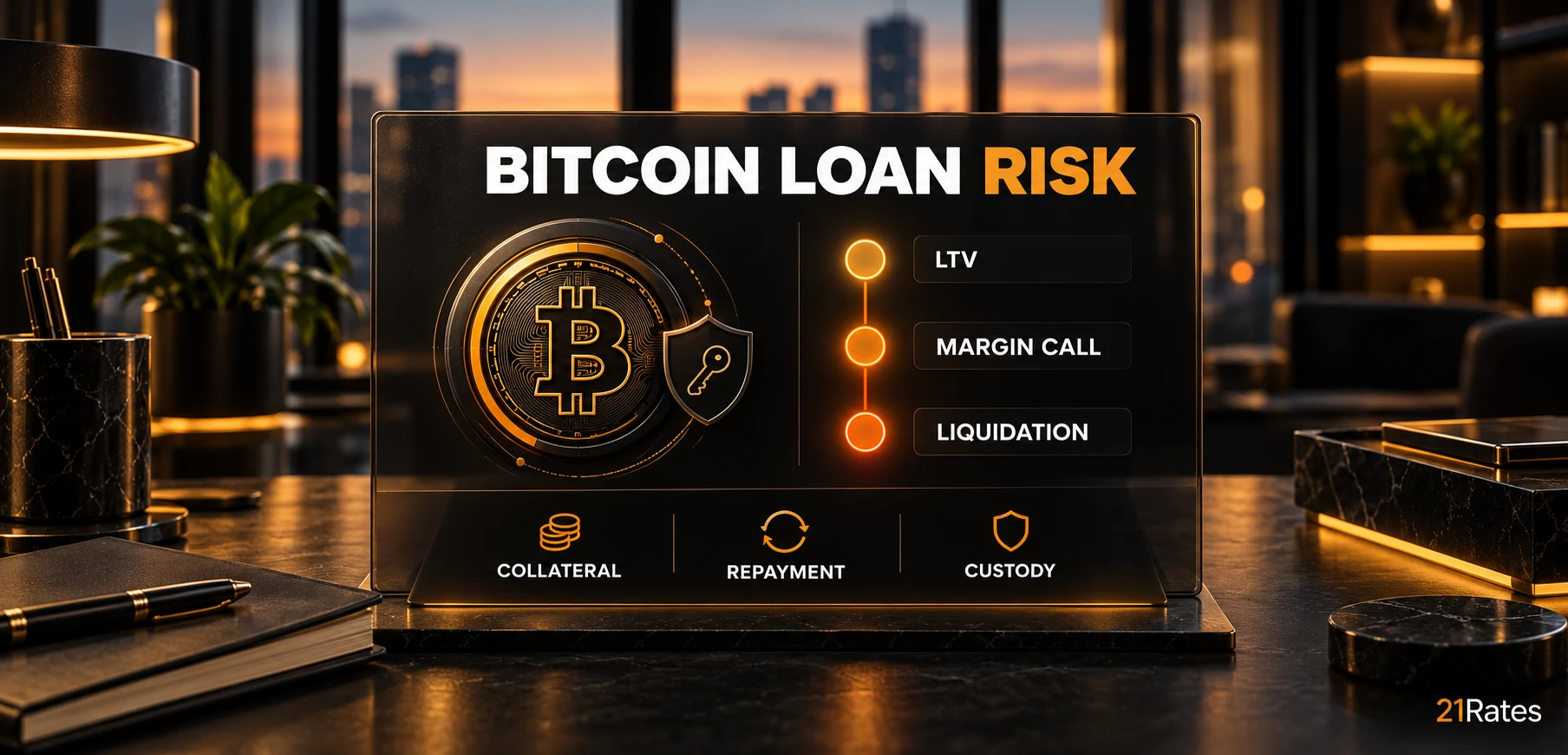
- Bitcoin loans
- Loan-to-value
- Liquidation risk
- Bitcoin custody
The short answer
Loan-to-value (LTV) on a Bitcoin-backed loan is the ratio of your outstanding loan balance to the current market value of the Bitcoin securing it. Liquidation risk is what happens when that ratio climbs too high: if Bitcoin's price falls, the collateral value drops, your LTV rises, and the lender can require you to add collateral, repay part of the loan, or sell some of your Bitcoin to cover the shortfall. The right LTV for you depends on the lender's specific thresholds, notice rules, and top-up mechanics, which are product-specific and not standard across the industry.
How LTV works
The formula is simple:
LTV = Loan balance ÷ Collateral value
Say you borrow a portion of your collateral's value. Your starting LTV is that portion expressed as a ratio. If Bitcoin's price then falls, the collateral value drops while your loan balance stays the same, so your LTV rises. A Bitcoin loan may begin at a stated loan-to-value ratio and can require borrower action when collateral value changes, per Ledn's product documentation (read 2026-09-30).
That is the core mechanism: the loan amount is fixed in dollars, but the collateral is volatile. Your risk is not just whether you can repay the loan. It is whether the collateral can hold its value relative to that fixed balance long enough for you to repay on your own terms.
Why falling collateral raises liquidation risk
When LTV rises past a lender's stated threshold, the lender has a few options, and which ones apply depends entirely on the product:
- Notice: the lender alerts you that your LTV has crossed a warning level.
- Top-up requirement: you add more Bitcoin (or sometimes another asset) to bring LTV back down.
- Partial repayment: you pay down part of the loan balance instead of adding collateral.
- Automatic top-up: some products move collateral automatically from a linked account, per Ledn's stated automatic top-up options (read 2026-09-30).
- Liquidation: the lender sells some or all of the collateral to bring the loan back to a safer ratio.
Borrowers need to understand what happens as LTV rises, including notices, adding collateral, repayment options, and liquidation terms, per Ledn's product page (read 2026-09-30). The order and the exact trigger points are set by each lender, not by the market.
What to compare before signing
Because thresholds, notices, top-up rights, custody, repayment, and liquidation rules differ lender by lender, compare the full account structure rather than the advertised rate alone. Use this framework:
| Factor | What to look for | Why it matters |
|---|---|---|
| Starting LTV | The ratio at origination and whether it is fixed or adjustable | Sets how much room you have before any action is required |
| Notice threshold | The LTV level that triggers a warning and how you are notified | Determines how much time you have to react |
| Top-up mechanics | Whether you add collateral manually, repay, or use an automatic option | Affects how quickly you can restore a safer ratio |
| Liquidation terms | At what LTV the lender can sell, how much is sold, and whether you get notice first | The point at which you lose Bitcoin without your consent |
| Custody model | Whether collateral sits with the lender, in multisig, or with a third party | Affects who controls the Bitcoin while you hold the loan |
| Repayment structure | Interest accrual, payment schedule, and whether you can repay early | Changes the total cost and how the balance moves over time |
| Fees | Origination, maintenance, and any penalty fees | Adds to the effective cost beyond the headline rate |
Custody deserves its own attention. Bitcoin-backed loan collateral arrangements can include multisig and on-chain collateral verification, depending on the lender's product, per Unchained's documentation (read 2026-09-30). That is one example of a custody structure, not a standard. Ask each lender directly who holds the collateral keys, what verification exists, and what happens to your Bitcoin if the lender becomes insolvent.
Calculate your own LTV
Before comparing lenders, know your own numbers. The 21Rates Bitcoin LTV calculator lets you enter your Bitcoin collateral value and desired loan amount to see the resulting ratio (read 2026-09-30). It is an illustrative tool, not a lender quote, and it does not imply any particular LTV is safe. Loan terms, collateral requirements, fees, availability, and rates are product-specific and can change, so treat the output as a starting point for conversations with lenders, not as a substitute for reading their agreement.
What to do next
- Calculate your starting LTV with the 21Rates calculator.
- Read one lender's full agreement, not their marketing page. Look for the notice threshold, top-up options, and liquidation terms specifically.
- Ask the lender directly what happens if Bitcoin falls sharply overnight: what notice you get, how long you have, and what the lender can sell without further consent.
- Compare at least two lenders on the full account structure using the table above, not just on the advertised rate. Use the 21Rates lender directory to identify lenders to evaluate, then confirm each lender's current terms directly.
- Decide your own comfort level for how much of a price drop you can absorb without a top-up or repayment you cannot easily make.
The trade-off
Borrowing against Bitcoin gives you liquidity while keeping your position, which is the main draw for holders who want cash without giving up their Bitcoin. The trade-off is that you take on a fixed dollar obligation against a volatile asset. If Bitcoin falls far enough, you can lose collateral through liquidation at a bad time, and the terms that govern that outcome are set by the lender, not by you. That is not a reason to avoid Bitcoin-backed loans. It is a reason to read the liquidation clause before you sign, because it is the single term most likely to determine whether you keep your Bitcoin or lose it.
FAQ
Is there a universal safe LTV for Bitcoin-backed loans? No. Each lender sets its own starting LTV, notice thresholds, and liquidation terms, and these are product-specific, not industry standards. A ratio that is comfortable with one lender's notice and top-up structure may be risky with another's.
What happens if Bitcoin's price falls and I cannot add collateral? Depending on the lender's terms, you may be able to repay part of the loan instead, or the lender may use an automatic top-up if that feature exists in the product. If neither is possible and LTV stays above the liquidation threshold, the lender can sell collateral under the agreement. Read the liquidation clause before signing to know exactly what that means for you.
Does the lender hold my Bitcoin, or do I? It depends on the product. Some lenders hold collateral directly, others use multisig or on-chain verification structures, per Unchained's product documentation (read 2026-09-30). Ask each lender who controls the keys and what happens in a lender insolvency.
Can I use the 21Rates calculator to get a loan quote? No. The calculator shows the loan-to-value ratio for a collateral value and loan amount you enter. It is illustrative, not a lender quote, and does not imply any particular LTV is safe. Use it to prepare numbers, then confirm terms directly with lenders.
Why do lenders differ so much on liquidation rules? Because liquidation terms reflect each lender's own risk model, custody structure, and product design, not a shared rule. That is why comparing the full account structure, including notices, top-up rights, and liquidation clauses, matters more than comparing advertised rates alone.