
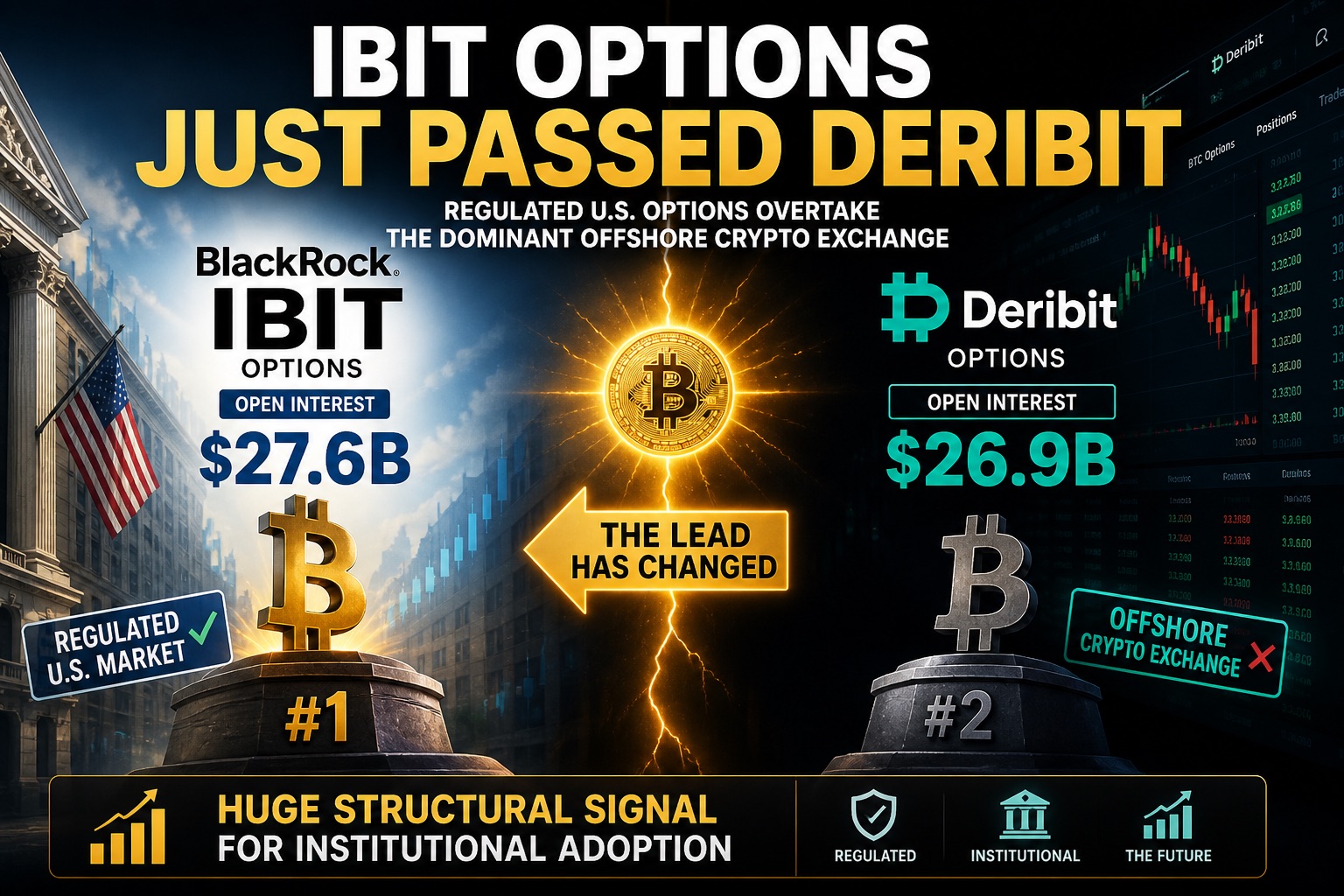
BlackRock's IBIT options open interest hit $27.61 billion on Nasdaq last Friday. Deribit's bitcoin options sat at $26.9 billion. First time a regulated U.S. venue has topped the offshore giant that's dominated crypto derivatives since 2016.
It took It took IBIT options less than two years to get here. to get here. Deribit had an eight-year head start. That gap closing this fast tells you something about where institutional money is actually going.
What the Numbers Show
IBIT options launched in November 2024. Eighteen months later, they've overtaken the biggest crypto-native derivatives exchange on the planet by open interest. That's not retail traders buying lottery tickets. The positioning data makes that clear.
Onshore call open interest is concentrated about 4 percentage points further out-of-the-money than offshore. The average delta is slightly lower. That pattern is consistent with two things: retail upside speculation and systematic call overwriting programs - the kind of strategy institutional desks and wealth managers run to generate income on existing Bitcoin positions. Both push OI into further-OTM strikes.
Put positioning tells a different story. It's largely aligned across both venues, concentrated around the $63,500 strike. That's your institutional hedging floor - the level where serious money has downside protection in place.
Expiry preferences split too. October 2026 expiries dominate on IBIT. August expiries lead on Deribit. The onshore market is pricing further out, which tracks with longer-duration institutional positioning versus Deribit's more active trading base.
Why Deribit Still Matters
Deribit isn't going anywhere. It's still the deepest liquidity pool for crypto options globally, and it serves a different market. Offshore traders, crypto-native funds, market makers - they're not switching to Nasdaq. The two venues serve different investor bases with different risk profiles and regulatory constraints.
But the symbolic weight matters. For a decade, the argument against Bitcoin derivatives was that they lived offshore, unregulated, in a Wild West that institutional allocators couldn't touch. IBIT options blew that argument up. You can now trade Bitcoin options through your prime broker, on Nasdaq, cleared through the OCC, with the same infrastructure you use for SPY options.
The Institutional Shift
Here's the context that makes this hit different. BlackRock's IBIT ETF holds over $70 billion in assets. Bitcoin ETFs collectively hold more than 1 million coins. Last week alone, crypto ETFs pulled in $1.2 billion in inflows - the fourth straight positive week. IBIT alone accounted for $732.6 million of that.
The options market is the next layer. Spot ETFs gave institutions a way to get exposure. Options give them a way to manage that exposure - hedge it, generate income on it, express directional views with defined risk. That's what real institutional adoption looks like. Not just buying Bitcoin. Managing a Bitcoin position the same way you manage any other asset class.
Put-call ratios, strike concentration, expiry curves - this is the plumbing of institutional finance, and it's now being built on top of Bitcoin at a scale that exceeds the crypto-native market. That's new.
What It Means
The center of gravity in Bitcoin derivatives is shifting onshore. Not completely - Deribit's liquidity and 24/7 trading still serve a purpose that regulated markets can't replicate. But the fact that more capital is now expressed through IBIT options than through the largest crypto exchange on earth tells you where the marginal dollar is coming from.
It's coming from advisors running covered call strategies. From funds hedging ETF positions. From desks that need OCC-cleared contracts and prime brokerage settlement. That's the market IBIT options were built for, and it just became the biggest Bitcoin options market in the world.
Sean Ristau | @SeanRistau | 21Rates / The Daily Stack