
- Bitcoin
- Commercial Real Estate
- Bitcoin Treasury
On September 23, 2026, I delivered this keynote at the Midwest Bitcoin Summit in Columbus, Ohio. The presentation grew out of more than thirty years of working in commercial real estate and my more recent study of Bitcoin, capital allocation, and the emerging market for Bitcoin-backed digital credit. What follows is an expanded written version of that presentation, including the slides I used onstage and additional context where the ideas benefit from more room to breathe. The premise is straightforward: commercial real estate is already an extraordinary wealth-generation engine. What happens when we give it another one?
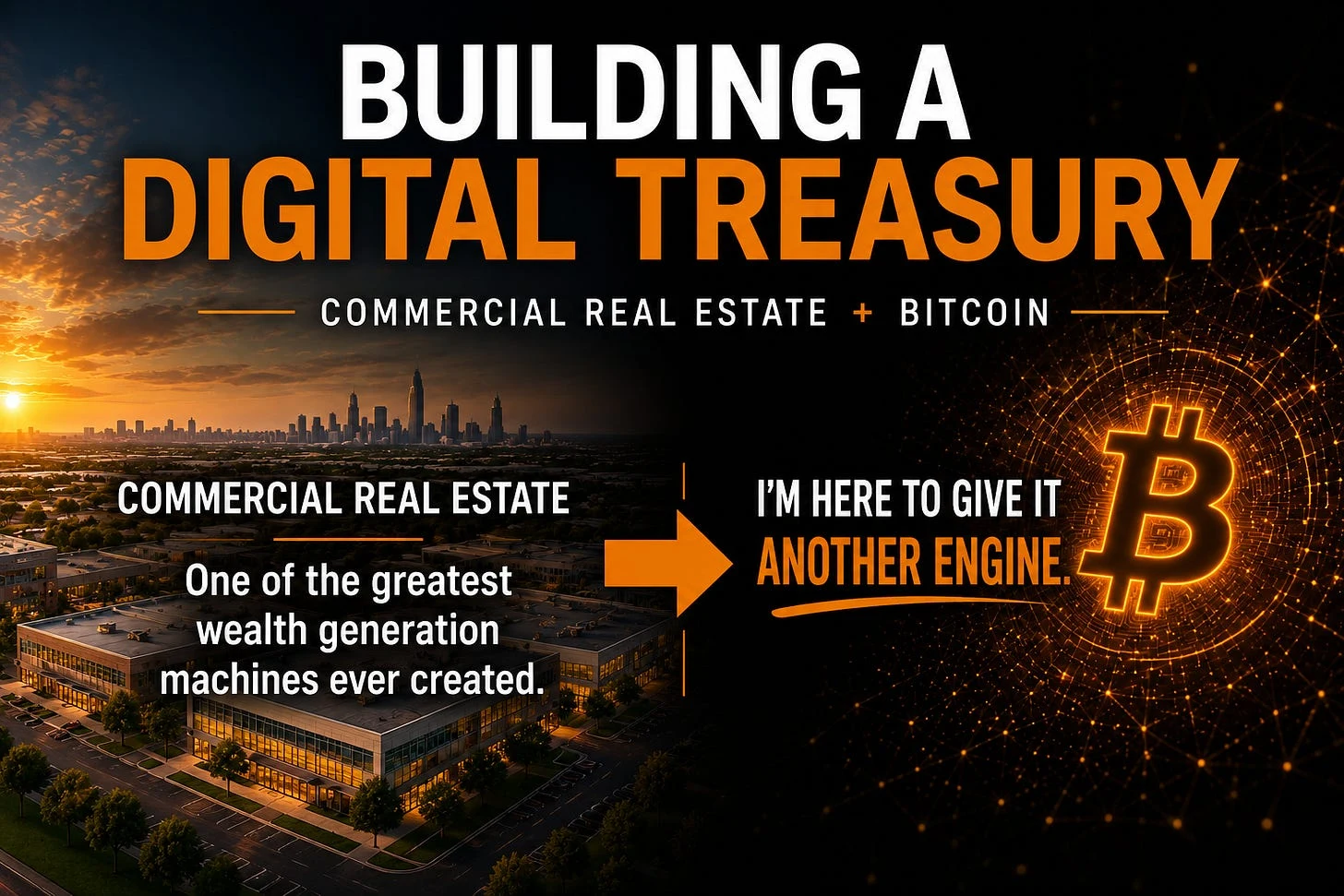
My name is David Marulli. I have over thirty years of experience in commercial real estate. I am the author of Bitcoin Consolidated and the founder of Proof of Work Advisory, a capital allocation consulting firm. In this presentation, I’ll be talking about using commercial real estate as a Bitcoin acquisition engine. More specifically, building a digital treasury to enhance commercial real estate. Commercial real estate is one of the greatest wealth generation machines ever created, and I am here to give it another engine.

Global real estate is one of the largest asset classes in the world, with a market cap of approximately $395 trillion. If you extract commercial real estate from that, it’s about $60 trillion. To put that in perspective, the global market cap of gold is approximately $30 trillion. So commercial real estate’s market cap is roughly double that of gold.
Look at those buildings. There’s proof of work in those buildings. It took hard work to construct them, and it wasn’t easy to fill them up and get them cash flowing. Look at the gold bar. There’s proof of work in the gold bar too. It’s not valuable just because it’s shiny and pretty. It’s valuable because it took a lot of work to get it out of the ground and refine it, and because it’s relatively scarce.
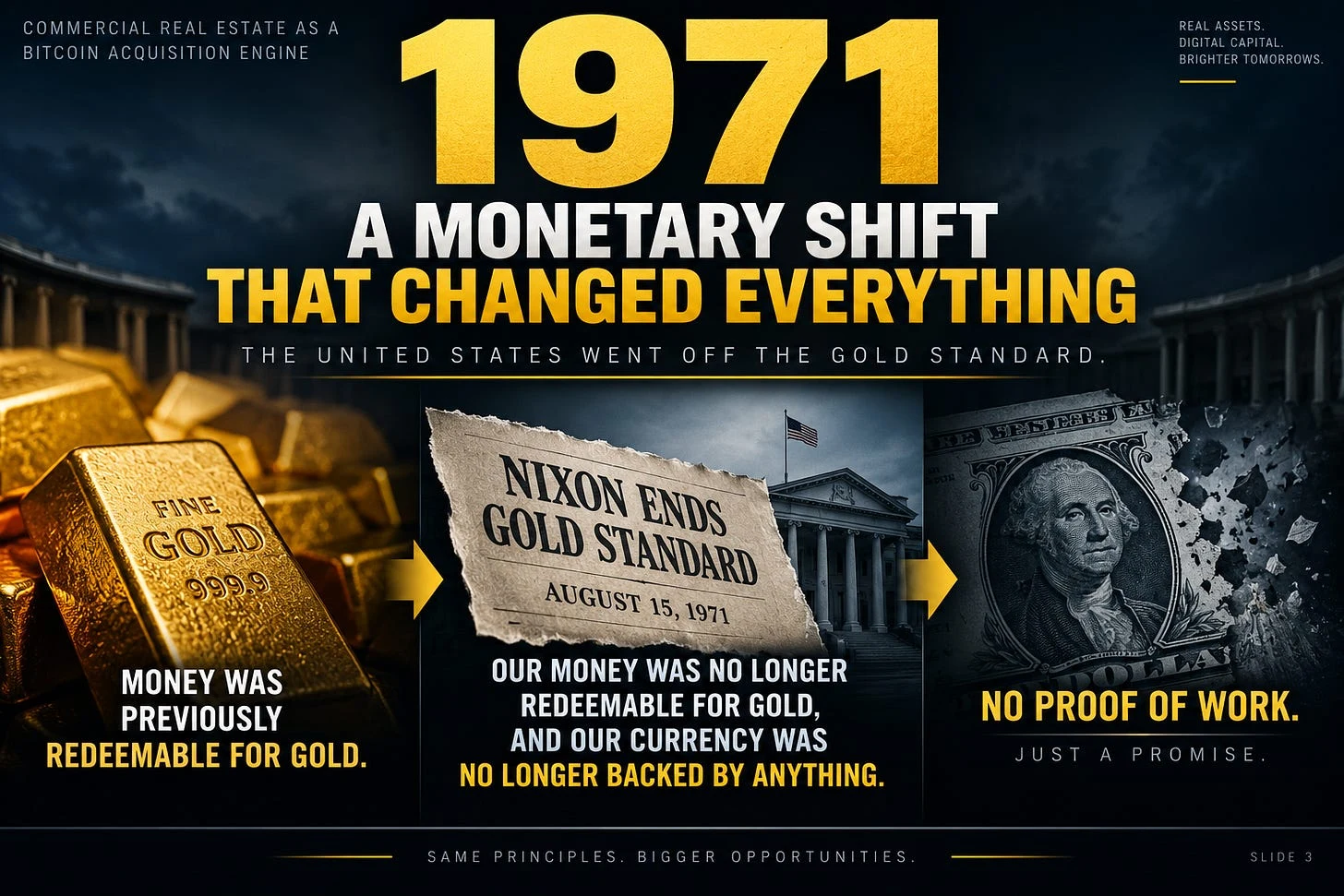
Before we really ramp up the capital allocation discussion, before we discuss fusing commercial real estate and Bitcoin, we must discuss something important. In 1971, there was a monetary shift that changed everything when the United States went off the gold standard. Our money was no longer redeemable for gold, and our currency was no longer backed by anything. No proof of work.
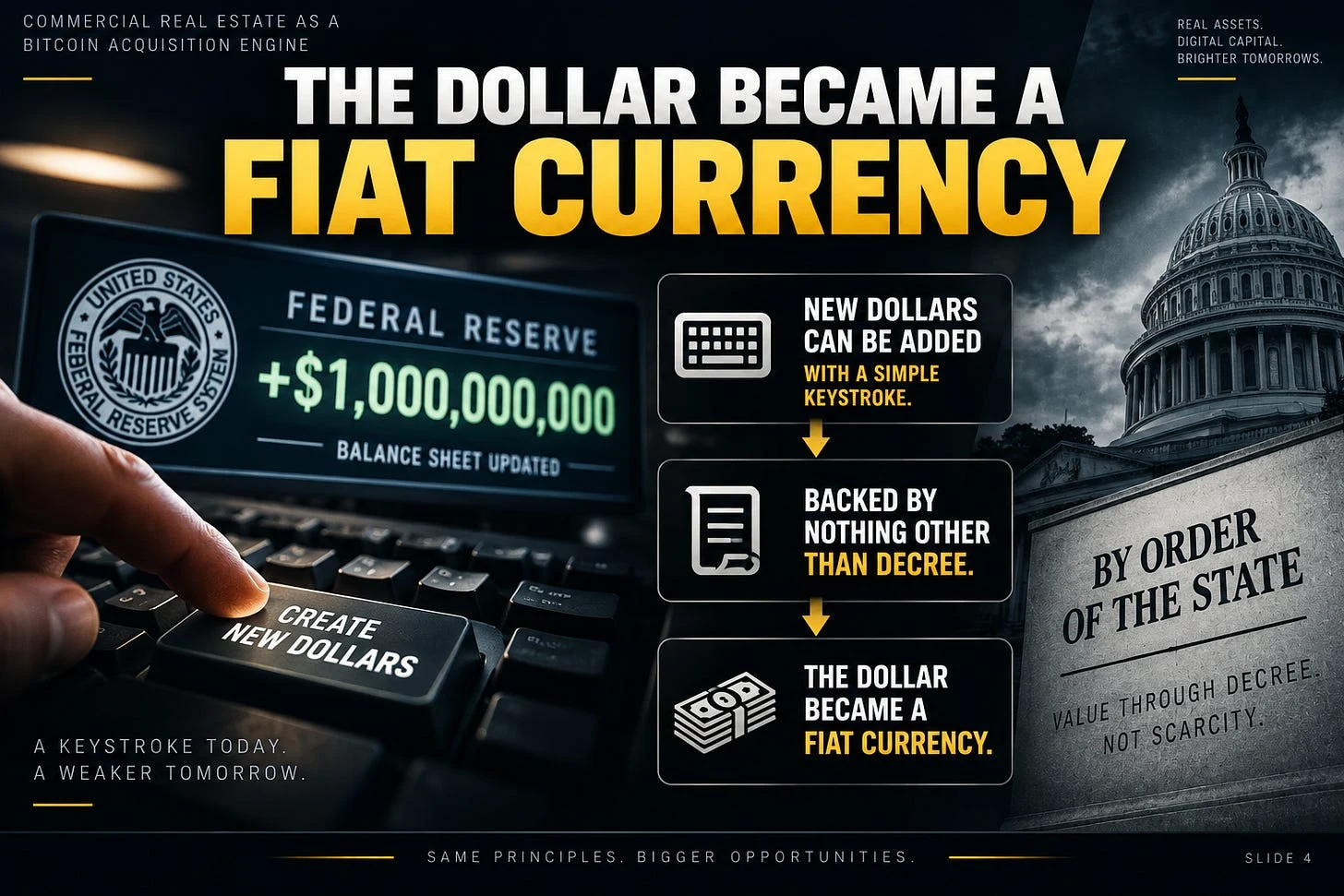
New dollars can be added to central bank balance sheets with a simple keystroke, backed by nothing other than decree. The dollar became a fiat currency.
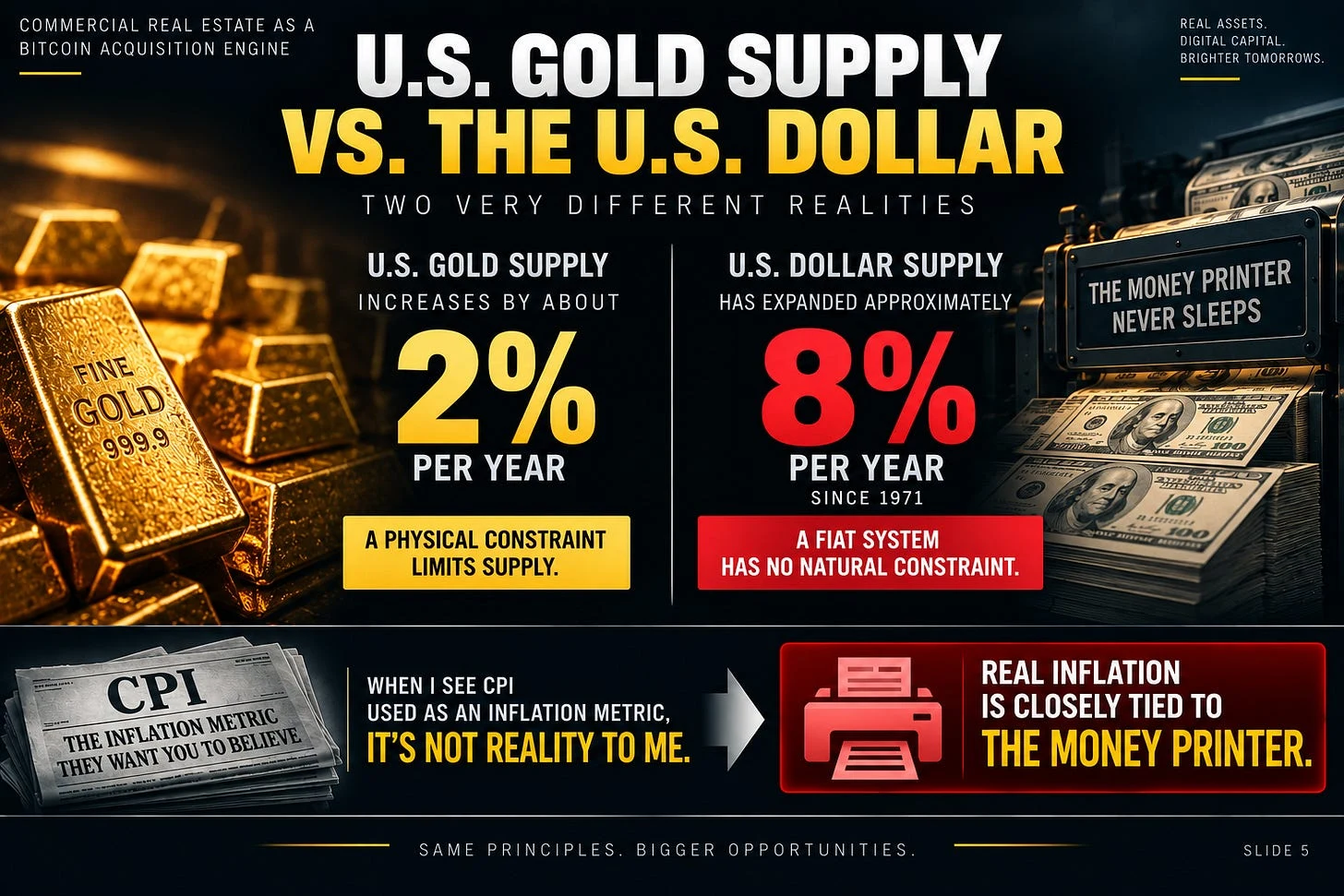
You see, the gold supply increases by about 2% per year, while since going off the gold standard in 1971, the U.S. dollar supply has expanded by approximately 8% per year. So when I see CPI used as the primary measure of inflation, it doesn't reflect the full picture to me. Real inflation is closely tied to the expansion of the money supply.
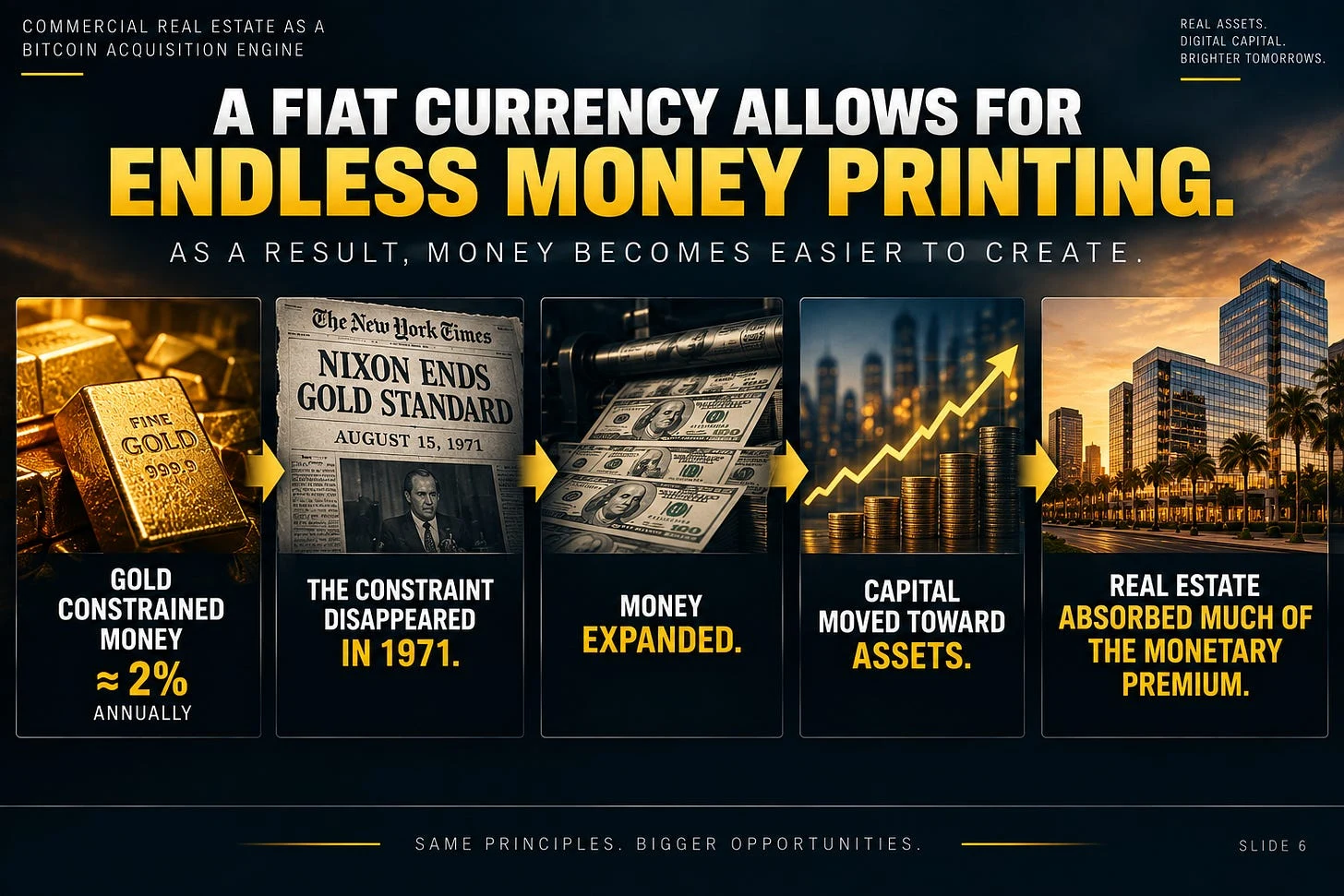
A fiat currency allows for endless money printing. As a result, money becomes easier to create. Gold constrained monetary expansion to around 2% annually. When that constraint disappeared in 1971, the money supply expanded, capital moved toward assets, and real estate absorbed much of the monetary premium.
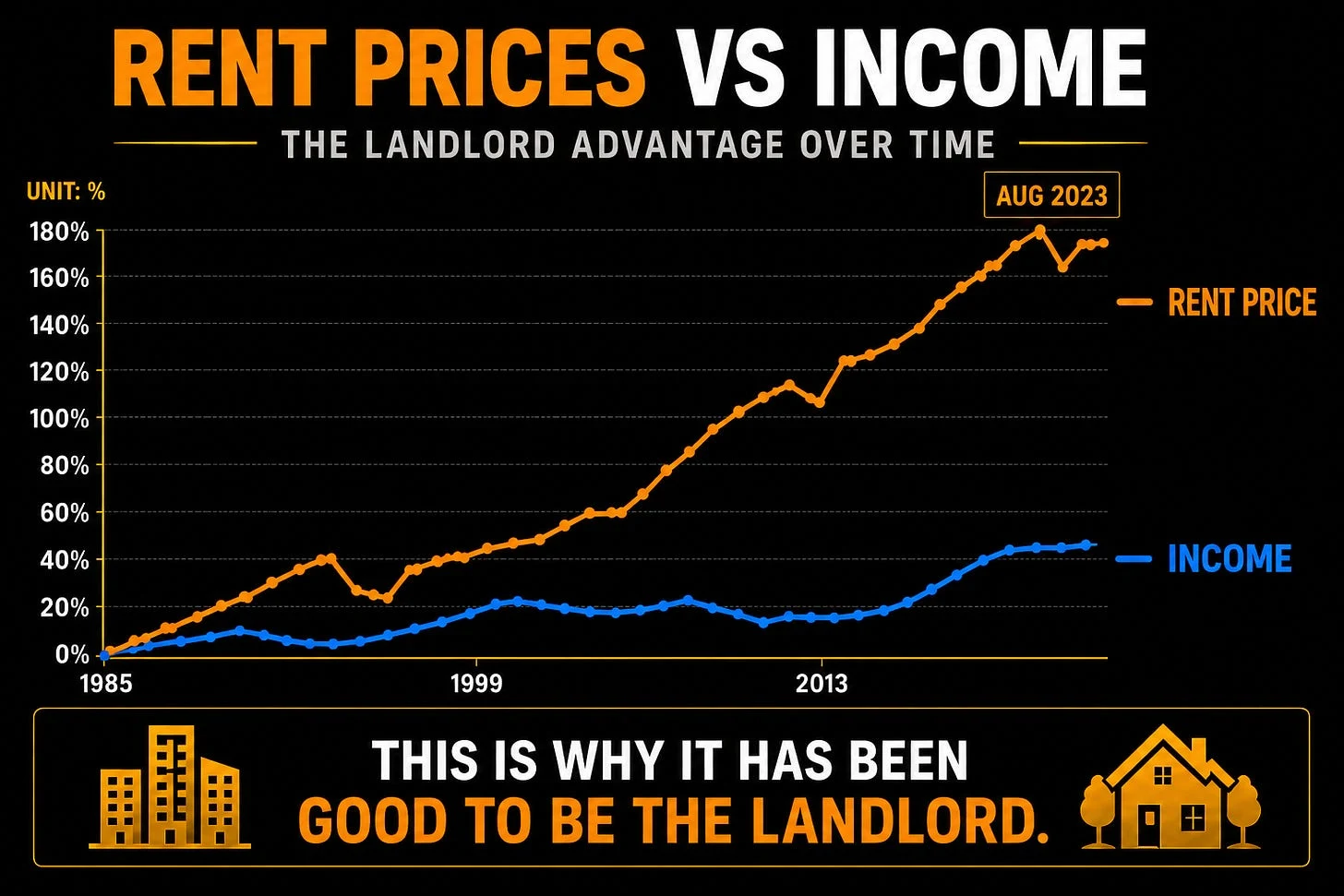
Here’s a great example. Look at this chart showing the severe divergence of escalating rent prices versus stagnating income since 1985. This is why it’s been good to be the landlord.

Commercial real estate is economically intriguing for several reasons. One is its ability to compound, allowing you to grow a portfolio over time. There's a special protocol in commercial real estate called a 1031 like-kind exchange. It's a set of rules that essentially allows you to sell an appreciated investment property, defer the capital gains taxes, roll the proceeds into a qualifying replacement property, and keep compounding into a larger asset base. The system works. And so, I'll introduce you to the $100 million operator.
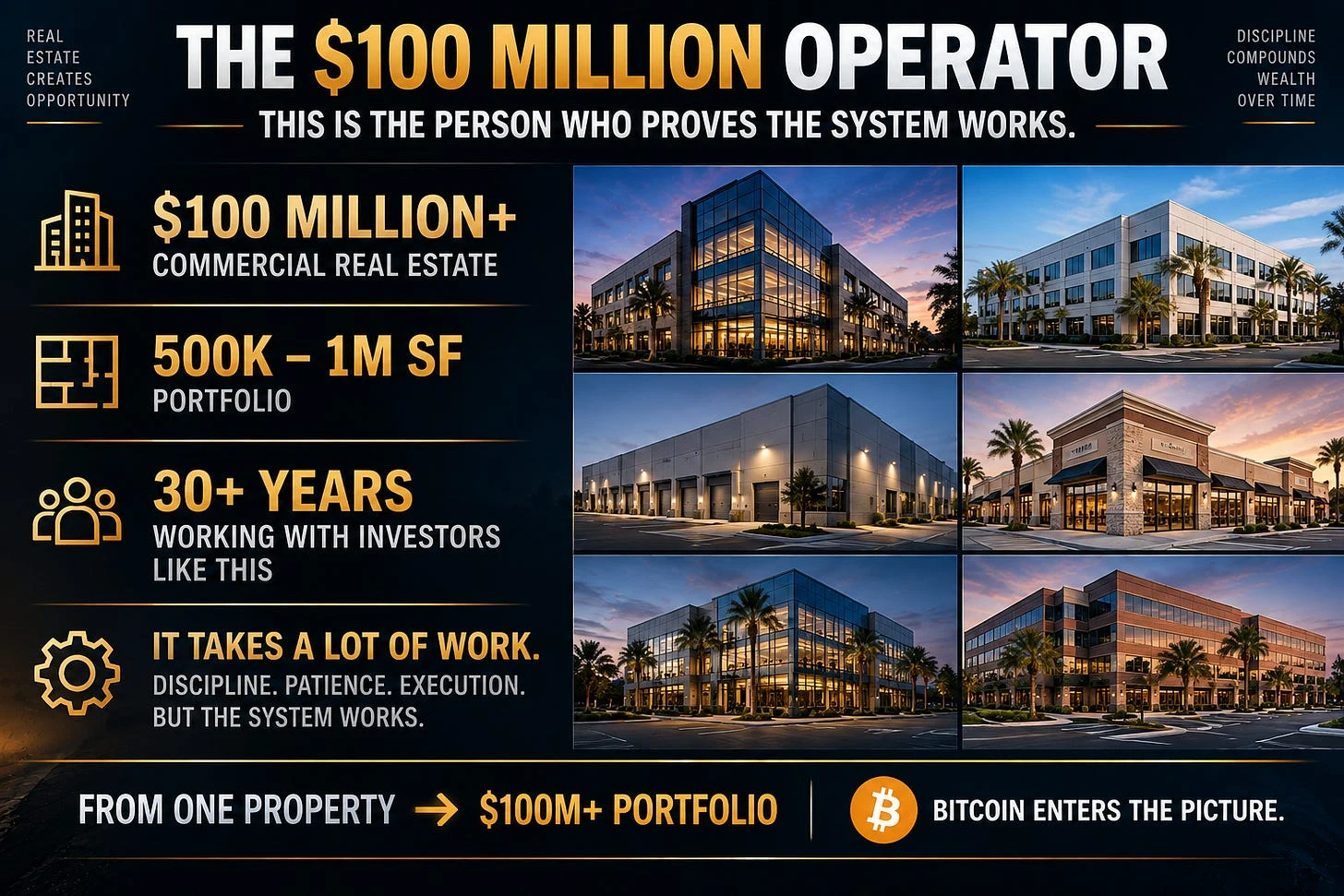
This is a person who owns $100 million of commercial real estate. This is the person who proves the system works. He probably owns somewhere between 500,000 and one million square feet of property. I’ve been working with investors like this for over thirty years, and I can tell you it’s a lot of work. But using the compounding engine of the 1031 exchange I just showed you, it is possible to start with a single commercial property and compound it over time into a $100 million portfolio. And you don’t have to stop there.
We’re at the Midwest Bitcoin Summit, and you’re probably wondering when I’m going to start talking about Bitcoin. It enters the picture now.
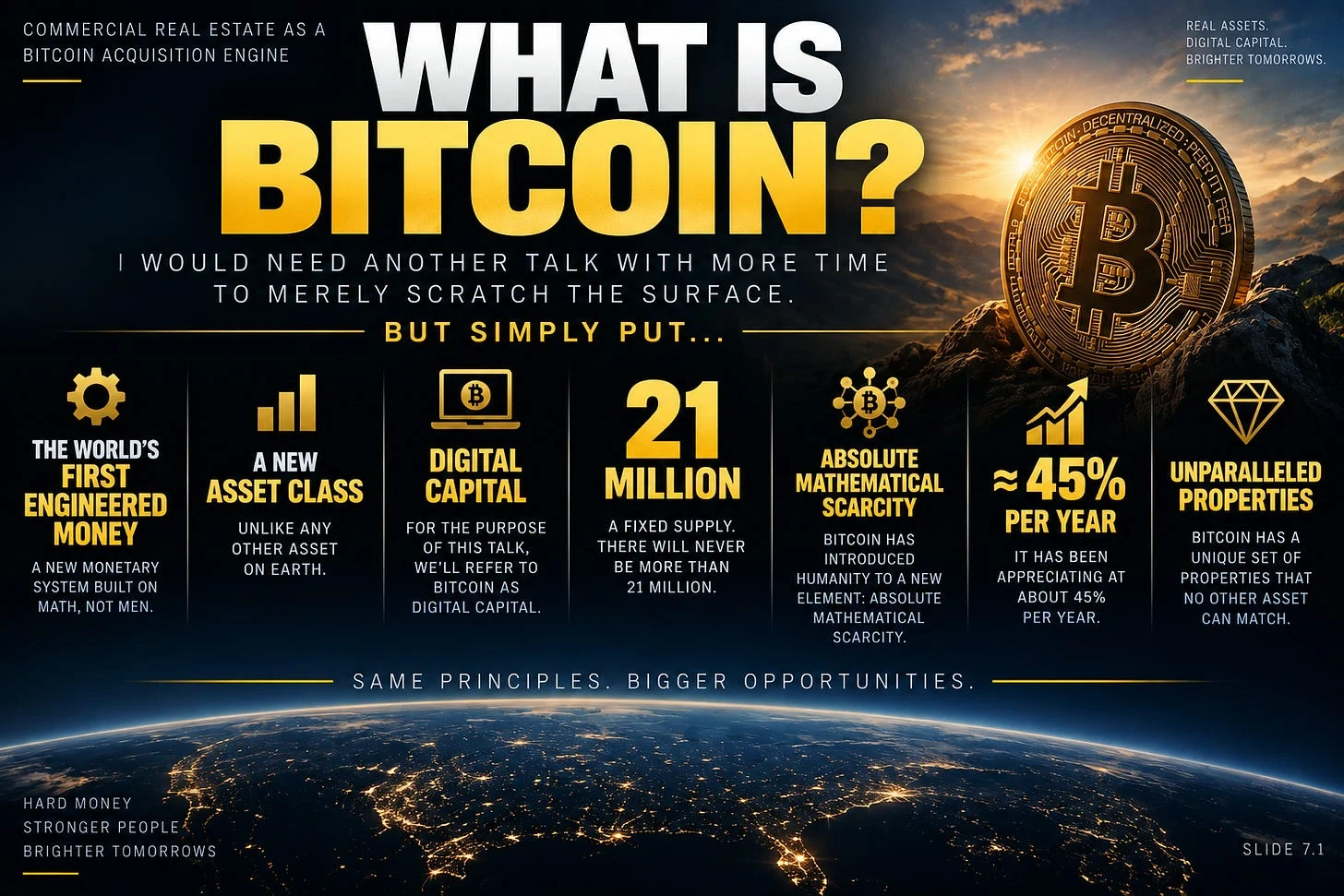
What is Bitcoin? I would need another talk, with a lot more time, to merely scratch the surface. But simply put, Bitcoin is the world's first engineered money. Bitcoin is a new asset class. For the purpose of this presentation, we'll refer to Bitcoin as digital capital. Unlike any other asset on Earth, Bitcoin has a fixed supply. There will never be more than 21 million bitcoin, which has introduced humanity to a new element called absolute mathematical scarcity. Bitcoin has appreciated at about 45% annually, and it has unparalleled properties.
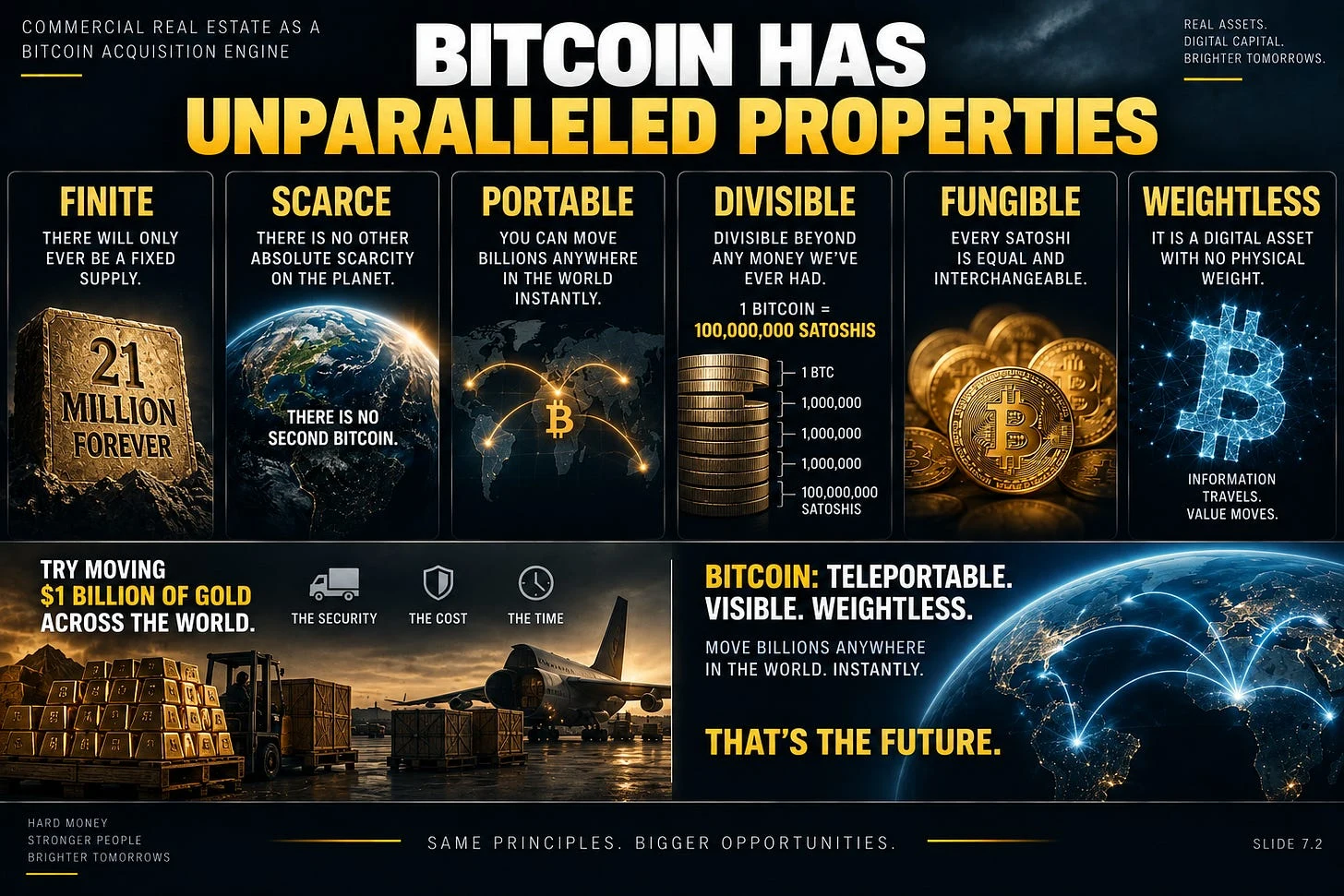
Bitcoin is finite because there will only ever be a fixed supply. It is scarce because there is no other absolute scarcity on the planet. It is portable because you can move billions anywhere in the world instantly. It is divisible, beyond any money we’ve ever had. It’s divisible down to a hundred million units per bitcoin. The units are called satoshis. It’s fungible because every satoshi is equal and interchangeable. It is weightless. It is a digital asset with no physical weight.
Try moving a billion dollars of gold across the world. Think about it: the security, the cost, the time. Now try moving something that’s teleportable, invisible, and weightless across the world. That’s the future.
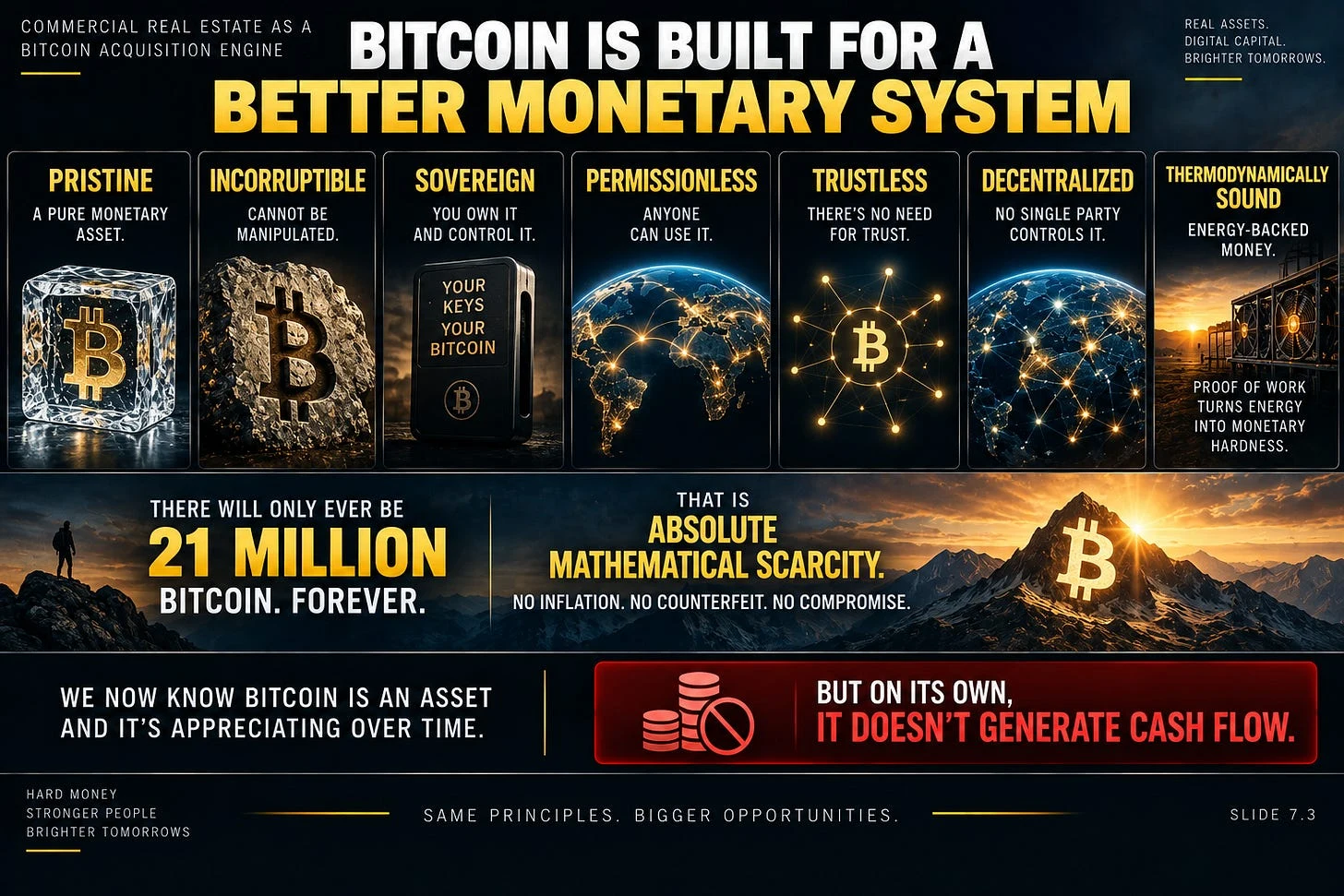
It’s pristine. It’s incorruptible. It’s sovereign; you own it and control it. It’s permissionless; anyone can use it. It’s trustless; there is no need for trust. It’s decentralized, and it’s thermodynamically sound. This is energy-backed money, and again, there will only ever be 21 million bitcoin. That is absolute mathematical scarcity: no inflation, no counterfeit, no compromise.
So now we know bitcoin is an asset, and it’s appreciating over time. But on its own, it doesn’t generate cash flow.
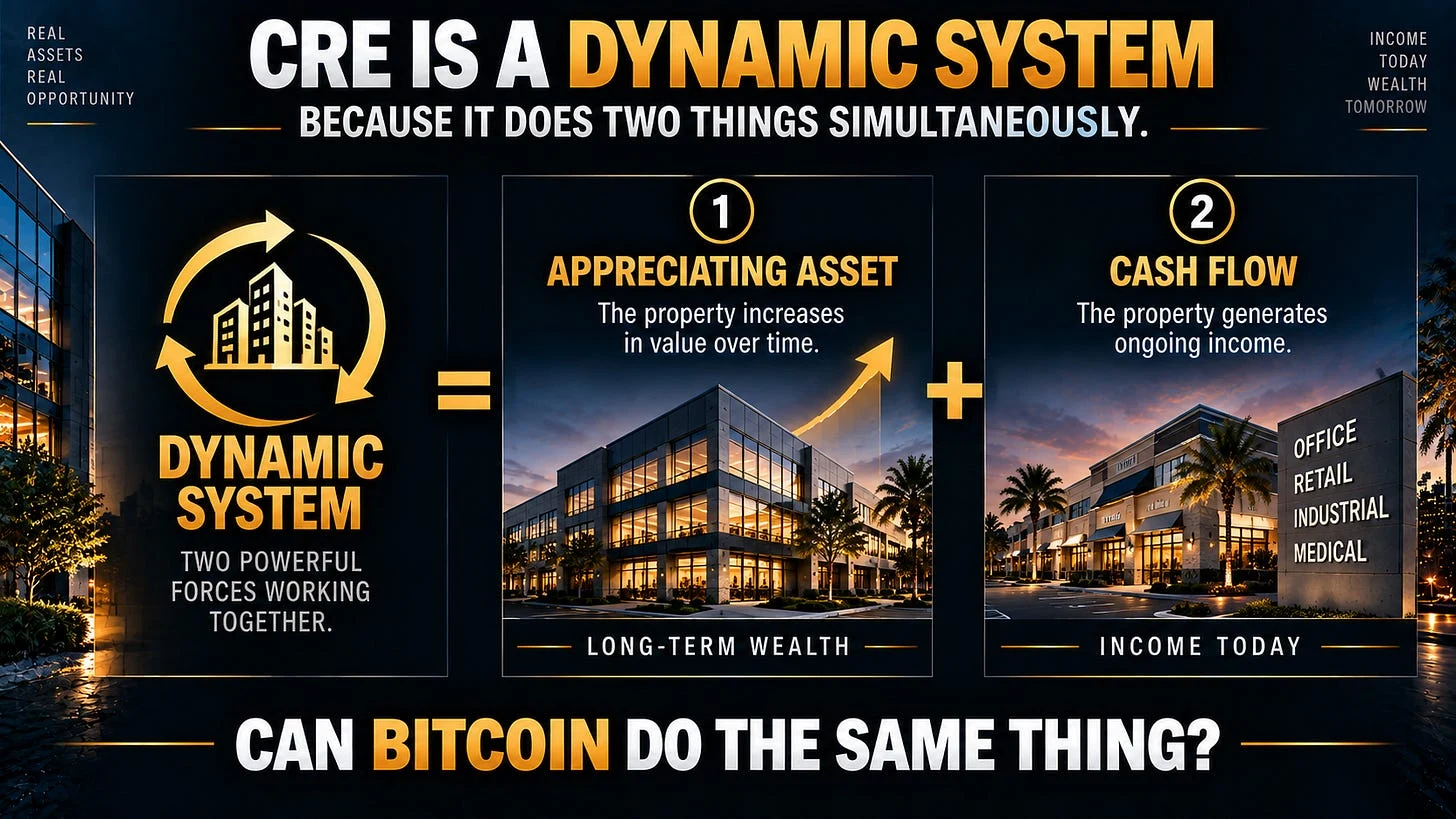
Coming back to real estate, commercial real estate is a dynamic system because it does two important things simultaneously: it appreciates over time, and it generates cash flow. So now the question becomes: we know that Bitcoin appreciates like real estate, even more than real estate. But can it do the same thing and generate cash flow?
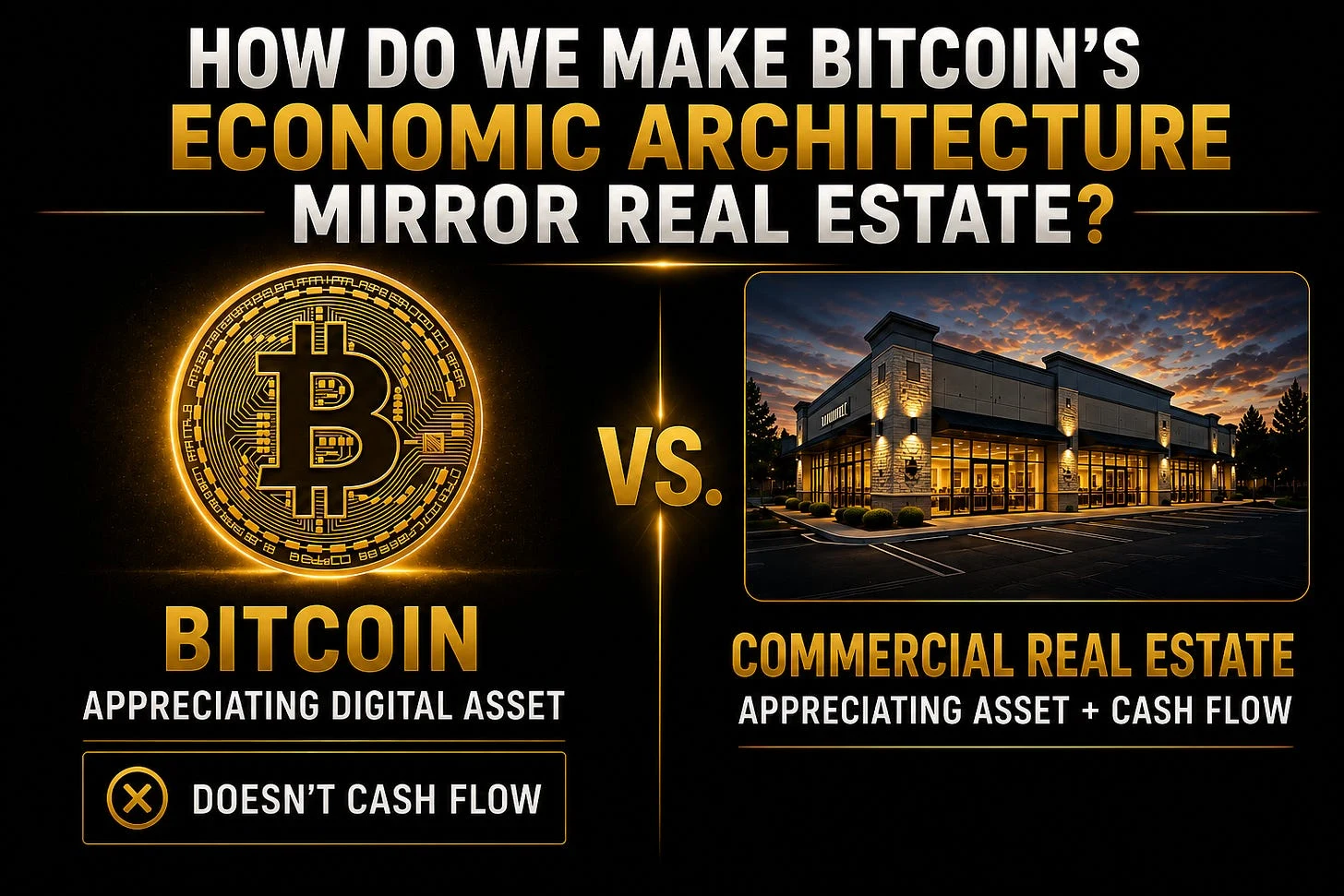
How do we make Bitcoin’s economic architecture mirror commercial real estate, and what happens when we do?
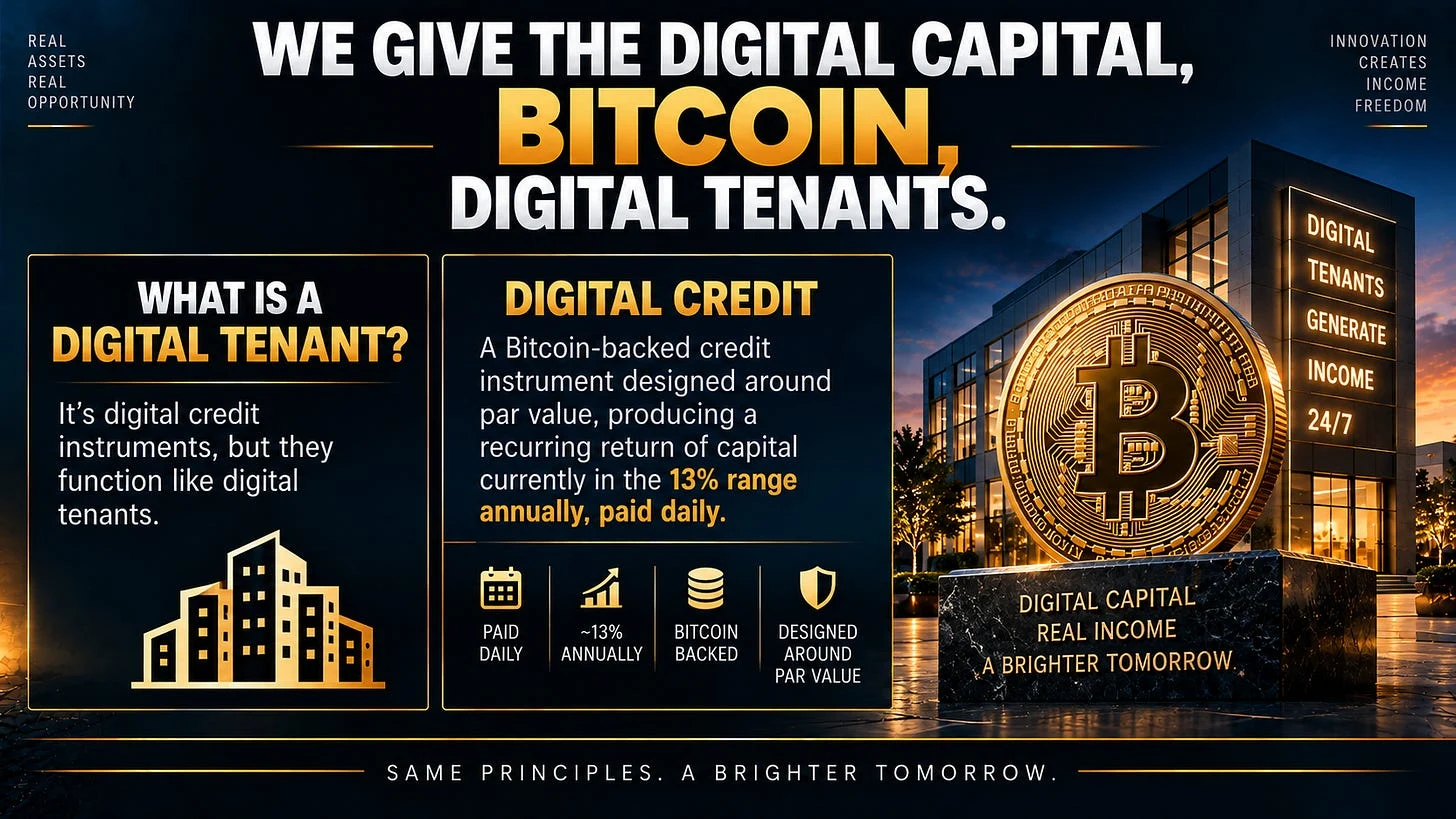
We give the digital capital, Bitcoin, digital tenants. What is a digital tenant? It's really a digital credit instrument, but it functions like a digital tenant. Digital credit is a Bitcoin-backed credit instrument designed around par value, producing a recurring return of capital currently in the 13% range annually, and it's paid daily.
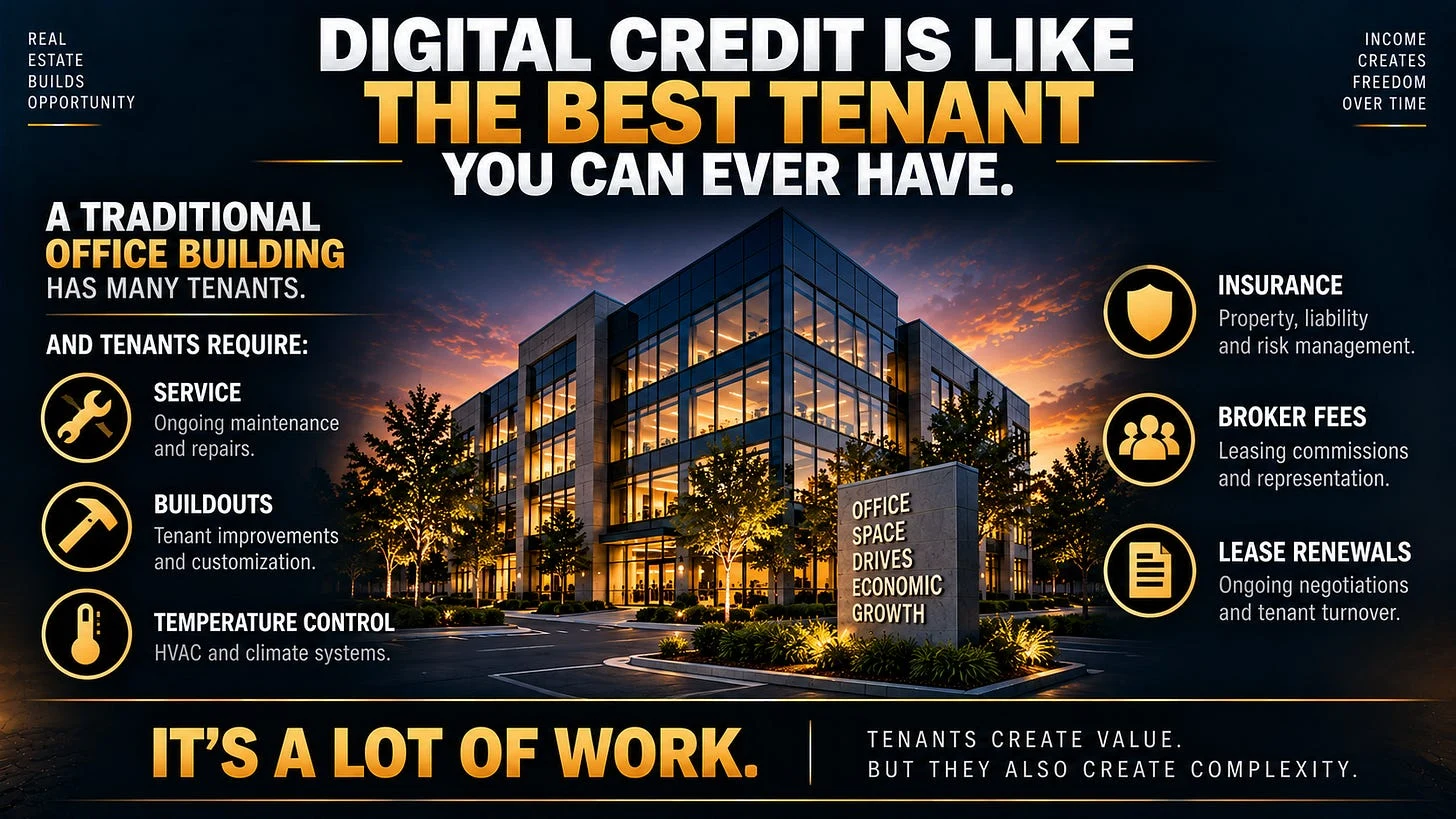
Digital credit is like the best tenant you could ever have. For example, let's imagine you own a ten-story office building. You have lots of tenants. They require service, buildouts, temperature control, insurance policies, broker fees, lease renewals, et cetera. It's a lot of work.
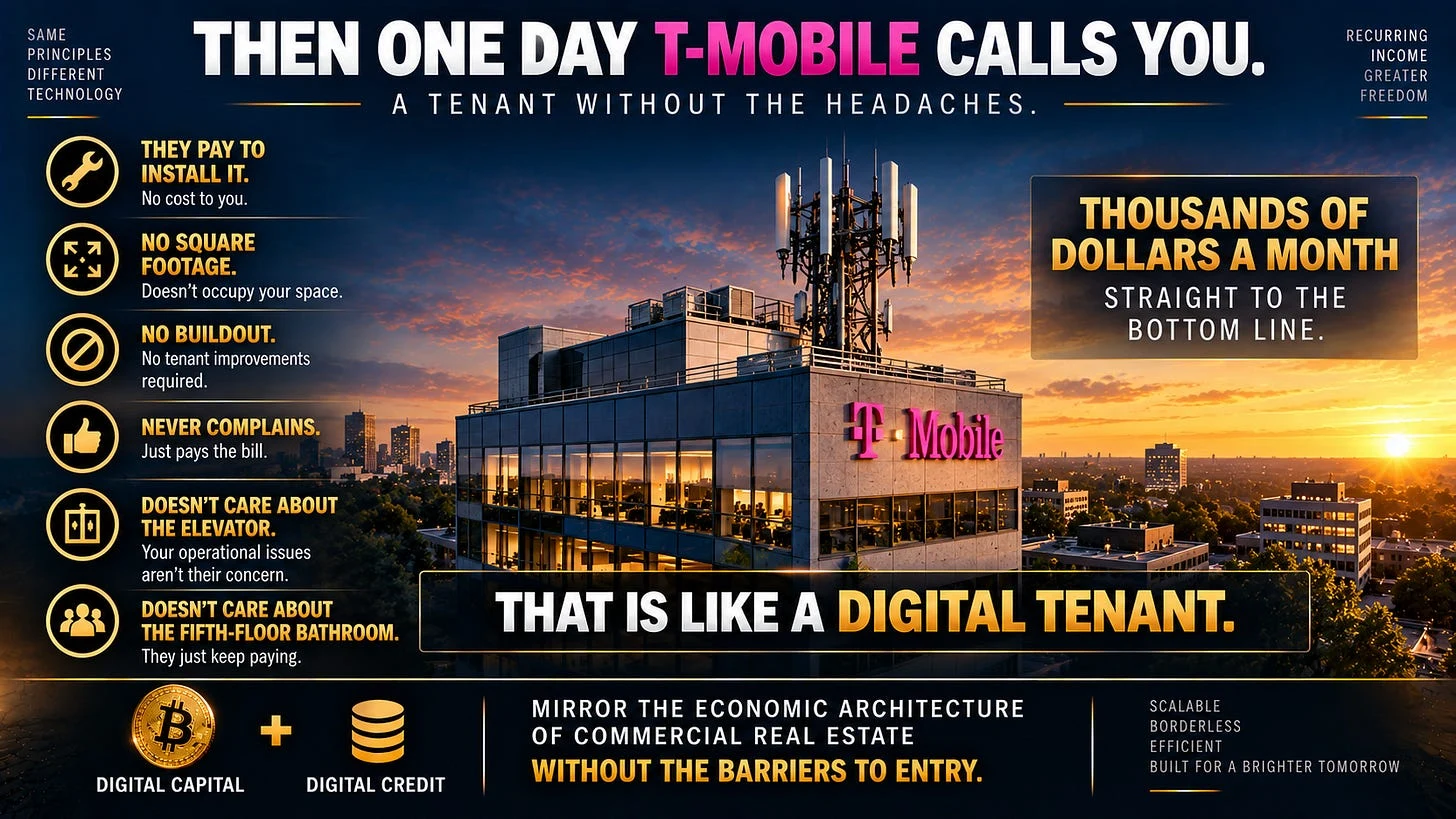
Then one day T-Mobile calls you. They want to put an antenna on your roof. They'll pay to install it. They don't take up any square footage. They never complain. They don't care if the elevator or the bathroom on the fifth floor is out of service. They just pay you thousands of dollars a month, straight to the bottom line. That's like a digital tenant. Digital capital and digital credit mirror the economic architecture of commercial real estate without the barriers to entry.
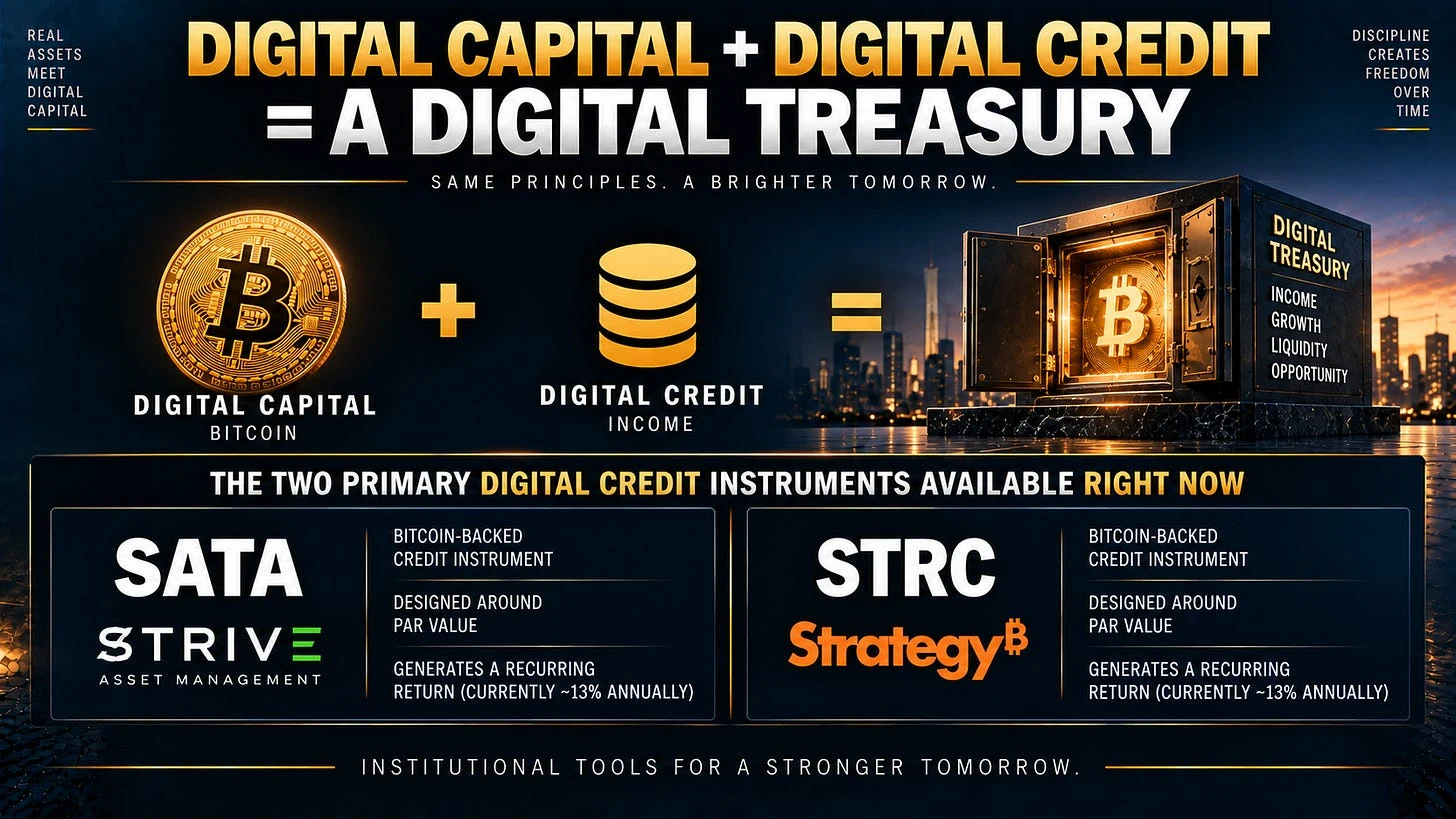
Adding digital capital and digital credit to the balance sheet creates a digital treasury. The two primary digital credit instruments available right now are SATA, issued by the publicly traded company Strive, and STRC, issued by the publicly traded company Strategy. The 13% annual return is powerful.
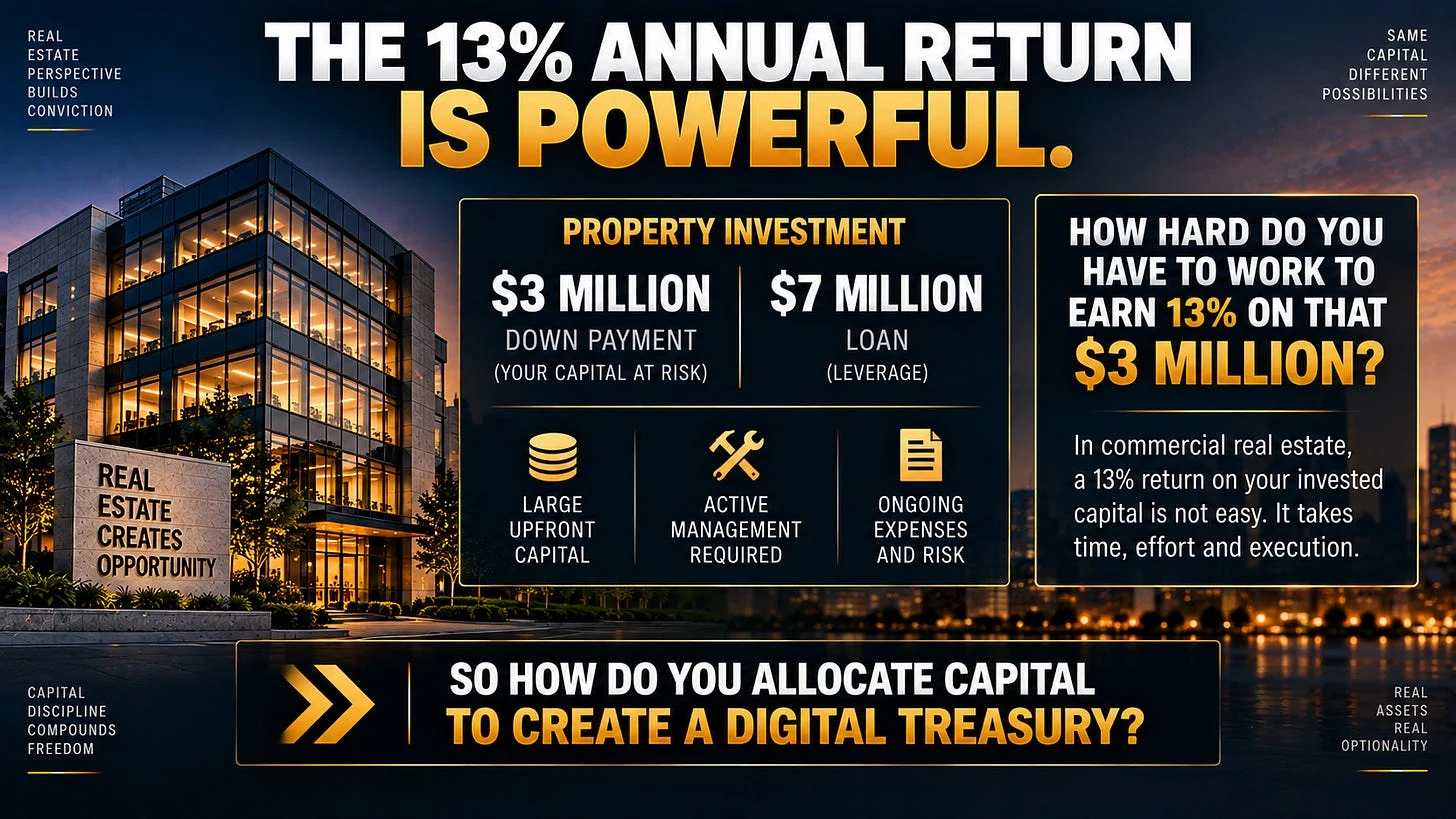
For example, if you buy a $10 million property, put $3 million down, and get a $7 million loan, you have to work very hard to generate a 13% return on the $3 million you invested in the property. So how do you allocate capital to create a digital treasury?
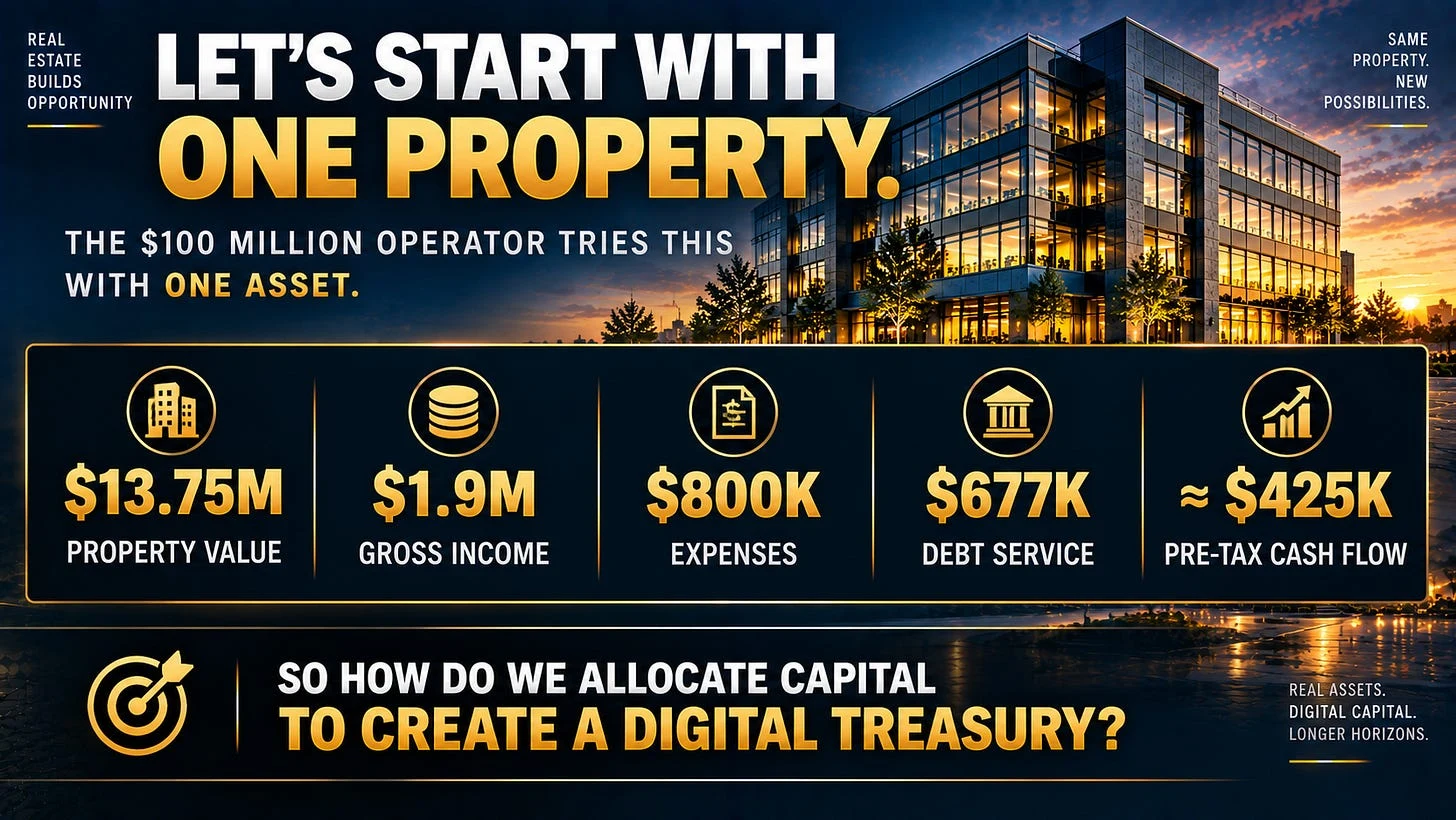
Let's say the $100 million operator wants to try this with just one of his properties. He bought one of his properties for about $13.75 million. It's got about $425,000 in profits, or what's called pre-tax cash flow.
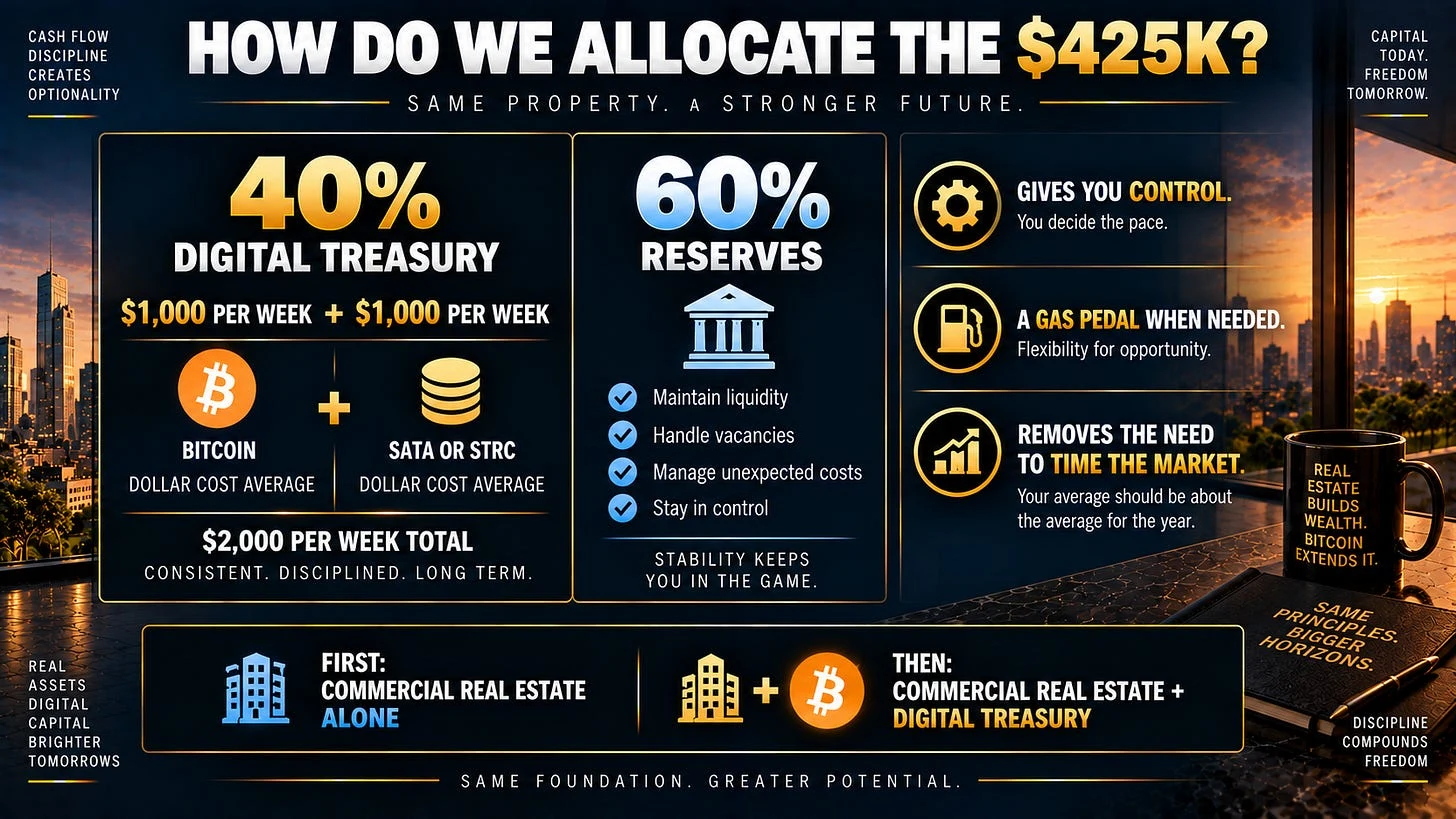
My suggestion is to allocate about 40% of that and leave 60% in the bank for reserves. Then you dollar-cost average. This gives you control. It gives you a gas pedal when needed. He’s going to allocate $1,000 a week to Bitcoin and $1,000 a week to SATA or STRC. At the end of the year, his average Bitcoin purchase price should be somewhere around the average price for the year, removing the need to try to time the market.
Let’s look at how commercial real estate performs on its own as a dynamic system, and then let’s see what happens when we add a digital treasury.
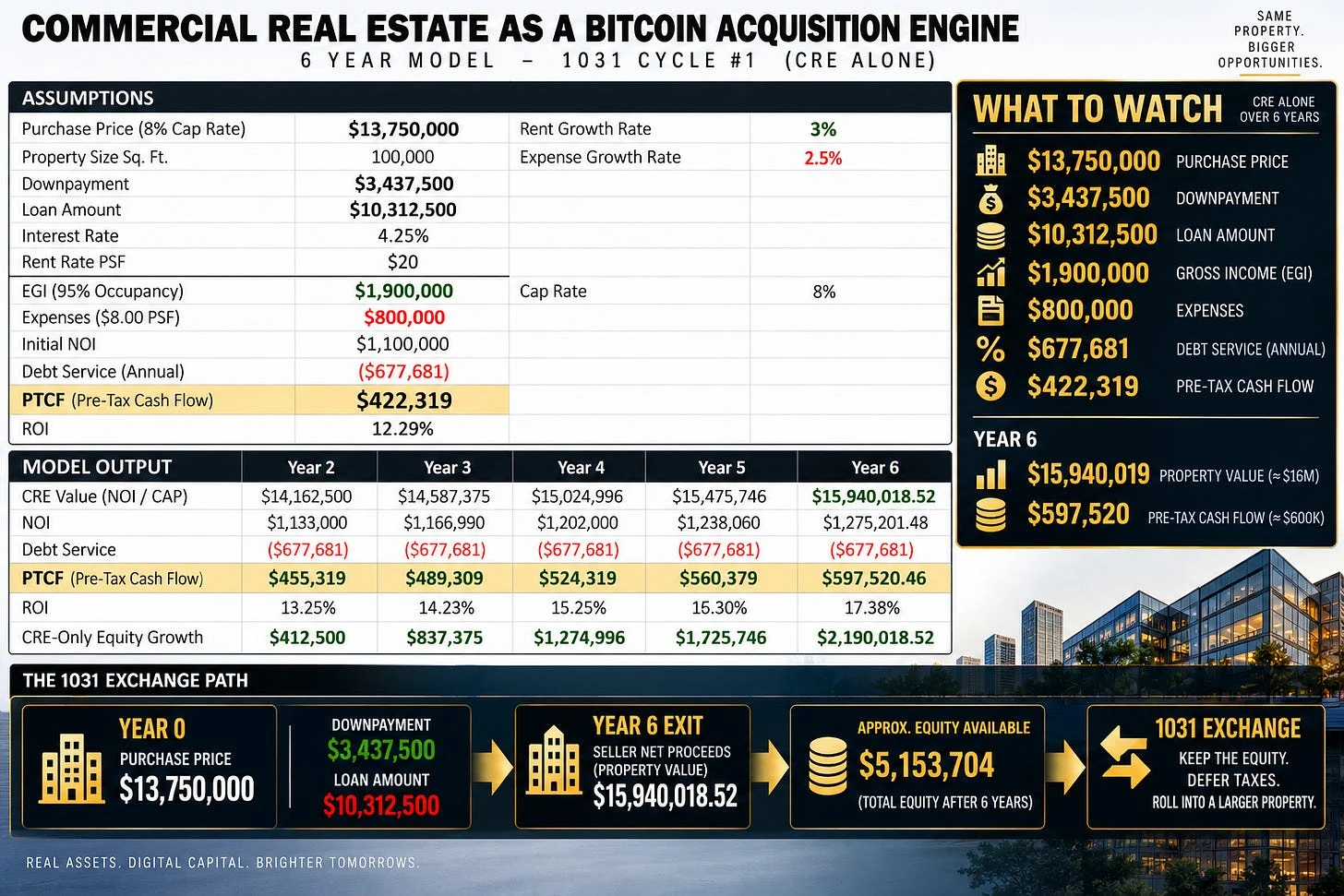
This spreadsheet shows the commercial property on its own over a six-year period. The property was purchased for $13.75 million with approximately $3.4 million down and a loan of just over $10 million. In year one, it generates approximately $422,000 in pre-tax cash flow. This is our baseline. Before we add Bitcoin or digital credit, let's see what commercial real estate does on its own.
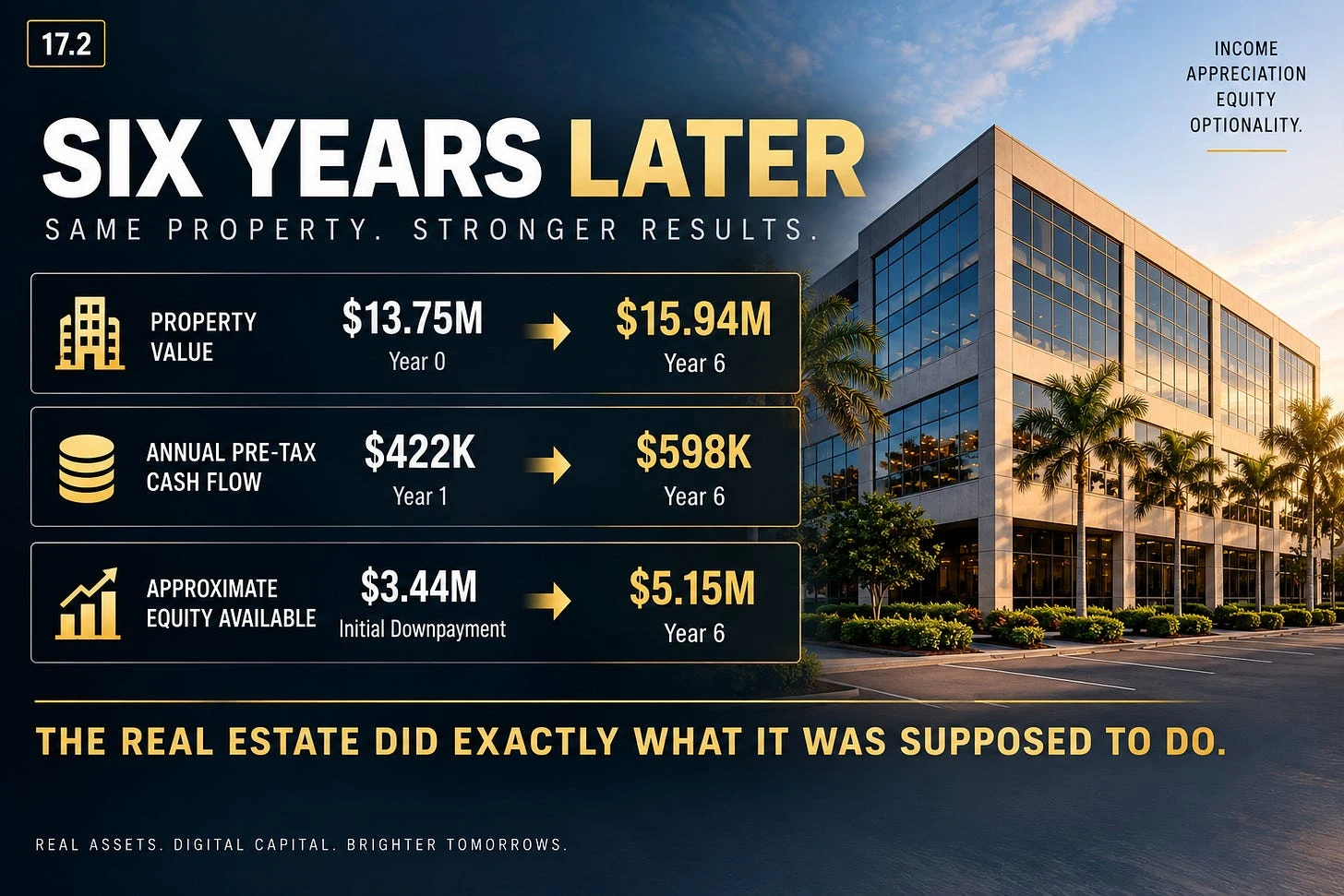
Now look at what happens over the six years that you own it. Rents increase, NOI grows, and the property appreciates. By year six, the building we bought for $13.75 million is worth approximately $16 million, and annual pre-tax cash flow has grown from about $422,000 to nearly $600,000. Our original $3.4 million of equity has grown to approximately $5.15 million.
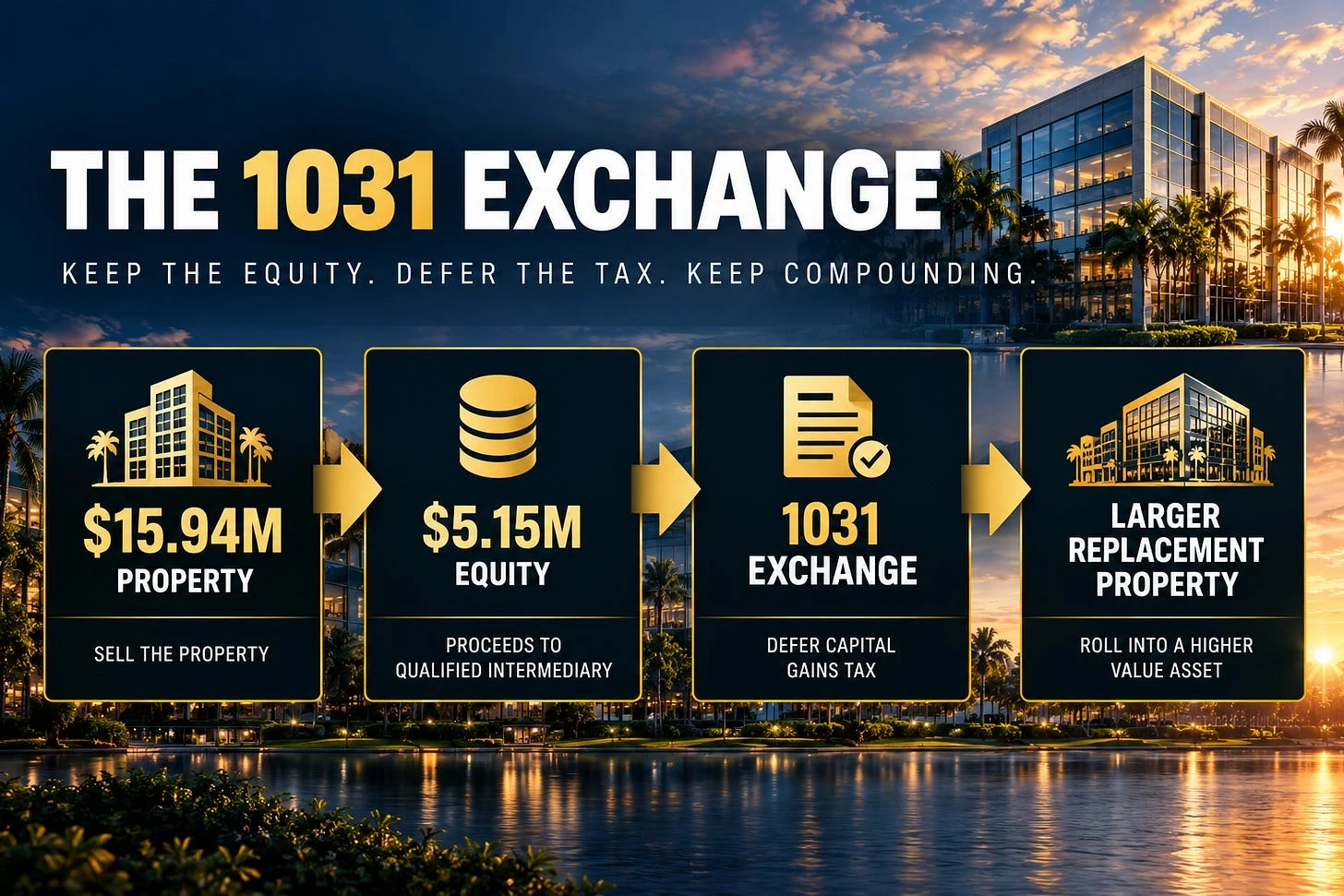
So let’s say a buyer comes along and says, “Hey, can I buy your building for $16 million?” And I say, “Yeah, I think that’s a good idea. I’d like to sell the building for $16 million.” But I don’t want to pay the capital gains taxes yet, and the building is now throwing off nearly $600,000 a year in pre-tax cash flow. I don’t want to give up that income either.
So I use the 1031 exchange. The property is sold, approximately $5.15 million of equity is transferred through a qualified intermediary, and I identify a qualifying replacement property of equal or greater value within the required time periods. The proceeds are rolled into the replacement property, the capital gains taxes are deferred, and the compounding continues.
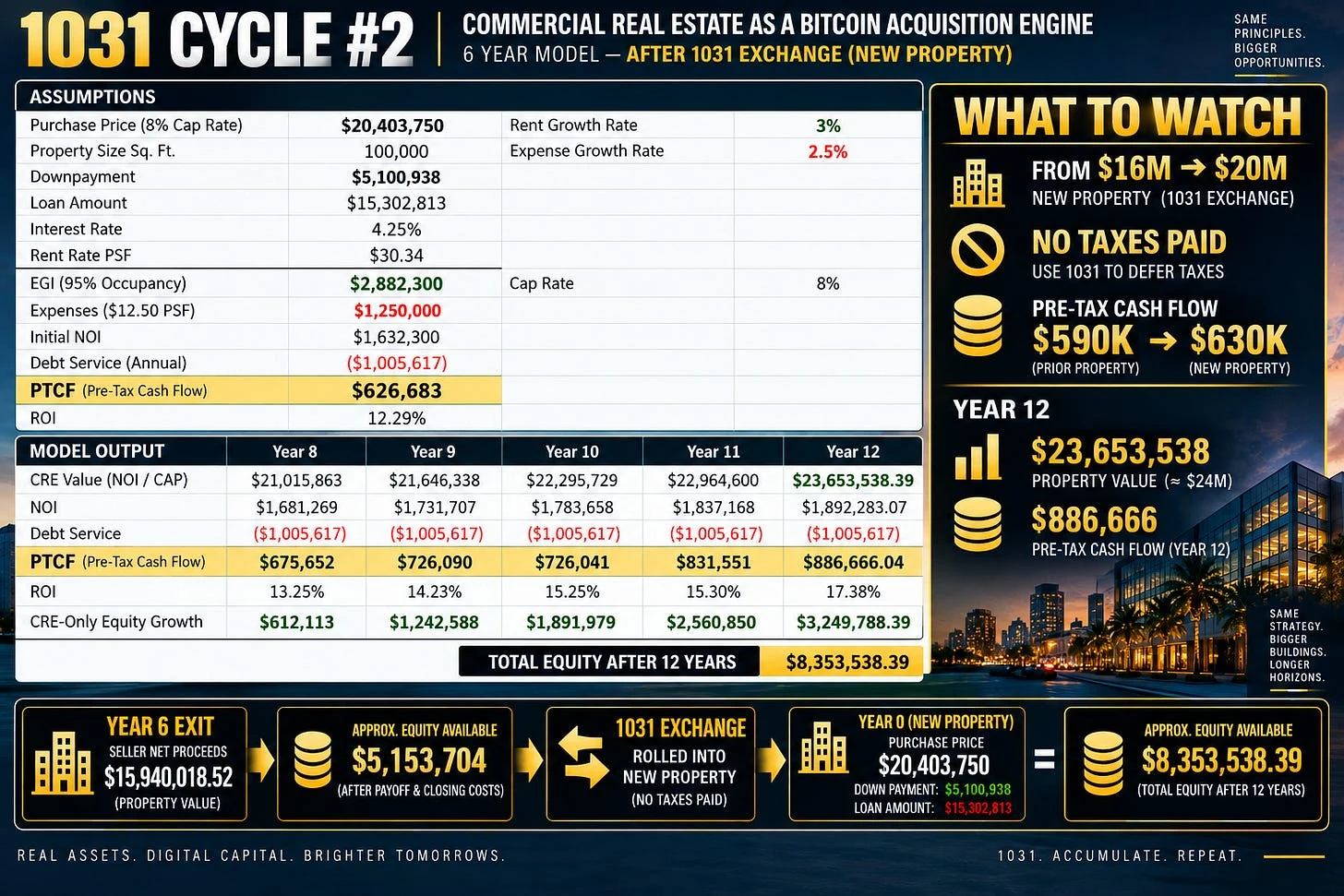
Then look what happens. I go from a $16 million building to a $20 million building. I deferred the capital gains taxes, and my pre-tax cash flow went from about $590,000 a year to $630,000 a year. And all I did was sell the building and roll the equity into the next property.
Now the same thing happens again. It’s another six-year hold. If the property is operated properly, by year 12 it’s potentially worth almost $24 million and generating about $886,000 in annual pre-tax cash flow. Same thing happens. Rinse and repeat. A buyer comes along, pays you $24 million, and you do another 1031 exchange.
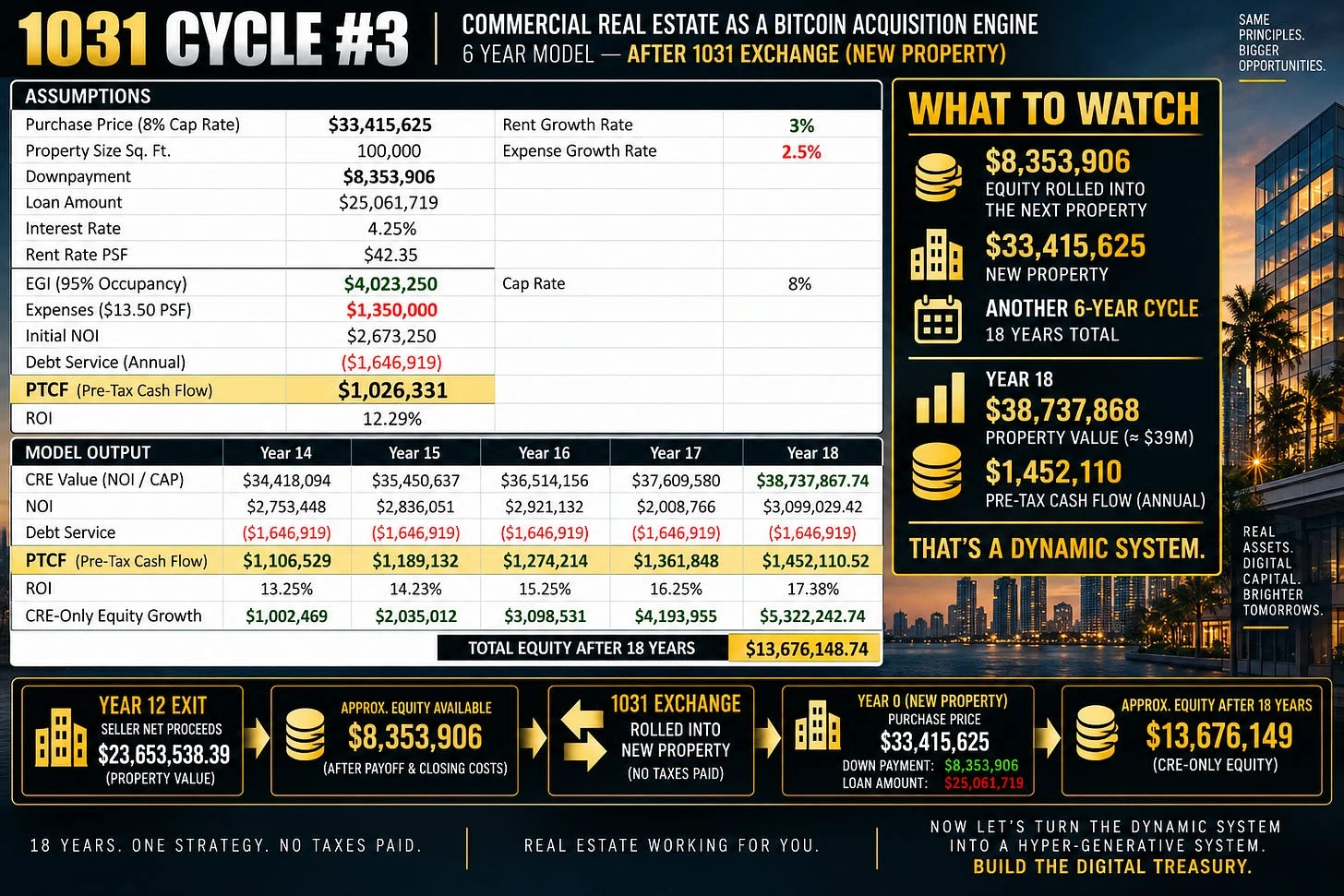
You take the $8.3 million of equity you have now and buy a $33 million building. Then we run another six-year cycle, bringing us to eighteen years. By the end of that cycle, the property is worth almost $39 million and generating about $1.45 million in annual pre-tax cash flow.
That’s great. That’s a dynamic system. But now let’s see what happens when we take this dynamic system and turn it into a hyper-generative system by building a digital treasury alongside it.
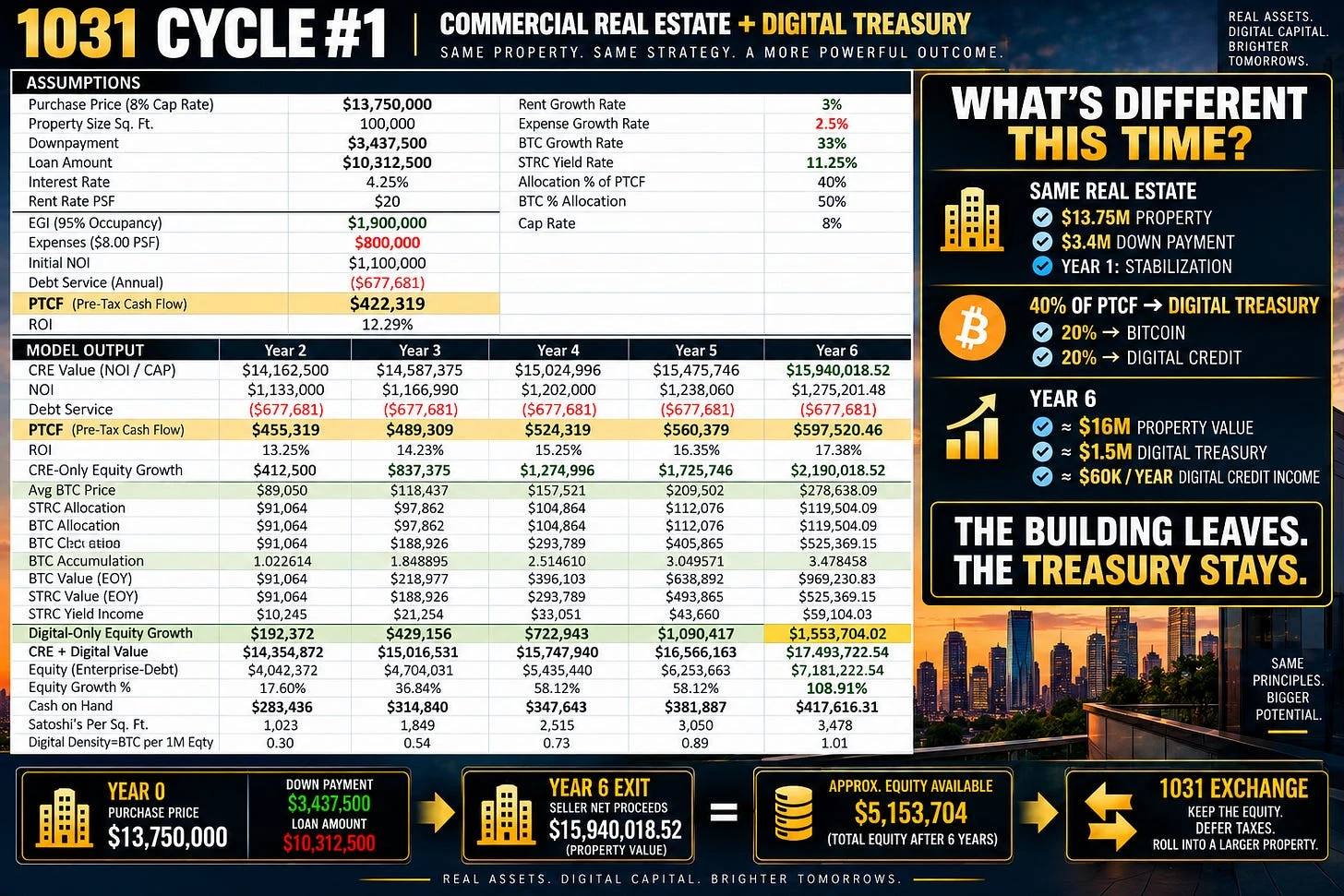
And, here we go. The real estate is the same. It’s the same $13.75 million building, with the same operating assumptions and the same six-year hold. But look at the bottom of the spreadsheet. We’ve added a digital treasury.
We’re allocating 40% of the property’s pre-tax cash flow into the digital treasury: half into digital capital, Bitcoin, and half into digital credit. The real estate hasn’t changed. We’ve simply added another engine.
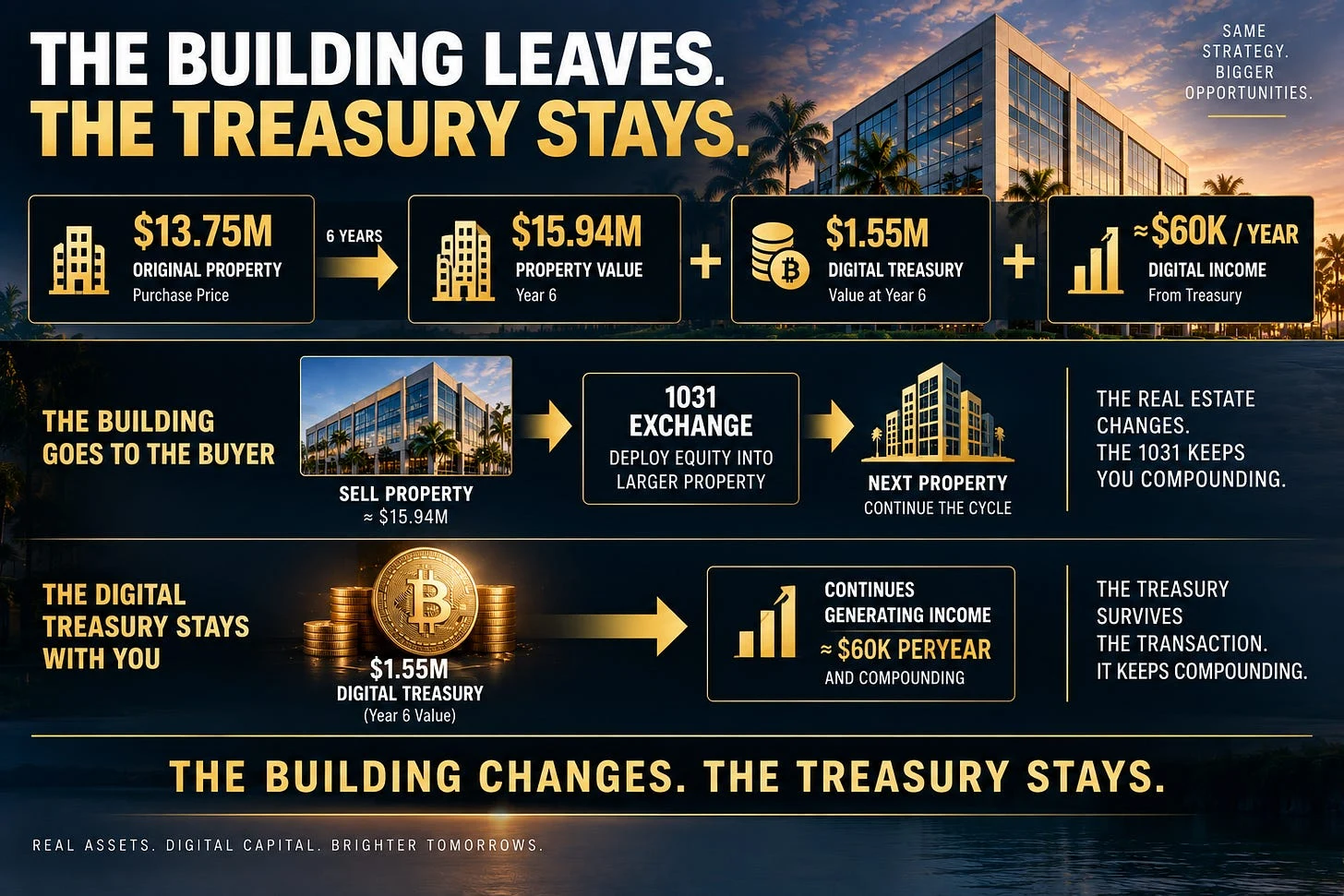
Now look at what happens by year six. A buyer comes along and wants to pay us approximately $16 million for the building we bought for $13.75 million. Just like before, we sell the property and complete the 1031 exchange.
But something is different this time. We also have a digital treasury worth approximately $1.5 million, generating about $60,000 a year in digital income. The building goes to the buyer. The digital treasury stays with us and continues compounding as we move into the next property.
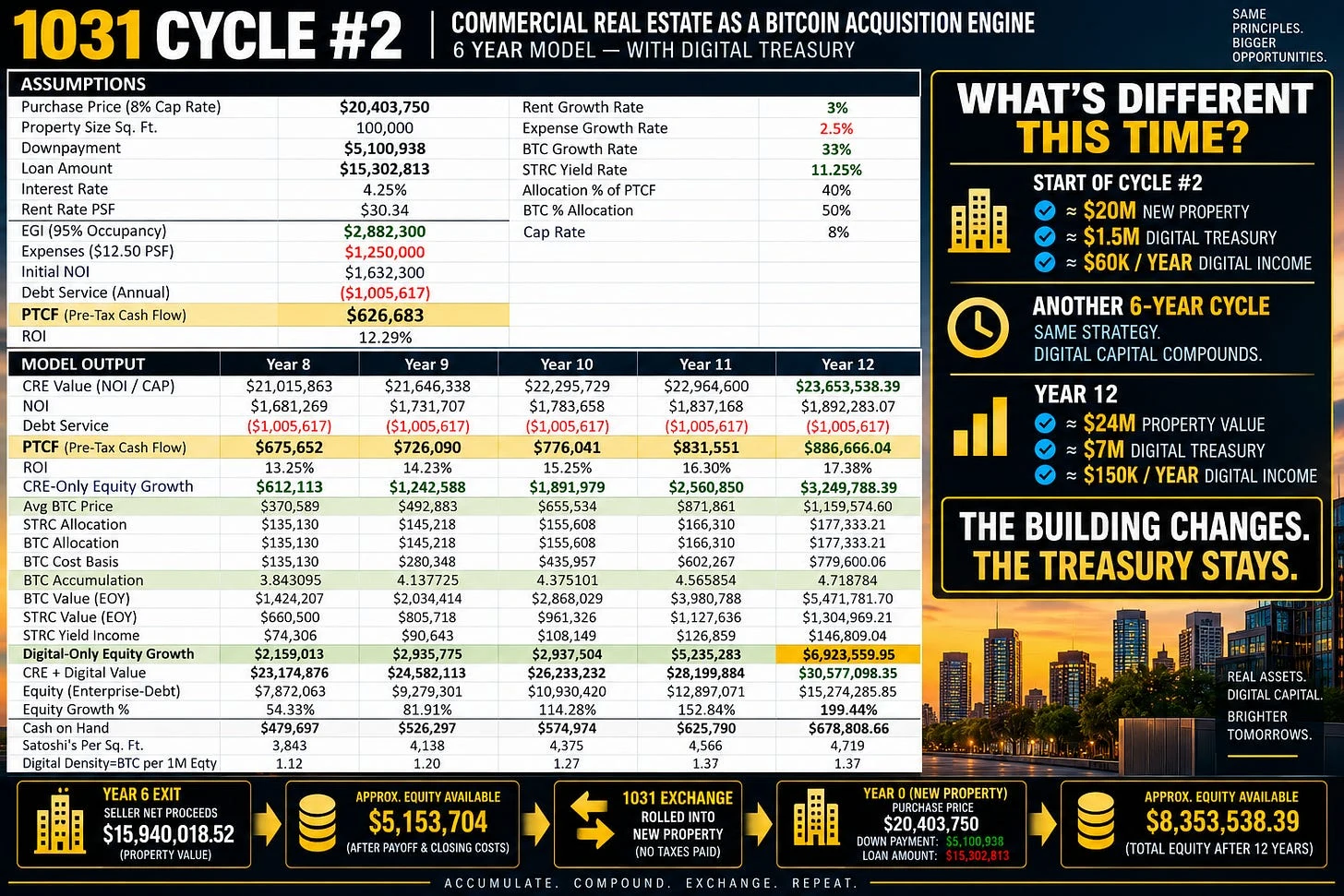
And boom! There we go. We bought the $20 million building just like we did last time. But now, in year one, we don’t just have the income from the building. We’ve also got about $60,000 a year in cash flow coming from our digital tenants, and a $1.5 million digital treasury insulating the asset.
Now look what happens over the next six-year cycle. By year 12, the property is worth about $24 million. A buyer comes along, buys the property, and we do another 1031 exchange. But now our digital treasury is worth almost $7 million, and it’s generating nearly $150,000 a year in cash.
So what happens? The building changes. The treasury stays.
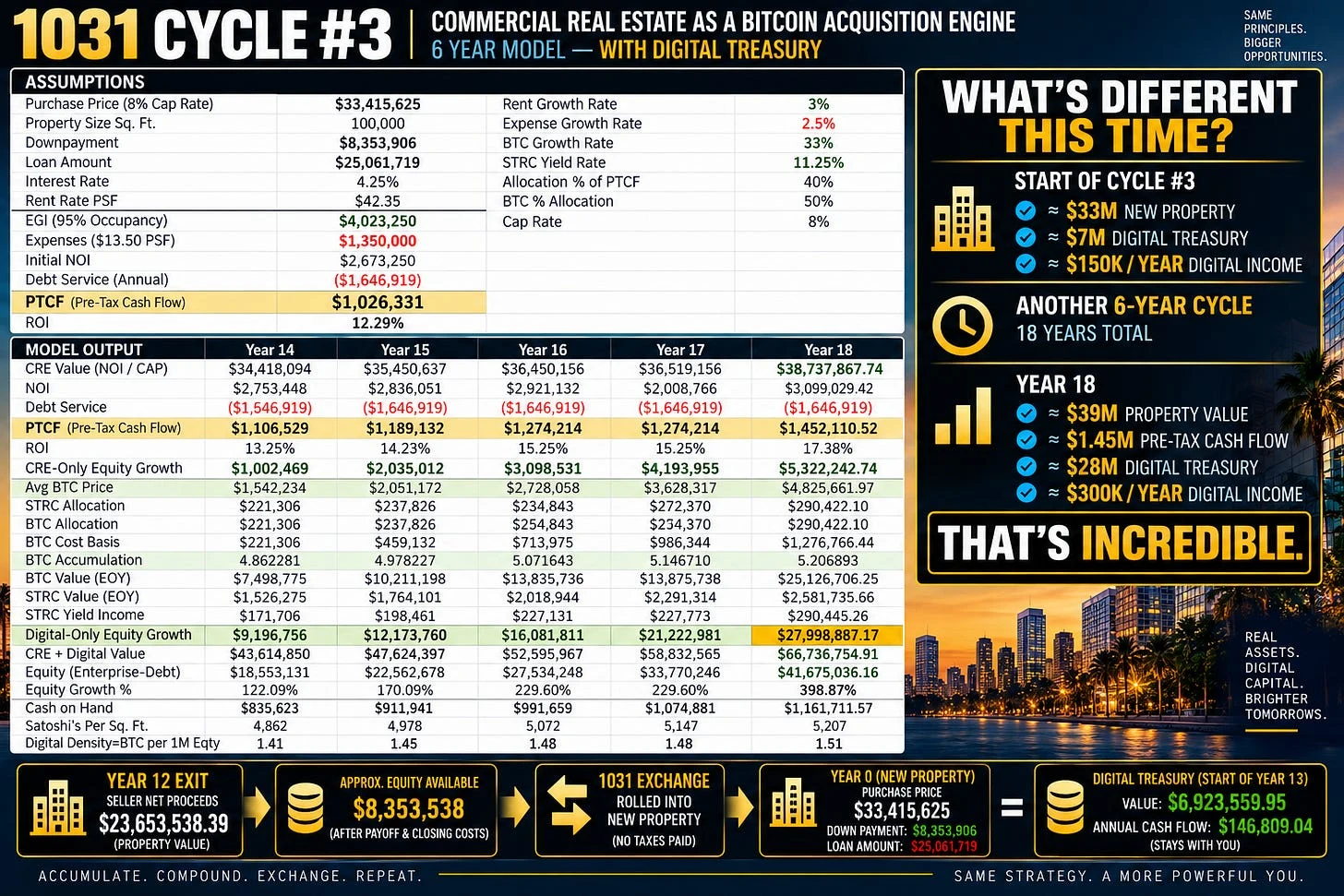
Now we buy the $33 million 1031 replacement property. In year one, we’ve got about $150,000 in annual income from our digital tenants, in addition to the income generated by the building.
Six years later, we reach year 18. The property is worth about $39 million and generating approximately $1.45 million in annual pre-tax cash flow, just like before. But now look at what else we have. Our digital treasury is worth approximately $28 million and generating about $300,000 a year in cash.
That’s incredible.
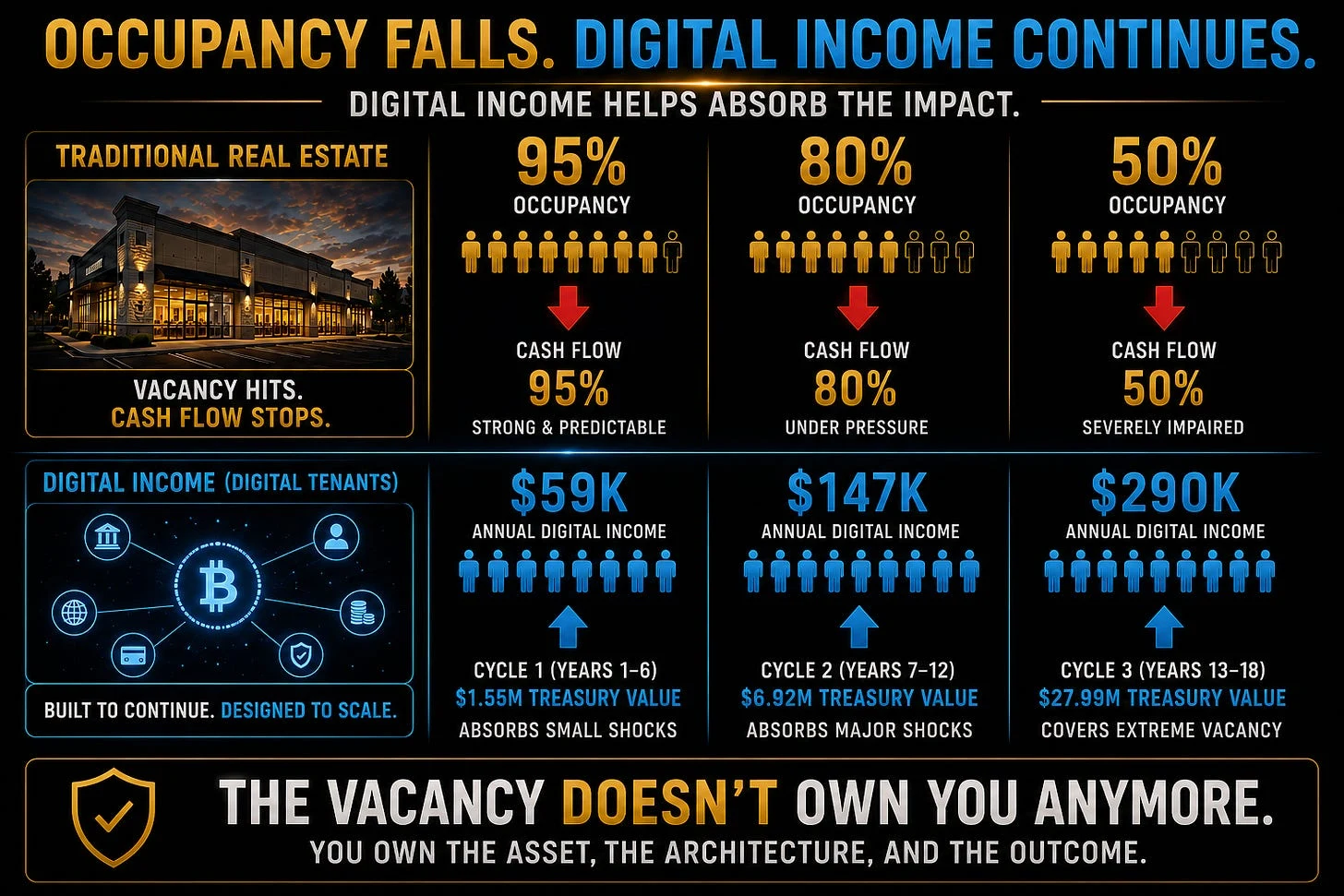
So now, when a tenant decides to leave or unexpectedly goes dark, the vacancy doesn’t own you anymore. This is every landlord’s wildest dream. Here is what it looks like.
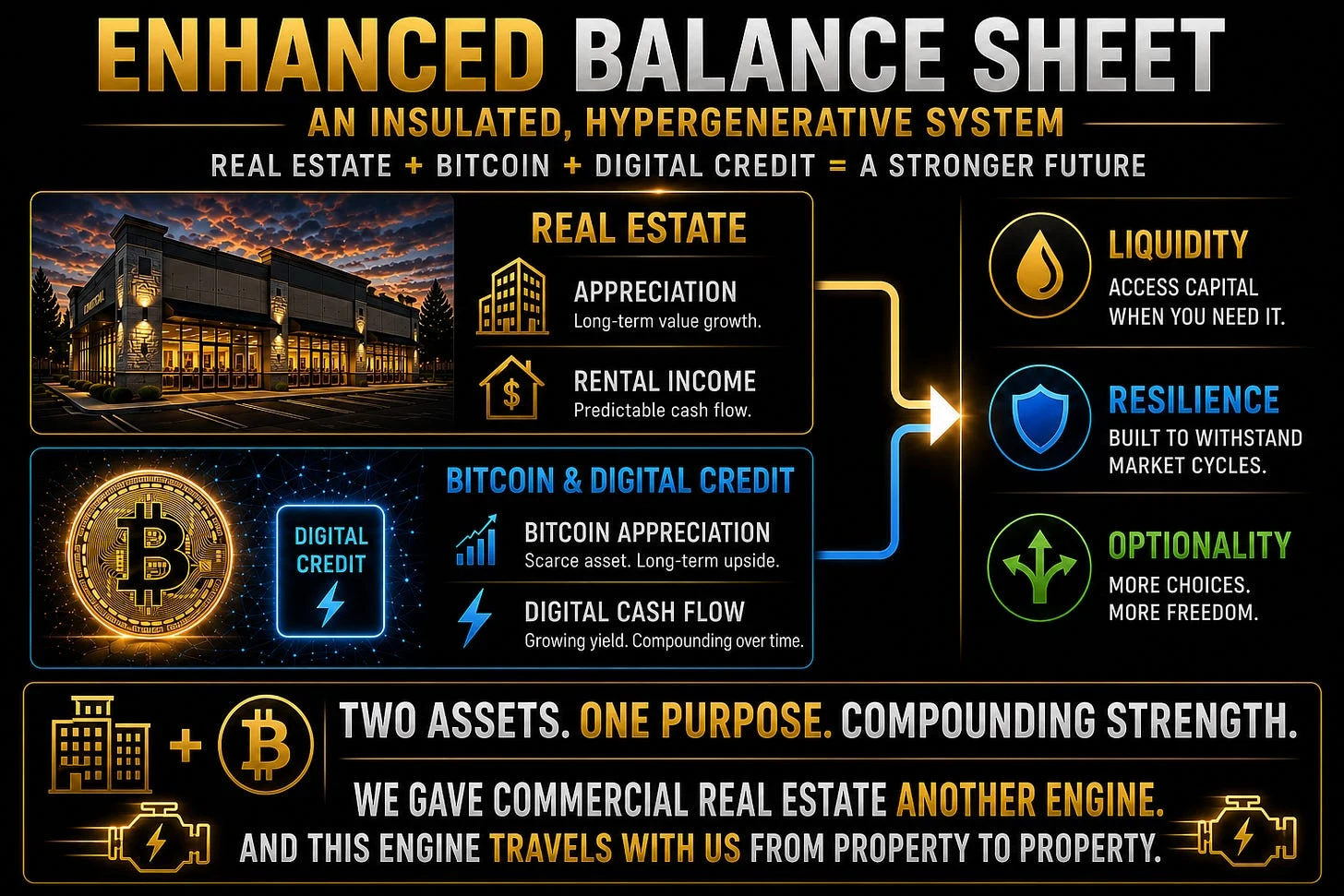
We've just transformed a dynamic system into an insulated, hyper-generative system. We have liquidity, resilience, and optionality. We're dealing from a position of strength. Eighteen years later, the real estate is still doing what real estate has always done: appreciating and generating cash flow. We've simply given it another engine, one that travels with us from property to property.

More Articles About Bitcoin
SkylarkOS Institutional Intelligence Summary: August 2026 Month-End
Structural liquidity strengthens as the Financial Liquidity Proxy eases and tactical momentum weakens. SkylarkOS reviews August 2026 month-end....
September 29, 2026
Qualified Custody vs Collaborative Multisig for Bitcoin
Qualified custody delegates key holding and signing to a provider under a contract; collaborative multisig keeps you as one of several required signer...
September 28, 2026
Best Bitcoin IRAs in 2026: Fees, custody and self-custody compared
Best Bitcoin IRAs in 2026: Fees, custody and self-custody compared Five providers account for much of the Bitcoin IRA market in 2026, but they are bui...
August 26, 2026
Podcast Conversations About Bitcoin


