- Bitcoin
- Bitcoin ETFs
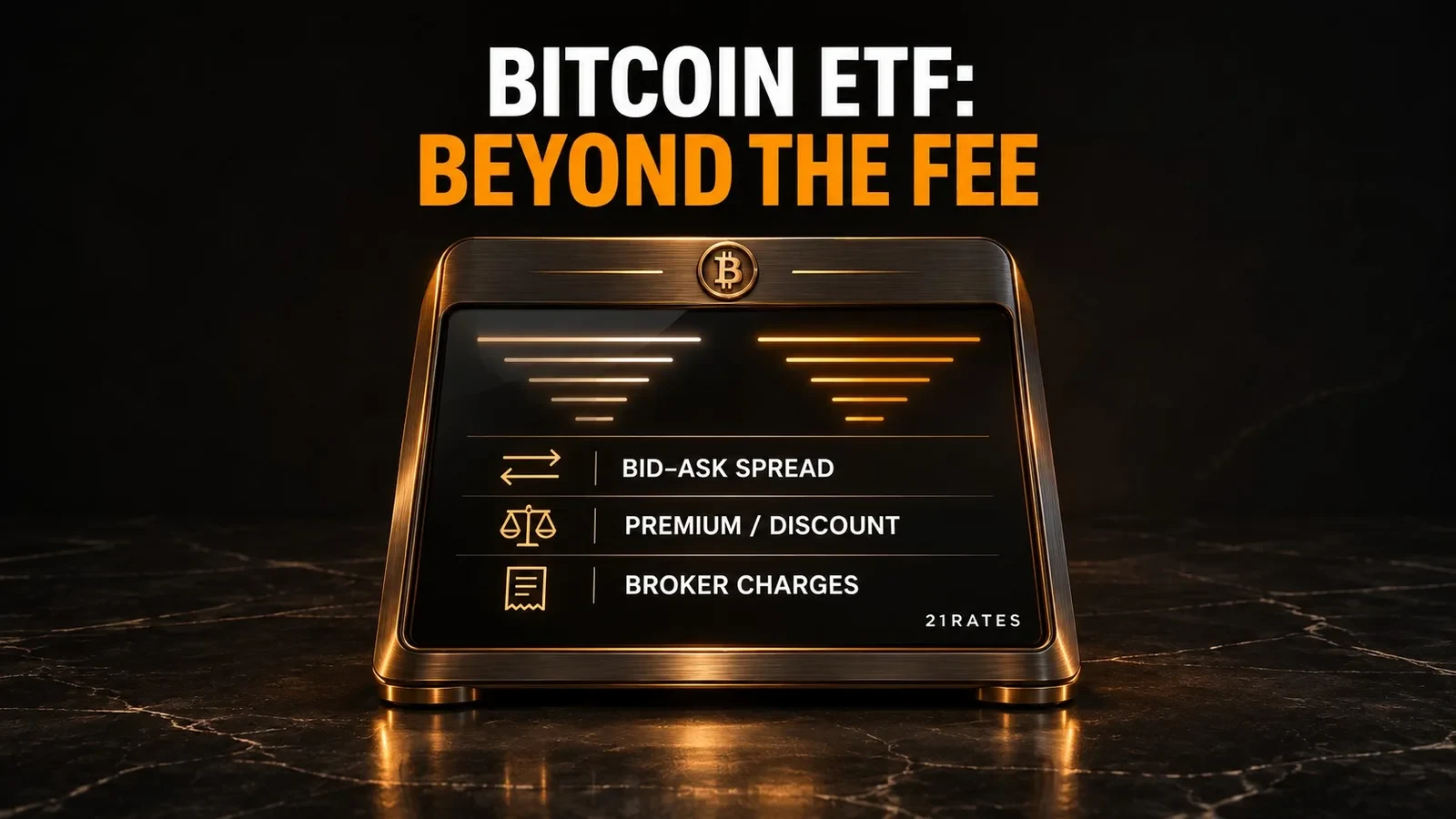
A spot Bitcoin ETF’s annual fee is not its full trading cost. You also need to check the bid-ask spread, whether the share price is above or below net asset value, and any brokerage charges. Compare these separately, rather than choosing on the annual fee alone. The SEC’s ETF investor bulletin explains these distinctions.
What a spot Bitcoin ETF costs to trade beyond its annual fee
| Item | What it tells you | Where to check |
|---|---|---|
| Bid-ask spread | The difference between the highest quoted buying price and the lowest quoted selling price, for the quantity quoted | Your broker’s quote; issuer disclosures for historical context |
| Premium or discount | Whether the market price is above or below net asset value per share | The issuer’s NAV, market-price and premium/discount disclosures |
| Brokerage charges | Commissions or other applicable account-level trading charges | Your broker’s fee schedule and trade review |
| Annual fund fee | The recurring expense of holding the fund, distinct from the trading quote | The prospectus expense disclosure |
The SEC bulletin, read 2026-11-09, identifies fund expenses, brokerage commissions and trading costs as separate considerations. It also explains that ETF market prices can differ from NAV and that ETF websites commonly publish historical premiums, discounts and median spreads. Source: SEC Investor.gov.
Read the quote in both directions
The bid is the highest price a buyer offers. The ask is the lowest price a seller accepts, for the quantity quoted. Their difference is the spread. Source: SEC Investor.gov.
Hypothetical quote, without numerical prices: Suppose the displayed ask is higher than the displayed bid. Buying at that ask and immediately selling at that bid would leave you with the difference as a loss before brokerage charges, assuming the quote remains unchanged and the quoted quantity is available.
The spread is a difference between prices, not a fixed charge added to every purchase. Do not simply add the entire displayed spread to the ask when estimating your purchase cost.
Compare market price with NAV separately
Net asset value, or NAV, is a different reference point from the bid and ask. A market price above NAV is a premium; a market price below NAV is a discount. Neither label is a separate broker invoice. Source: SEC Investor.gov.
The spread compares buying and selling quotes. The premium or discount compares market price with NAV. Treating both as interchangeable fees can lead to double-counting or a misleading comparison.
Check the dates and measurement periods alongside the figures. Historical disclosures give context, but they are not the quote for your proposed trade.
For a specific example, the iShares Bitcoin Trust ETF disclosures, read 2026-11-09, publish NAV, market price and a 30-day median bid/ask spread. Use those fields for different checks, rather than treating the median spread as a promised execution cost. Source: iShares disclosures.
Match the comparison to your decision
| Your decision | Put this check first | Keep this trade-off visible |
|---|---|---|
| Making a purchase now | Compare the bid, ask and your broker’s charges | A lower annual fee does not establish a lower entry cost |
| Planning repeated trades | Review trading charges and quote differences for each trade | A historical median spread does not describe every quote |
| Comparing holdings over time | Read the prospectus expense disclosure | Recurring expenses matter, but entry and exit prices still count |
Costs are not the only selection factor. The iShares trust seeks to reflect bitcoin price performance, and its disclosures direct readers to the prospectus for risks and costs. That is a statement about this product, not every Bitcoin investment structure. Source: iShares disclosures.
Your next check before submitting a trade
Open the issuer’s product page beside your broker’s order screen. Confirm the ticker, read the bid and ask with their quoted quantities, and check the broker’s applicable charges.
Then review the issuer’s NAV and market-price disclosures, their dates, and the prospectus expense section. If your comparison rests only on an annual fee or a historical median spread, finish those checks before choosing the fund.
Frequently asked questions
Does a commission-free trade mean there are no trading costs?
No. A commission-free offer does not settle your spread or premium/discount comparison. The SEC bulletin distinguishes fund expenses, commissions and trading costs.
Should I choose a fund just because it trades at a discount?
No. A discount describes market price relative to NAV, not the full cost of your proposed trade. Use the SEC’s distinctions to compare the discount alongside the spread, fund expenses and brokerage charges.
Can I stop at costs when choosing a Bitcoin fund?
No, read the product’s risk disclosures as well. For example, the iShares Bitcoin Trust ETF disclosures direct readers to its prospectus for risks and costs; that product-specific review belongs alongside your trading-cost comparison.
Read next
More Articles About Bitcoin
Bitcoin Loan APR vs Interest Rate: Compare Written Quotes
Compare APR with APR, not with a figure labeled only as interest. The dated 21Rates table uses different labels for Arch, Ledn and Unchained. Before c...
November 12, 2026
How Bitcoin loan collateral is held: Ledn vs Unchained
Ledn permits collateral re-posting under stated protections and describes reporting and proof-of-reserves checks. Unchained describes shared-key custo...
November 11, 2026
Bitcoin and the November Stock Market Selloff: What Changed
Bitcoin fell about 5.6% on Nov 5, 2026, while the Nasdaq fell 5.5%, IBIT fell 5.1% and MSTR fell 9.3%. These daily returns use different trading windo...
November 11, 2026
Podcast Conversations About Bitcoin

Buying Bitcoin Isn’t Enough | The Bitcoin Advice Nobody Talks About
Buying Bitcoin may be the beginning — but it shouldn't be the end. This conversation challenges the ...

Bitcoin's Biggest Obstacle Isn't What You Think | Ophelia Snyder
In this episode of The Daily Stack, we sit down with Ophelia Snyder, co-founder of 21Shares, the com...

Bitcoin Is Changing — Self-Custody, Saylor & the New Bitcoin Era
Bitcoin is changing — and the biggest debate may not be about price. In this episode, we dive into t...