- Bitcoin
- Bitcoin loans
The short answer
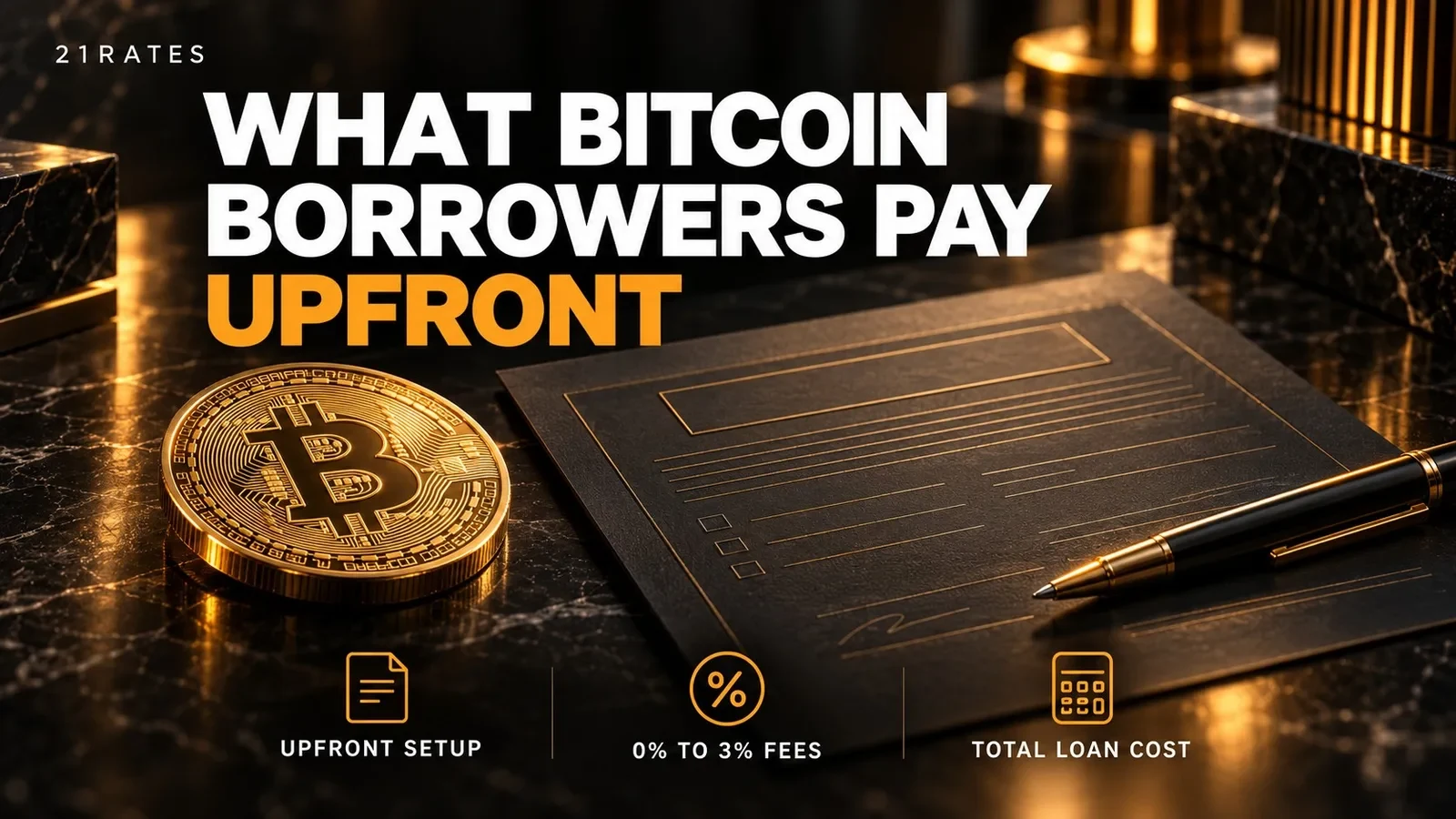
A bitcoin loan origination fee is a one-time charge a lender takes for setting up your loan, usually quoted as a percentage of the amount you borrow. It is separate from the interest that accrues over the life of the loan. In the 21Rates lender directory, with data as of October 29, 2026 and accessed October 30, listed origination fees range from zero to 3%. These are directory listings, not personalized quotes, so treat them as a starting point for questions rather than a final price.
If you are comparing lenders, the practical move is simple: ask what the quote includes, then compare total cost over the term you actually plan to borrow for.
What the origination fee is, and what it is not
Three distinctions clear up most confusion:
Origination fee versus interest rate. The origination fee is charged once, at or before funding. The interest rate describes what accrues on the balance over time. A loan can have a low rate and a high fee, or the reverse.
APR versus interest rate. APR is meant to fold certain borrowing costs into a single annualized figure, while a plain interest rate is not. The directory lists APR for most lenders, but Unchained lists "From 12% interest," which is an interest rate, not an APR, and should not be read as one. Because the basis of each lender's APR is not verified in the directory, do not add the origination percentage to a listed APR to build your own "true APR." Ask the lender directly whether the origination fee is already reflected in their APR figure.
Term versus total cost. A fee that looks small on a 12-month loan weighs much heavier on a 3-month loan, because you pay it once regardless of how long you borrow. The shorter your term, the more a one-time fee dominates your cost.
What the October 29 directory shows
All figures below are from the 21Rates lender comparison, data as of October 29, 2026, accessed October 30, 2026. They are directory listings, not personalized quotes.
| Lender | Listed rate | Origination fee | Term |
|---|---|---|---|
| Psalion Lend | 5.5% to 6.5% APR | 0.5% | 3 to 6 mo |
| Roxom Credit Line | From 7.25% APR | 0% | Not published |
| Arch Lending | 7.25% to 10.49% APR | 0.25% to 1.49% | 1 to 12 mo |
| STRIKE | 7.49% to 11.25% APR | 0% | 12 mo |
| SALT Lending | 7.49% to 10.5% APR | 0% | 12 to 60 mo |
| Lantern | From 8% APR | 2% | 12 mo |
| Figure Markets | 8.91% to 11.5% APR | 1% | 12 mo |
| Ledn | 9.25% to 11.49% APR | 0% | 12 mo |
| Crypto Lending by LendingUSA | 9.89% to 17.17% APR | 1% | 12 mo |
| APX Lending | 9.99% to 11.49% APR | 0% | 12 to 60 mo |
| Unchained | From 12% interest | 2% | 12 mo |
| GVNR / Diamond Hands | Rate not published | 3% | 12 mo |
Anchorage Digital and Coinbase list their origination fee as not published. Not published is not zero. It means you have to ask.
How to read the trade-offs
Zero origination is not a free loan. STRIKE, SALT, Ledn, APX, and Roxom all list 0% origination, but their APRs differ, and the interest over your term is still the main cost. A 0% fee paired with a higher APR can cost more than a 1% fee paired with a lower APR, depending on how long you hold the loan.
A fee can be worth paying for a shorter or more flexible term. Arch Lending lists terms from 1 to 12 months with an origination fee of 0.25% to 1.49%. If you only need liquidity for a few weeks, a lender offering a one-month term may beat a cheaper-fee lender that locks you into 12 months of interest.
Short terms amplify flat fees. Psalion Lend lists a 0.5% origination fee on 3 to 6 month terms. Paid once on a 3-month loan, that fee is a larger share of your total cost than the same fee on a longer loan.
High listed fees demand a reason. GVNR / Diamond Hands lists a 3% origination fee with the rate not published, and Unchained lists a 2% fee with interest from 12%. Before paying a fee at that level, you would want to know exactly what it buys: custody structure, underwriting, servicing, or something else.
What to ask before you sign
The directory numbers are a screening tool. Your quote is the decision tool. Ask each lender:
- Is the origination fee included in the APR you quoted me, or charged on top of it?
- Is the fee deducted from the loan proceeds at funding, or added to the balance?
- What other charges exist: closing, servicing, late, early repayment, or liquidation-related fees?
- Does the fee change with my LTV, loan size, or term?
A lender that lists 0% origination can still have other charges, and a lender with a published fee may quote you something different based on your profile. The only reliable comparison is the total cost each lender puts in writing for your specific loan.
A note on the directory itself
The 21Rates directory states that advertisers pay for Featured Spot placement, while comparison table data and rankings are not manipulated to favor advertisers or sponsors. That disclosure matters when you use any comparison page: know which placement is paid, and base your decision on the table data and your own quotes rather than on ordering.
Frequently asked questions
Is a 0% origination fee the same as a free bitcoin loan?
No. Zero origination only means there is no upfront setup fee. You still pay interest over the term, and other charges may apply. Several lenders in the October 29, 2026 directory list 0% origination with APRs that differ meaningfully from each other.
Does a lender's APR already include the origination fee?
It depends on the lender, and the directory does not verify the basis of each APR figure. Do not add the origination percentage to a listed APR yourself. Ask the lender whether the fee is reflected in their quoted APR or charged separately.
What does it mean when a lender's origination fee is not published?
It means the fee is not disclosed in the listing, not that it is zero. Anchorage Digital and Coinbase list their origination fee as not published in the October 29 directory. You need to request a written quote to find out what they charge.
How much does term length matter when comparing fees?
A lot. An origination fee is paid once, so on a short loan it makes up a larger share of your total cost. A 2% fee on a 12-month loan and the same fee on a 3-month loan are very different propositions, even at identical interest rates.
Are the rates in the directory the rate I will get?
Not necessarily. The figures are directory listings with data as of October 29, 2026, not personalized quotes. Your actual rate and fee will depend on your loan size, LTV, term, and the lender's underwriting.
Read next
More Articles About Bitcoin
Ledn Introduces Partial Liquidation for Bitcoin-Backed Loans Effective November 9, 2026
Ledn has published partial liquidation terms effective November 9, 2026. Under the terms, when a loan reaches its contract-defined liquidation LTV, on...
October 29, 2026
Bitcoin Tax Loss Harvesting: 2026 Rules for Direct Coins and ETFs
Bitcoin tax loss harvesting is selling bitcoin below your adjusted cost basis to realize a loss that offsets capital gains. SALT says current wash sal...
October 29, 2026
Borrow Against Bitcoin: How to Compare Loans Before You Commit
Borrowing against Bitcoin gives you cash without selling, but the loan is only as good as its structure. Start with who controls your collateral, then...
October 28, 2026
Podcast Conversations About Bitcoin

Buying Bitcoin Isn’t Enough | The Bitcoin Advice Nobody Talks About
Buying Bitcoin may be the beginning — but it shouldn't be the end. This conversation challenges the ...

Bitcoin's Biggest Obstacle Isn't What You Think | Ophelia Snyder
In this episode of The Daily Stack, we sit down with Ophelia Snyder, co-founder of 21Shares, the com...

Bitcoin Is Changing — Self-Custody, Saylor & the New Bitcoin Era
Bitcoin is changing — and the biggest debate may not be about price. In this episode, we dive into t...