- Bitcoin loans
- Bitcoin liquidation
- Loan-to-value
- Margin calls
- Collateral
Short answer
Borrowing against Bitcoin avoids an immediate sale, but it does not avoid liquidation risk. When you take a bitcoin-backed loan, your Bitcoin sits as collateral and nothing is sold at origination. If Bitcoin's price falls while your loan balance stays fixed, your loan-to-value (LTV) ratio rises. If it rises far enough, your lender can require you to fix the ratio, and if you do not, it can sell some or all of your collateral to cover the outstanding balance.
How collateral value drives LTV
LTV is the loan balance divided by the value of your collateral. Two things move it:
- Collateral value. Bitcoin's price falls, your collateral value falls, your LTV rises. This is the main driver and the one you cannot control.
- Loan balance. Repaying principal lowers LTV. Borrowing more raises it.
Ledn's published example puts a 50% LTV at about $2 of Bitcoin for every $1 borrowed (Ledn, read 2026-10-11). That ratio matters because it shows the buffer at origination: collateral worth roughly double the debt. A price drop eats into that buffer. A large enough drop removes it.
What a margin notice can require
When LTV crosses a lender's notice thresholds, the lender typically notifies you and asks you to bring the ratio back down. Ledn states it notifies borrowers at 70% and 75% LTV, and says borrowers can top up BTC, make a full or partial repayment, or use Auto Top-Up where available (Ledn, read 2026-10-11).
Those three options are the practical menu on most bitcoin-backed loans, though the specifics live in your loan agreement:
- Top up collateral. Add Bitcoin so the denominator grows and LTV falls.
- Repay. Pay down some or all of the loan so the numerator shrinks.
- Automated top-up. Some lenders can move Bitcoin you have pre-positioned with them without waiting for you to act.
The window between a notice and forced sale is a product term, not an industry constant. Read your agreement for it before you sign.
What a collateral sale can look like
Ledn's page describes liquidation as automatic and irreversible at or above 80% LTV: collateral is sold to cover the outstanding balance, a 0.50% trade spread is applied, and any remainder is returned to the borrower (Ledn, read 2026-10-11).
Three features of that example are worth internalizing, and all three are Ledn-specific:
- Automatic and irreversible. Once the threshold is hit, the sale happens without further borrower action and cannot be undone.
- Sold to cover the balance. The lender sells enough to clear the debt, not necessarily your entire position.
- Costs come out of the sale. A trade spread applies, and only the remainder comes back to you.
These thresholds and mechanics are Ledn's current published terms as of the date above. Other lenders set different notice levels, different sale triggers, different spreads, and different cure windows. Do not assume any single lender's numbers are the market standard.
The decision guide
The question is not whether liquidation exists. It is which loan structure leaves you enough room and enough control to manage it. Compare the full account structure, not just the advertised trading fee.
| Decision factor | What to check | Why it changes the answer |
|---|---|---|
| Notice thresholds and cure window | At what LTV does the lender notify you, and how long do you have to act? | A longer, earlier warning gives you room to top up or repay instead of being sold out. |
| Sale trigger | Is sale automatic at a set LTV, or discretionary? | Automatic sales remove negotiation room; discretionary ones depend on the lender's process. |
| Sale costs | What spread or fees apply to a forced sale? | Costs come out of your collateral, so they reduce what you get back. |
| Collateral control | Who holds keys, and can you verify collateral on-chain? | Unchained describes its commercial loans as bitcoin-backed with multisig collateral and on-chain verification, with a key the customer controls (Unchained, read 2026-10-11). Control affects what happens if the lender has problems, not whether price-driven liquidation can occur. |
| Top-up mechanics | Can you pre-position collateral or automate top-ups? | Automation can act faster than you can, but it also commits your Bitcoin in advance. |
Unchained notes that actual rates, payments, costs, program terms, and conditions can vary and that borrowers should review the loan agreement for actual terms (Unchained, read 2026-10-11). That instruction applies to any lender: the agreement, not the marketing page, is the document that governs your liquidation terms.
What to do next
- Before signing, find three numbers in the loan agreement: the notice LTV, the liquidation LTV, and the cure window between them.
- Model your own downside. At your starting LTV, work out how far Bitcoin's price would have to fall to reach the notice level, then the sale level. If that range is uncomfortably tight, borrow less.
- Decide in advance how you would respond to a notice: pre-positioned Bitcoin for top-up, cash for repayment, or both.
- Read the sale mechanics: spread, fees, whether the sale is partial or full, and what happens to the remainder.
For the pre-signing comparison across lenders, including custody models and counterparty risk, see the 21Rates guide to bitcoin-backed loans and LTV, which covers the questions to settle before you commit collateral.
One thing to hold onto
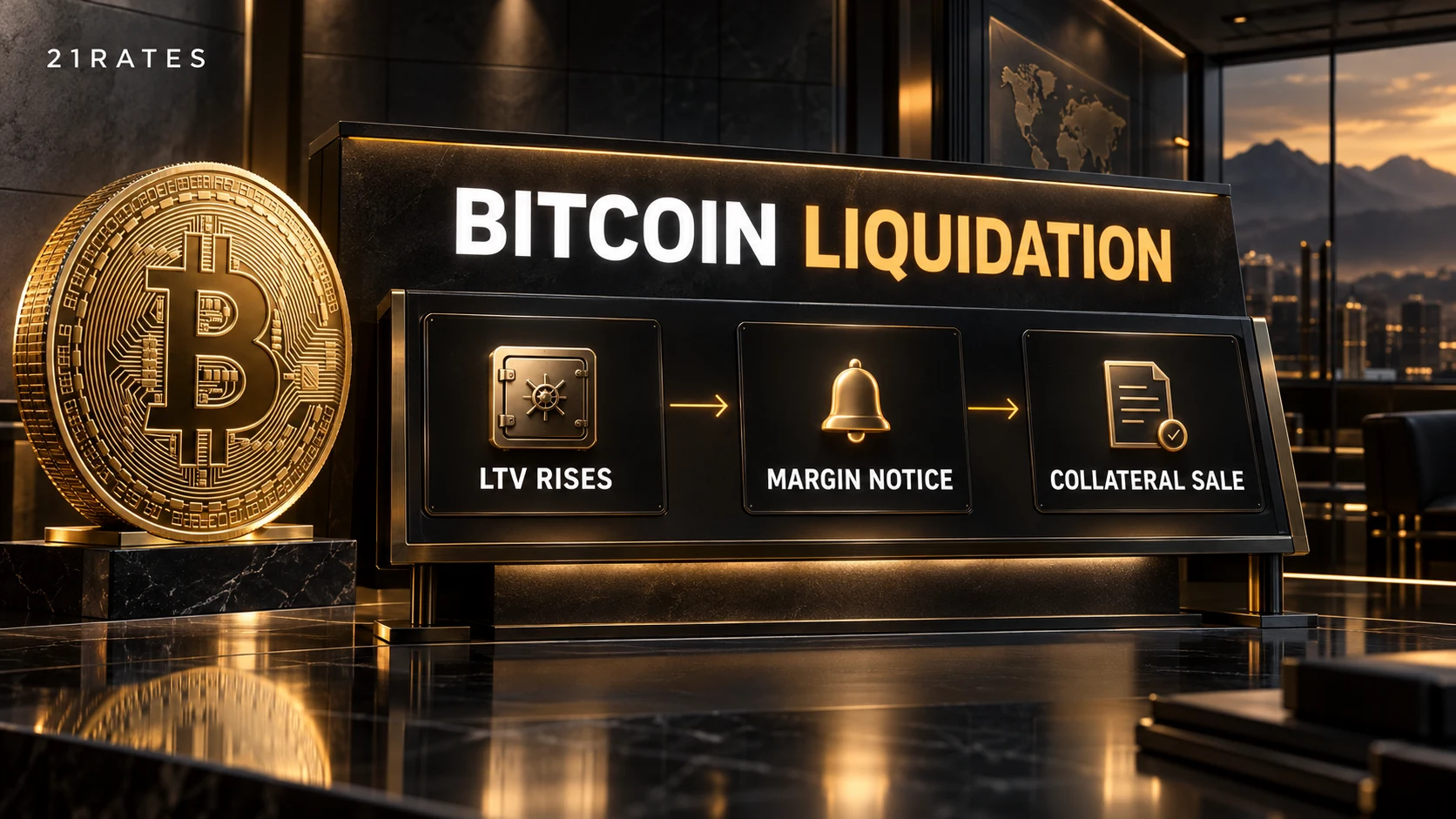
A bitcoin-backed loan converts price risk into a sequence: price falls, LTV rises, notice, cure, possible sale. Each step has terms you can read before you borrow. The loan does not force an immediate sale, and it does not protect you from one. What it gives you is a documented process, and the quality of that process is the thing worth comparing.
Frequently asked questions
Does borrowing against Bitcoin mean my coins get sold right away?
No. In a bitcoin-backed loan your Bitcoin is pledged as collateral and nothing is sold at origination. The sale risk appears later, if Bitcoin's price falls enough that your LTV crosses the lender's notice and liquidation thresholds.
What happens if I get a margin notice and ignore it?
If you do not top up collateral or repay, the lender can proceed to sell collateral to cover the outstanding balance. In Ledn's published example, liquidation at or above 80% LTV is automatic and irreversible, but each lender's process and timing are set in its own loan agreement.
Is there a universal safe LTV for bitcoin-backed loans?
No. Ledn's example describes notices at 70% and 75% LTV and automatic liquidation at or above 80%, but those are Ledn's terms, not market rules. The right starting LTV depends on your lender's thresholds, your tolerance for a forced sale, and your plan for responding to a notice.
Does holding my own key prevent liquidation?
No. Key control affects who holds your collateral and how you can verify it, which Unchained addresses with multisig and on-chain verification on its commercial loans. Price-driven liquidation is a function of the loan terms, so it can occur under any custody arrangement.
What do I get back after a collateral sale?
In Ledn's published example, collateral is sold to cover the outstanding balance, a 0.50% trade spread is applied, and any remainder is returned to the borrower. Check your own agreement for the applicable spread, fees, and whether the sale is partial or covers your whole position.