- Bitcoin
- Digital Assets
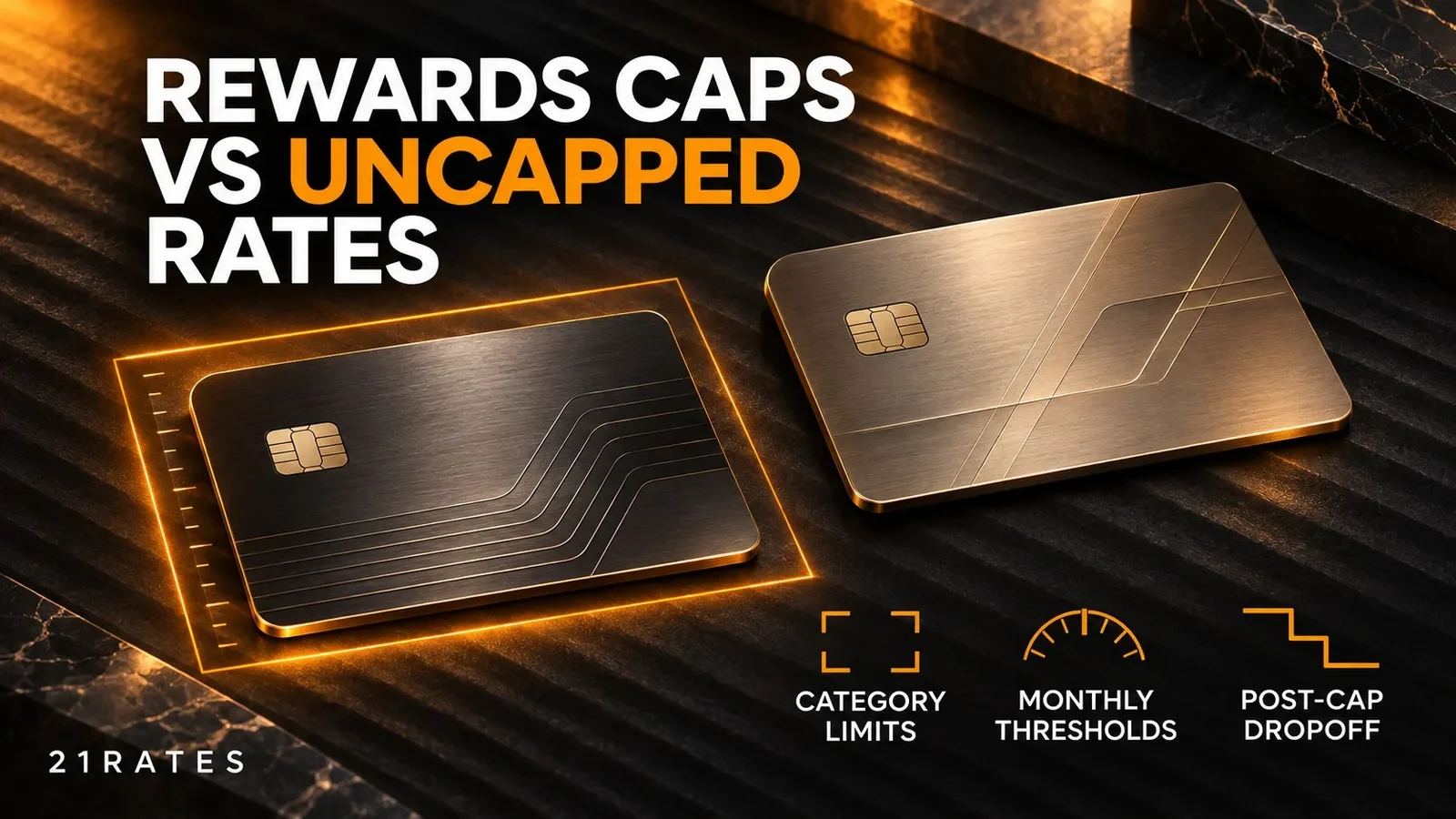
Bitcoin credit card rewards caps are the spend limits after which your earn rate drops. They matter more than the headline percentage, because the headline rate only applies until the cap, and everything after that earns at the lower rate. If you are comparing cards, the decision is not which card advertises the biggest number. It is which card's structure matches where your spending actually goes each month.
There are three cap structures you will see on bitcoin rewards cards:
- Category cap: a high rate on specific categories, but only up to a monthly spend limit in those categories. After that, the rate falls to the base rate.
- Balance-qualified boosted tier: a higher rate unlocked by holding a qualifying balance, usually capped at a monthly spend ceiling.
- Uncapped base rate: one flat rate on every purchase, with no monthly ceiling.
Two cards in the 21Rates directory show how different these structures can be in practice.
Side by side: Gemini Credit Card and Fold Credit Card
These are 21Rates directory-listed terms, not independently verified issuer terms. The Gemini profile displays Last verified: Oct 29, 2026, and the Fold Credit Card profile displays Last verified: Oct 28, 2026, both read November 2, 2026. Check current issuer terms before applying.
| Condition | Gemini Credit Card | Fold Credit Card |
|---|---|---|
| Headline rate | 4% on gas, EV charging and transit | Up to 5% with Fold Reserve |
| Cap on headline rate | First $300 per month in those categories, then 1% | First $5,000 per month |
| Condition for headline rate | None listed beyond the category | Reserve tier: $100,000 balance required for 5%, lower Reserve tiers of 1.75% to 4% |
| Other category rates | 3% dining, 2% groceries | Not listed as category-based |
| Base rate | 1% on everything else | 1.5% back in bitcoin on every purchase, uncapped |
| Annual fee | $0 | $0 |
| Issuing bank and network | WebBank, Mastercard | Celtic Bank, Visa |
Sources: Gemini Credit Card profile, Fold Credit Card profile.
What happens after the cap
This is the part most comparison pages skip.
Gemini: the 4% rate applies to the first $300 per month across gas, EV charging and transit combined, per the 21Rates listing. Spend past that in the same month and those purchases earn 1%, the same as everything else outside the bonus categories. So the value of the 4% tier depends entirely on whether your monthly fuel and transit spend sits under or over that line. If it sits well over, most of that category's spend earns the base rate, and the card behaves more like a flat 1% card with a small monthly bonus.
Fold Credit Card: the base rate of 1.5% back in bitcoin is listed as uncapped, so there is no monthly ceiling on what the base earns. The boosted Reserve rates are a separate layer: up to 5% on the first $5,000 per month, with the 5% tier requiring a $100,000 qualifying balance and lower Reserve tiers listed at 1.75% to 4%. The 21Rates listing does not specify the exact post-cap payout on Reserve-tier spending, how eligible balances are defined, or how the Reserve cap combines with the base rate. Those are questions to take to Fold's current terms, not assumptions to make from the headline.
Which structure fits which spender
The right choice depends on your spending pattern and whether you want a balance requirement attached to your earn rate.
- If most of your monthly spend is fuel, EV charging or transit, and it stays near or under the category cap, a category-capped card concentrates its value where you spend.
- If your spending is spread across many categories, or is large enough that any cap would be hit early in the month, an uncapped flat base rate is easier to model and does not cliff after a threshold.
- If you already hold a qualifying balance with the issuer and spend within the boosted ceiling, a balance-qualified tier can pay more, but the rate is conditional. The trade-off is that your card rewards are now tied to keeping assets in one place, which is a counterparty and concentration decision, not just a rewards decision.
None of these structures is universally correct. The trade-off is between a higher conditional rate and a lower unconditional one.
Questions to check in current issuer terms
Directory listings are dated snapshots. Before you act on any of this, confirm in the issuer's own current terms:
- Is the cap per category or combined across bonus categories, and does it reset monthly by calendar month or statement cycle?
- What exactly counts toward a qualifying balance for boosted tiers, and what happens to your rate mid-cycle if the balance drops?
- What rate applies to spending above a boosted tier's monthly ceiling?
- Are rewards paid in bitcoin directly, or in points converted to bitcoin, and at what conversion terms?
- Have any rates, caps or tier thresholds changed since the directory's last verified date?
A separate decision: whether to use a credit card at all
Rewards caps only matter if carrying the card makes sense for you in the first place. Whether paying in full makes bitcoin credit cards worthwhile is a different question with its own trade-offs, and it is covered separately. Caps decide how much you earn. The pay-in-full question decides whether the card earns you anything net at all.
Frequently asked questions
What is a bitcoin credit card rewards cap?
It is a spend limit after which your earn rate drops. A card might pay a high rate on a category up to a monthly dollar limit, then pay its lower base rate on spending past that limit. The cap, not the headline rate, determines what heavy spenders actually earn.
Is the Gemini 4% rate uncapped?
No. The 21Rates Gemini Credit Card profile lists 4% on gas, EV charging and transit only on the first $300 per month, then 1% after that. Dining is listed at 3% and groceries at 2%, with 1% on everything else.
Does the Fold Credit Card pay 5% on everything?
No. The 21Rates listing shows up to 5% only on the first $5,000 per month, and only through Fold Reserve tiers, with the 5% tier requiring a $100,000 qualifying balance. The base rate is 1.5% back in bitcoin on every purchase, listed as uncapped.
Are these the current issuer terms?
They are 21Rates directory-listed terms with verification dates of late October 2026, read November 2, 2026. They are not independently verified issuer promises, so confirm rates, caps and tier conditions in the issuer's current terms before applying.
Which card earns more?
It depends on where your spending goes and whether you meet a balance requirement. Category-capped cards concentrate value in specific categories up to a limit, while an uncapped flat rate is easier to model for broad or high-volume spending. Compare the post-cap rate against your actual monthly pattern.
More Articles About Bitcoin
Strategy's Average Bitcoin Price: What the $75,446 Cost Basis Tells You
Strategy's average bitcoin purchase price is approximately $75,446 per coin on 848,517 bitcoin, per its October 26, 2026 Form 8-K. A November 1, 2026 ...
November 1, 2026
Is My Bitcoin Safe on an Exchange? What the Binance Incident Changes
Is my bitcoin safe on an exchange? An exchange holds your private keys, so safety depends on that company's security, reserves and insurance. Binance'...
October 31, 2026
Bitcoin Loan Origination Fees: What Borrowers Actually Pay Upfront
A bitcoin loan origination fee is a one-time setup charge, separate from interest over time. In the 21Rates directory dated October 29, 2026, listed f...
October 30, 2026
Podcast Conversations About Bitcoin

Buying Bitcoin Isn’t Enough | The Bitcoin Advice Nobody Talks About
Buying Bitcoin may be the beginning — but it shouldn't be the end. This conversation challenges the ...

Bitcoin's Biggest Obstacle Isn't What You Think | Ophelia Snyder
In this episode of The Daily Stack, we sit down with Ophelia Snyder, co-founder of 21Shares, the com...

Bitcoin Is Changing — Self-Custody, Saylor & the New Bitcoin Era
Bitcoin is changing — and the biggest debate may not be about price. In this episode, we dive into t...