- Bitcoin
- Stablecoins
- Regulations
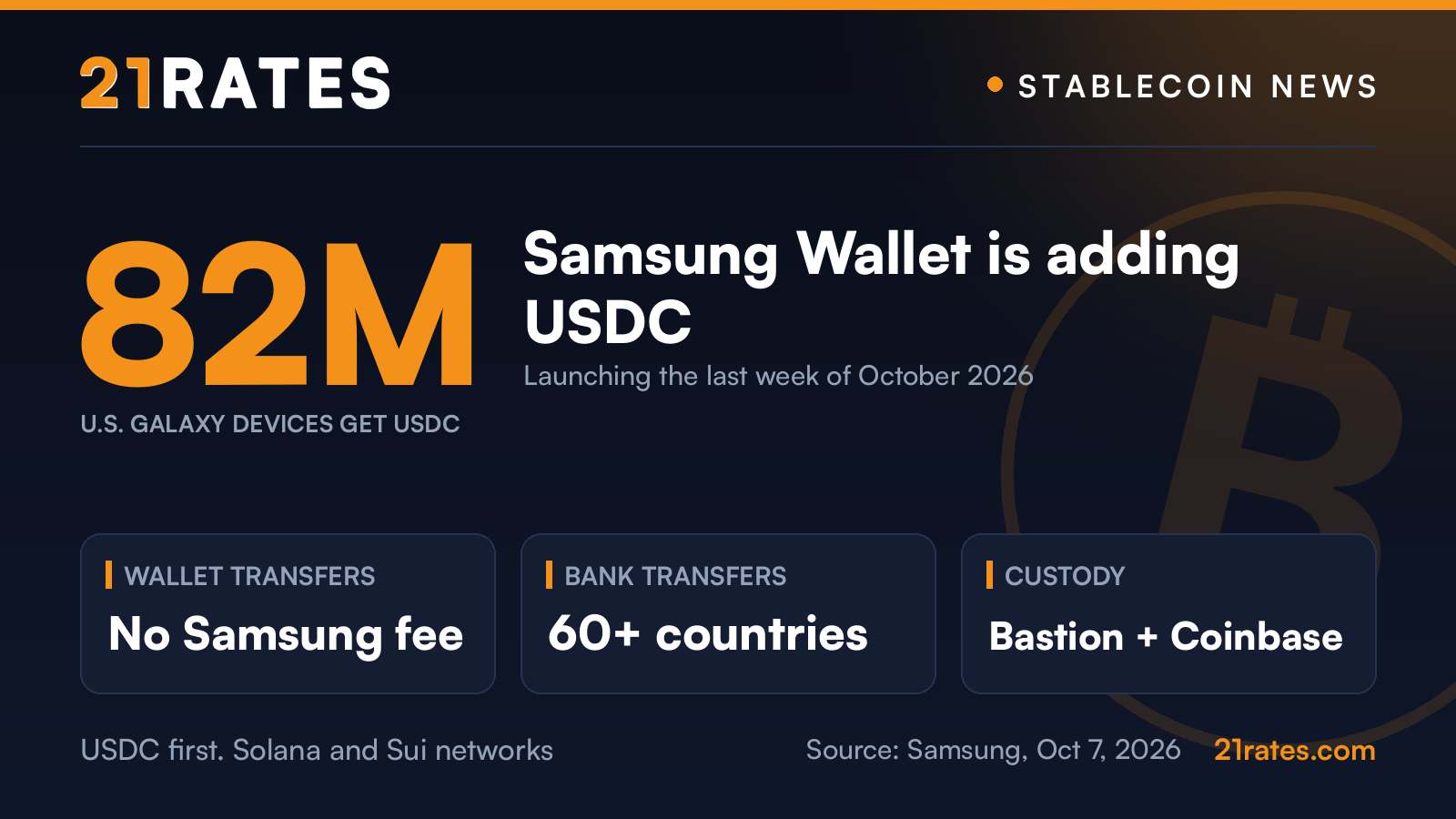
Samsung is putting USDC inside Samsung Wallet. Samsung Electronics America said on October 7, 2026 that eligible Galaxy users in the United States will be able to buy USDC and send it to crypto wallets or to bank accounts in more than 60 countries, starting in the last week of October. The feature reaches 82 million U.S. Galaxy devices, with custody handled by Bastion and Coinbase rather than Samsung itself.
For anyone who holds dollar stablecoins, earns on them, or borrows against bitcoin, this is a distribution story. A dollar stablecoin is about to sit next to the credit cards on one of the two big phone platforms in America.
Key takeaways
- Samsung Wallet supports USDC first. The "Buy Stablecoin" button defaults to USDC. Launch is the last week of October 2026 for eligible U.S. Galaxy users.
- Transfers to compatible external crypto wallets carry no Samsung fee. Bank transfers to 60 plus countries carry fees shown in the app before you confirm.
- Bastion, a licensed stablecoin custodian with a New York trust charter, runs the accounts. Coinbase is the sub-custodian, holding the USDC in Coinbase Prime Vault.
- Solana and Sui provide blockchain network support. Samsung says it does not hold customer funds.
- Online and tap-to-pay stablecoin payments are listed as a possible next step.
What exactly did Samsung announce?
The announcement came from Samsung Electronics America on October 7, 2026. Stablecoin functionality arrives in Samsung Wallet in the last week of October for eligible Galaxy users in the United States. USDC is the only supported stablecoin at launch.
Eligible users will see a "Buy Stablecoin" option in the app. From there they can send USDC to a compatible third party crypto wallet or exchange account with no transfer fee from Samsung, or send money to a qualifying bank account in more than 60 countries, paid out in local currency. The bank transfers carry fees that vary by country and amount.
Eligibility is limited to U.S. residents 18 or older with a Samsung account, on Galaxy devices running Android 13 or higher. Identity verification and biometric setup are required.
Who is actually holding the USDC?
Not Samsung. The company says it is not a bank, money transmitter or digital asset custodian and does not hold customer funds.
Accounts, custody and money movement run on Bastion, which holds a New York trust charter and has preliminary conditional approval from the OCC for a national trust bank charter. Bastion uses Coinbase as its sub-custodian, and the USDC sits in Coinbase Prime Vault. Solana and Sui provide network support, as TechRepublic also reported.
Samsung tied the launch to the arrival of a U.S. regulatory framework for stablecoins. Circle, the issuer behind USDC, became a federally chartered trust bank earlier this year.
Why does this matter for people who hold or earn on stablecoins?
Until now, holding USDC meant picking an exchange or a self custody wallet and learning how it worked. Samsung Wallet removes that step for tens of millions of people, which means more USDC in circulation and more demand for places to put it.
Samsung's version is a spending and remittance tool, not a savings account. It does not pay interest. Anyone who wants a return on stablecoins still has to move them to a platform that offers one, and those platforms vary widely in rates, counterparty risk and custody. Know who holds the asset, how the yield is generated, and what happens if the platform fails.
What does it mean for bitcoin-backed borrowing?
Most bitcoin-backed loans are paid out in dollars or a dollar stablecoin, and USDC is a common choice. Coinbase's bitcoin-backed loans, for example, are disbursed in USDC through Morpho on the Base network. A borrower often ends up holding USDC and then needs a way to spend it.
Samsung Wallet adds a mainstream off ramp for exactly that balance: send the loan proceeds to a Galaxy phone, then pay a bank account abroad or forward them to another wallet. If Samsung ships online and tap-to-pay payments, loan proceeds could go straight to checkout. Phone level distribution of USDC fits the direction our Q3 2026 lending review described.
How should you compare your options?
The Samsung news does not change the numbers that matter when you borrow. Rates, loan to value limits, custody and liquidation terms still decide the outcome.
21Rates tracks 21 bitcoin lenders side by side, with published rates from 1.0% to 17.2%, maximum LTV, minimum loan size, term and who holds the collateral. Start with the lender comparison, and read the LTV and liquidation guide before you sign. If the plan is to hold rather than borrow, the custody comparison covers 23 custodians, including the qualified custodians that now sit behind consumer products like this one.
Nothing here is financial advice. A stablecoin on a phone is still a claim on a custodian, and a loan against bitcoin is still a loan.
FAQ
When does USDC arrive in Samsung Wallet? The last week of October 2026, for eligible Galaxy users in the United States on Android 13 or higher.
Does Samsung charge a fee to send USDC? No fee for transfers to compatible external crypto wallets. Bank transfers to more than 60 countries carry fees that vary by destination and amount, shown in the app before you confirm.
Who custodies the USDC in Samsung Wallet? Bastion runs the accounts and money movement. Coinbase is the sub-custodian and holds the USDC in Coinbase Prime Vault. Samsung does not hold customer funds.
Can I earn interest on USDC in Samsung Wallet? Samsung has not announced any yield feature. Earning a return on stablecoins means moving them to a separate platform, with its own risks and terms.
Source: Samsung Electronics America newsroom, October 7, 2026.
More Articles About Bitcoin
U.S. Government Moves $1 Billion in Seized Bitfinex Bitcoin: What It Means
The U.S. government moved 12,267 BTC ($1.01B) from a Bitfinex-hack seizure wallet on Oct 8, 2026. No sale is confirmed. What it means for BTC holders....
October 8, 2026
The State of Bitcoin-Backed Lending, Q3 2026: A Smaller Market With Better Habits
Crypto lending shrank to $56.16B in Q2 with no blowups. How Coinbase, Arch, Strike, Ledn and Unchained compare on rate, LTV, custody and transparency....
October 7, 2026
Skylark Digital Assets — Institutional Intelligence Summary: September 2026 Month-End
Michael Pierre examines competing cycle scenarios: a rollover or an extended expansion, alongside September liquidity, funding, and Bitcoin network re...
October 6, 2026
Podcast Conversations About Bitcoin


