
- Bitcoin
- Custody
- Security
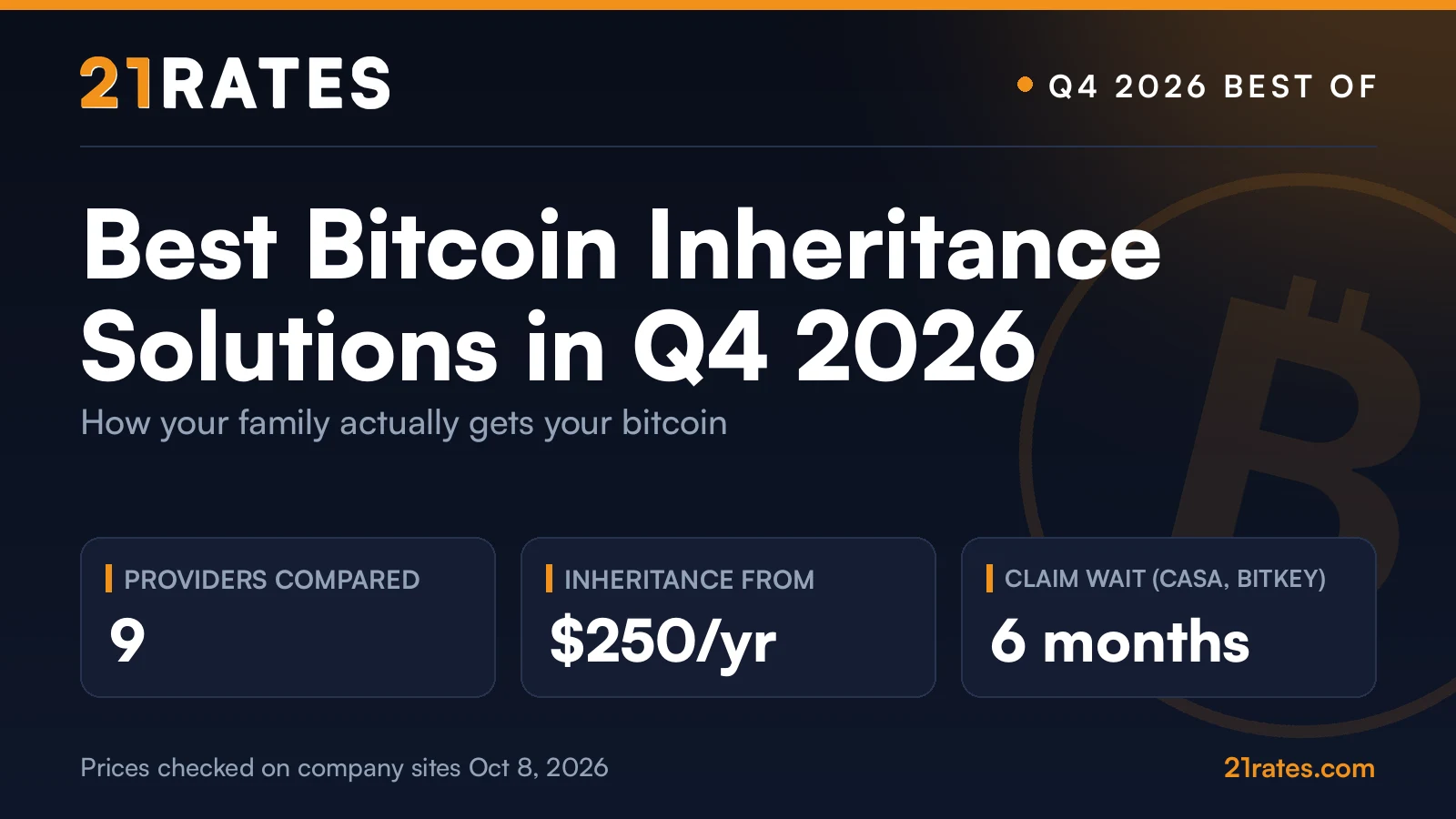
For most bitcoin holders, the best inheritance setup in Q4 2026 is collaborative multisig with a plan your family can actually follow. Casa Standard is the cheapest full package at $250 a year with inheritance built in, Unchained is the pick if you want the legal side and the custody side built together, and Nunchuk's Honey Badger plan ($480 a year) is the strongest option if you want timelocks and no KYC.
Every price below comes from the company's own site, checked Oct 8, 2026.
Key takeaways
- Casa Standard costs $250 a year and includes inheritance. Your heir gets a key that only unlocks after a six month inactivity check.
- Unchained vaults run $250 per vault a year. Its Inheritance Boot Camp, built with Gannett Wealth Advisors, costs $4,000 and covers estate documents plus a trust vault.
- Nunchuk Honey Badger ($480 a year) gives you a dedicated inheritance key and a choice of on-chain or off-chain timelock.
- Bitkey ($250 hardware) has inheritance in the app, with a six month waiting period you can cancel if you're still around.
- Onramp and AnchorWatch spread custody across institutions and are priced for larger balances.
What is the best bitcoin inheritance solution in Q4 2026?
The honest answer is the one your family can execute without you. A seed phrase in a drawer works just as well for a thief as for an heir. Every service here mixes multisig, a waiting period and paperwork your executor can follow.
If you want to compare more providers side by side, our bitcoin inheritance page has the full list.
Best overall value: Casa
Casa's Standard plan is $250 a year with a 30-day free trial, and inheritance is included. You add a recipient, assign them a key in your vault, and they can only use it after you pass. When they file a claim in the Casa app, Casa runs a six month inactivity check before they can move anything. Premium is $2,100 a year and Private Client is $7,500.
Pros:
- Inheritance included at the entry price
- Waiting period protects you from an early or fake claim
- Works alongside your will or trust
Cons:
- Six months is a long wait for a family that needs funds
- Hardware is extra on Standard
Best for a complete legal and custody plan: Unchained
Unchained charges $250 per vault per year for its collaborative multisig vaults. Its inheritance system includes an Inheritance Protocol (documents that walk your executor through recovery), trust vaults, transfer-on-death beneficiaries and Connections, which let family members get familiar with the setup without getting access.
The standout is the Inheritance Boot Camp: $4,000 per client, four meetings co-delivered with Gannett Wealth Advisors, covering a revocable living trust, will, power of attorney, a trust vault, two hardware devices and the first year of the vault.
Pros:
- Ties legal title and key access together, which is where most plans break
- Beneficiary and trust options built in
Cons:
- The full Boot Camp is a real upfront cost
- More meetings and paperwork than an app-only setup
Best for timelocks and privacy: Nunchuk
Nunchuk's Honey Badger plan is $480 a year and is built around inheritance. You get two 2-of-4 assisted multisig wallets, a dedicated inheritance key, and a choice of protocol: an on-chain timelock that the bitcoin network enforces, or an off-chain timelock you can adjust without moving funds. No KYC is required. Honey Badger Premier is $2,100 a year.
Pros:
- On-chain option works even if Nunchuk isn't around
- Off-chain option can split an inheritance across people and over time
- No KYC
Cons:
- Hardware keys are bought separately, and the on-chain option needs Miniscript-compatible devices
- Switching protocols later means moving funds to a new wallet
Best simple self-custody wallet with inheritance: Bitkey
Bitkey is a 2-of-3 multisig wallet with no seed phrase, and the hardware costs $250. Inheritance lives in the app: you add a beneficiary, who needs their own Bitkey app and device. If they file a claim, a six month waiting period starts and Bitkey tries to notify you, so you can cancel if you're still active.
Pros:
- Easiest setup here for a single person
- Beneficiary sees nothing about your wallet until a claim is processed
Cons:
- Your heir needs their own Bitkey hardware
- No legal planning or advisor layer
Best for hands-off custody at larger balances: Onramp
Onramp uses Multi-Institution Custody, with keys held by Onramp, BitGo and CoinCover, so no single institution can move your bitcoin. Inheritance planning comes with the Core plan, which starts at $250 a month (Onramp says annual billing saves 20%). Private starts at 0.04% a month.
Pros:
- No keys for you or your heirs to manage
- Inheritance, IRA, trading and loans under one relationship
Cons:
- Priced for bigger stacks
- You're trusting institutions instead of holding keys yourself
Best with insurance: AnchorWatch
AnchorWatch's Inheritance Protocol comes with documentation structured by trust and estate attorneys, so heirs don't need to hold keys or follow a treasure map. Custody runs $100 a month for vaults up to $500K, capped at $1,000 a month for individuals. AnchorWatch is a Lloyd's of London coverholder, and optional insurance starts at $4,000 per $1 million of coverage a year, with a $250,000 minimum policy.
Pros:
- Insurance on the vault is rare in self-custody
- Built for families, trusts and estate planners
Cons:
- Insurance is a separate cost on top of custody
- Overkill for small balances
Best paid-in-bitcoin advisory: The Bitcoin Adviser
The Bitcoin Adviser is a non-custodial key agent. Its fee is 1.00% a year in years 1 to 4, 0.75% in years 5 to 8 and 0.50% from year 9, calculated on your average bitcoin balance and paid in sats. Clients get an Estate Plan Protocol after onboarding, a private document that tells your executor or spouse how to start recovery without exposing keys.
Pros:
- Hands-on help from people who walk your family through it
- Fee steps down over time
Cons:
- A percentage fee grows with your stack
- Early termination fees apply in years 1 to 4
Also worth knowing: Theya and Swan
Theya offers 2-of-3 multisig vaults where you can hand custody of a key to a family member or advisor, with both self-run and assisted recovery. Its site doesn't list pricing, so check before you sign up. Try Theya
Swan Vault is collaborative multisig at $30 a month up to $150K, then 0.02% a month, capped at $500. Its Vault page doesn't describe an inheritance claim process. Swan Generations is a different idea: irrevocable bitcoin gifts to kids, held by an administrator until an age you pick between 18 and 25. Swan Vault
How do bitcoin inheritance costs compare?
Prices as stated on each company's site, checked Oct 8, 2026.
| Company | Starting price | How heirs get access | Best for | Link |
|---|---|---|---|---|
| Casa | $250/yr | Assigned key, 6 month check | Value | Casa |
| Unchained | $250/vault/yr; Boot Camp $4,000 | Protocol, trust vault, beneficiaries | Legal plus custody | Unchained |
| Nunchuk | $480/yr | Inheritance key plus timelock | Privacy | Nunchuk |
| Bitkey | $250 hardware | Beneficiary claim, 6 month wait | Simplicity | Bitkey |
| Onramp | $250/month (Core) | Multi-institution release | Large balances | Onramp |
| AnchorWatch | $100/month up to $500K | Inheritance Protocol | Insurance | AnchorWatch |
| The Bitcoin Adviser | 1.00%/yr, steps down | Estate Plan Protocol | Advisory | TBA |
| Theya | Not listed | Delegated family key | Light setup | Theya |
| Swan | $30/month | No claim process stated | Gifts to kids | Swan |
Should you use multisig or a qualified custodian?
Multisig keeps you holding most of the keys while a company holds one as a backup. A qualified custodian or multi-institution setup takes keys off your plate entirely. We break down the tradeoffs in qualified custody vs collaborative multisig, and you can compare custodians on our custody page.
How we picked
We started with the inheritance providers on 21rates.com and checked each company's pricing and inheritance page on Oct 8, 2026. We left out any number we couldn't find on the company's own site. Picks are grouped by what each does best, not ranked on one score. For the planning side, our bitcoin inheritance guide covers wills, trusts and what to write down.
FAQ
What happens to my bitcoin when I die?
Without a plan, it can be gone for good if nobody has the keys or knows how to use them. Inheritance services give a named heir a controlled path to access, usually after a waiting period or proof of death.
What is the cheapest bitcoin inheritance option?
Casa Standard at $250 a year includes inheritance. Bitkey's hardware is a one-time $250, and its inheritance feature is in the app.
Do my heirs need to understand bitcoin?
Not deeply. Unchained, AnchorWatch and The Bitcoin Adviser all provide written protocols for executors, and Casa and Bitkey run claims through an app.
Can I cancel an inheritance claim if I'm still alive?
With Bitkey, yes, during the six month waiting period. Casa runs a six month inactivity check before a recipient can move funds.
Does a will alone cover bitcoin?
A will names who inherits, but it doesn't give anyone the keys. That's why most plans here pair legal documents with a key setup.
Disclosure: 21Rates may earn a commission when you sign up through some links in this article. This doesn't change our picks or the rates shown, which come from each company's own site as of October 8, 2026. This is not financial advice.
More Articles About Bitcoin
Best Bitcoin ETFs in Q4 2026
Grayscale's BTC leads on fees at 0.15%, IBIT leads on size at $67.3B, GBTC has the longest record. All 10 US spot bitcoin ETFs compared....
October 15, 2026
Bitcoin Rewards Cards Worth It If You Pay in Full?
Bitcoin rewards cards can be worth it if you pay your statement balance in full, want automatic bitcoin accumulation, and accept platform custody. Thi...
October 10, 2026
Best Bitcoin Exchanges and Apps in Q4 2026
Where to buy bitcoin in the US in Q4 2026: one-time fees, free recurring buys, spreads and free withdrawals at 9 exchanges and apps....
October 10, 2026
Podcast Conversations About Bitcoin


